
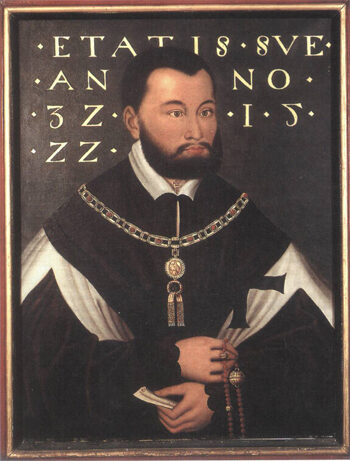
Albert, Duke in Prussia
Albert, Duke in Prussia was a Duke of Prussia from 1525 to 1568. Born May 17, 1490, in Ansbach. Died March 20, 1568, in Tapiau castle. Positions held include Grand Master of the Teutonic Knights (1511–1525) and Duke of Prussia (1525–1568). Known for What my God wants, should always happen.
Facts
33 facts · 2 confirmed by two sources · 7 cited · 24 from one source
Where this comes from
Papalocal keeps its own record. It started from these sources; what each one said is kept here as it was copied, so a change on their side never changes this page by itself. Tap one to read its version.
What Wikidata says · copied November 16, 2026 · revision 2570159663
- Described as
- Duke of Prussia from 1525 to 1568
- Other names
- Albert of Prussia, Albert, Duke of Prussia, Albert of Hohenzollern, Albert of Brandenburg-Ansbach, Albert, Albrecht von Preussen
- Born
- May 17, 1490 · 2 references
- Died
- March 20, 1568 · 6 references
- Born in
- Ansbach · 3 references
- Died in
- Tapiau castle
- Buried in
- Königsberg Cathedral
- Occupation
- hymnwriter
- Positions held
- Grand Master of the Teutonic Knights (1511–1525); Duke of Prussia (1525–1568)
- Known for
- What my God wants, should always happen
- Spouse
- Anna Marie of Brunswick-Lüneburg (1550–1568) · 1 reference; Dorothea of Denmark (1526–1547) · 1 reference
- Children
- Anna Sophie of Prussia; Albert Frederick of Prussia; Katharina von Hohenzollern · 1 reference; Friedrich Albrecht von Hohenzollern · 1 reference; Lucia Dorothea von Hohenzollern · 1 reference; Lucia von Hohenzollern · 1 reference; Albrecht von Hohenzollern · 1 reference; Elisabeth von Hohenzollern · 1 reference
- Father
- Frederick I, Margrave of Brandenburg-Ansbach
- Mother
- Sophia Jagiellon, Margravine of Brandenburg-Ansbach
- Siblings
- Elisabeth of Brandenburg-Ansbach-Kulmbach; Barbara of Brandenburg-Ansbach-Kulmbach; Sophie of Brandenburg-Ansbach-Kulmbach; Anna of Brandenburg-Ansbach-Kulmbach; Margarete von Brandenburg-Ansbach; George of Brandenburg-Ansbach; Gumpert of Brandenburg-Ansbach-Kulmbach; Johann of Brandenburg-Ansbach; Wilhelm von Brandenburg; Casimir, Margrave of Brandenburg-Bayreuth
- Religion
- Catholic Church (–1525); Lutheranism (1525–)
- Wikipedias with a page
- 43
Wikidata item Q40433 (wikidata.org/wiki/Q40433), public domain (CC0). Copied November 16, 2026.
What Wikipedia says · copied November 16, 2026 · revision 1385497291
Albert of Prussia (German: Albrecht von Preussen; 17 May 1490 – 20 March 1568) was a German prince who was the 37th grand master of the Teutonic Knights and, after converting to Lutheranism, became the first ruler of the Duchy of Prussia, the secularized state that emerged from the former Monastic State of the Teutonic Knights. Albert was the first European ruler to establish Lutheranism, and thus Protestantism, as the official state religion of his lands. He proved instrumental in the political spread of Protestantism in its early stage, ruling the Prussian lands for nearly six decades (1510–1568).
Albert was the great-grandson of the converted pagan ruler Jogaila of Poland and Lithuania, vanquisher of the Teutonic Knights at the Battle of Grunwald. He was also a member of the Brandenburg-Ansbach branch of the House of Hohenzollern. He became grand master of the Teutonic Knights in their attempt to diplomatically win over the Polish-Lithuanian union. His skill in political administration and leadership ultimately succeeded in reversing the decline of the Teutonic Order. But Albert was sympathetic to the demands of Martin Luther, whose teachings had become popular in his lands. So he rebelled against the Roman Catholic Church and the Holy Roman Empire by converting the Teutonic state into a Protestant and hereditary realm, the Duchy of Prussia, for which he paid homage to his uncle, Sigismund I, king of Poland. That arrangement was confirmed by the Treaty of Kraków in 1525. Albert pledged a personal oath to the king and in return was invested with the duchy for himself and his heirs.
Albert's rule in Prussia was fairly prosperous. Although he had some trouble with the peasantry, the confiscation of the lands and treasures of the Catholic Church enabled him to propitiate the nobles and provide for the expenses of the newly established Prussian court. He was active in imperial politics, joining the League of Torgau in 1526, and acted in unison with the Protestants in plotting to overthrow Emperor Charles V after the issue of the Augsburg Interim in May 1548. Albert established schools in every town and founded the University of Königsberg in 1544. He promoted culture and arts, patronising the works of Erasmus Reinhold and Caspar Hennenberger. During the final years of his rule, Albert was forced to raise taxes instead of further confiscating now-depleted church lands, causing peasant rebellion. The intrigues of the court favourites Johann Funck and Paul Skalić also led to various religious and political disputes. Albert spent his final years virtually deprived of power and died at Tapiau on 20 March 1568. His son, Albert Frederick, succeeded him as Duke of Prussia.
- Born, in its opening lines
- May 17, 1490
- Died, in its opening lines
- March 20, 1568
From the Wikipedia article “Albert, Duke of Prussia” (en.wikipedia.org/wiki/Albert,_Duke_of_Prussia), by its contributors, under CC BY-SA 4.0 (creativecommons.org/licenses/by-sa/4.0/). Copied November 16, 2026; not changed.
Confirmed Two sources agree. Cited One source, and it names where it got it. One source One source, without a reference of its own. Sources disagree The sources disagree. We show the best-supported value and keep theirs below.
