
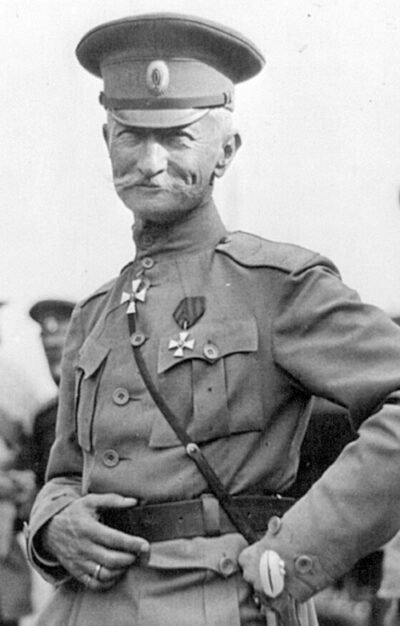
Aleksey Brusilov
Aleksey Brusilov was a Russian and Soviet military commander. Born August 3, 1853, in Tbilisi. Died March 17, 1926, in Moscow. Educated at Page Corps. Awards include Order of Saint Anna, 1st class, Order of Saint Stanislaus, 3rd class and Order of Saint Anna, 3rd class.
Facts
34 facts · 1 confirmed by two sources · 2 cited · 30 from one source · 1 where the sources disagree
What’s different
- Born: we show August 3, 1853 (Sources disagree). Wikipedia says August 31, 1853
Where this comes from
Papalocal keeps its own record. It started from these sources; what each one said is kept here as it was copied, so a change on their side never changes this page by itself. Tap one to read its version.
What Wikidata says · copied November 16, 2026 · revision 2568544874
- Described as
- Russian and Soviet military commander
- Other names
- Aleksey Alekseyevich Brusilov, Aleksky Brusilov, Aleksei Alekseyevich Brusilov
- Born
- August 3, 1853
- Died
- March 17, 1926 · 5 references
- Born in
- Tbilisi · 1 reference
- Died in
- Moscow · 3 references
- Buried in
- Novodevichy Convent
- Cause of death
- pneumonia
- Citizen of
- Russian Empire; Soviet Union
- Occupation
- military officer; memoirist
- Education
- Page Corps (1867–1872)
- Awards
- Order of Saint Anna, 1st class (1909); Order of Saint Stanislaus, 3rd class (1878); Order of Saint Anna, 3rd class (1878); Order of Saint Stanislaus, 2nd class (1878); Order of Saint Anna, 2nd class (1883); Order of St. Vladimir, 4th class (1895); Order of noble Bukhara (1896); Order of St. Vladimir, 3rd class (1898); Order of Saint Stanislaus, 1st class (1903); Order of St. Vladimir, 2nd class (1913); Order of St. George, 4th class (1914); Order of St. George, 3rd class (1914); Order of the White Eagle (1915); Gold Sword for Bravery (2 times) (1915, 1916); Order of the Lion and the Sun (2 times) (1874, 1903)
- Spouse
- Naděžda Brusilovová (1910–1926)
- Children
- Aleksei Brusilov
- Father
- Aleksey Brusilov
- Military branch
- Imperial Russian Army; Red Army (1920–)
- Military rank
- poruchik (1874–); shtabs-kapitan (1877–); captain (1881–)
- Wikipedias with a page
- 59
Wikidata item Q207738 (wikidata.org/wiki/Q207738), public domain (CC0). Copied November 16, 2026.
What Wikipedia says · copied November 16, 2026 · revision 1380802979
Aleksei Alekseyevich Brusilov (, US also ; Russian: Алексе́й Алексе́евич Бруси́лов, IPA: [ɐlʲɪkˈsʲej ɐlʲɪkˈsʲejɪvʲɪdʑ brʊˈsʲiɫəf]; 31 August [O.S. 19 August] 1853 – 17 March 1926) was a Russian and later Soviet general most noted for the development of new offensive tactics used in the 1916 Brusilov offensive, which was his greatest achievement.
Born into an aristocratic military family, Brusilov trained as a cavalry officer, but by 1914 had realized that cavalry was obsolete in an offensive capacity against modern weapons of warfare such as mass adoption of rifled guns, machine guns, and artillery. He is considered a very outstanding general who won many battles against the Austro-Hungarian army. His offensive in 1916 was the final major success of the Tsarist army. In the government, this offensive meant the transfer of the strategic initiative to the Russians and the beginning of preparations for the general offensive of 1917, which, however, was disrupted by the revolution.
Despite his noble status and prominent role in the Imperial Russian Army, he sided with the Bolsheviks in the Russian Civil War and aided in the early organization of the Red Army until retiring in 1924.
Brusilov is one of the prominent Russian commanders in history. Although not regarded as especially brilliant, he was pragmatic and open to change based on experience; his eponymous offensive succeeded in part from his willingness to properly train and prepare his troops, including in modern artillery and air reconnaissance.
- Born, in its opening lines
- August 31, 1853
- Died, in its opening lines
- March 17, 1926
From the Wikipedia article “Aleksei Brusilov” (en.wikipedia.org/wiki/Aleksei_Brusilov), by its contributors, under CC BY-SA 4.0 (creativecommons.org/licenses/by-sa/4.0/). Copied November 16, 2026; not changed.
Confirmed Two sources agree. Cited One source, and it names where it got it. One source One source, without a reference of its own. Sources disagree The sources disagree. We show the best-supported value and keep theirs below.
