
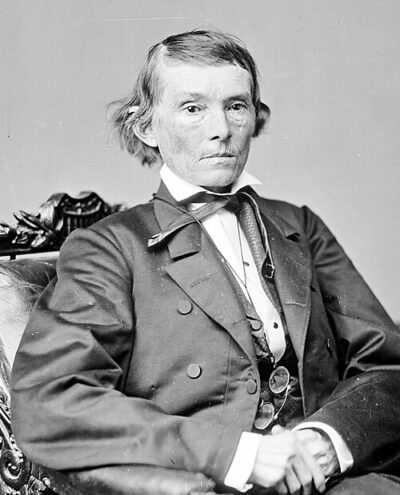
Alexander H. Stephens
Alexander H. Stephens was a vice president of the Confederate States from 1861 to 1865. Born February 11, 1812, in Taliaferro County. Died March 4, 1883, in Atlanta. Positions held include Governor of Georgia (1882–1883), United States representative (2 times) (1843–1882) and Vice President of the Confederate States of America (1861–1865). Educated at University of Georgia.
Facts
21 facts · 2 confirmed by two sources · 4 cited · 15 from one source
Where this comes from
Papalocal keeps its own record. It started from these sources; what each one said is kept here as it was copied, so a change on their side never changes this page by itself. Tap one to read its version.
What Wikidata says · copied November 15, 2026 · revision 2567400355
- Described as
- vice president of the Confederate States from 1861 to 1865 (1812–1883)
- Other names
- Alex. H. Stephens, A. H. Stephens, The Honorable Alexander H. Stephens, Alexander Hamilton Stephens
- Born
- February 11, 1812 · 6 references
- Died
- March 4, 1883 · 6 references
- Born in
- Taliaferro County · 1 reference
- Died in
- Atlanta · 1 reference
- Buried in
- A. H. Stephens State Park
- Name at birth
- Alexander Hamilton Stephens
- Citizen of
- United States (1812–1861); Confederate States of America (1861–1865)
- Occupation
- politician · 1 reference; writer · 1 reference
- Positions held
- Governor of Georgia (1882–1883); United States representative (2 times) (1843–1882); Vice President of the Confederate States of America (1861–1865); member of the Georgia State Senate (1842–1843); member of the Georgia House of Representatives (1836–1842)
- Political party
- Whig Party; Democratic Party
- Worked for
- University of Georgia
- Education
- University of Georgia
- Siblings
- Linton Stephens
- Religion
- Presbyterianism
- Wikipedias with a page
- 33
Wikidata item Q549495 (wikidata.org/wiki/Q549495), public domain (CC0). Copied November 15, 2026.
What Wikipedia says · copied November 15, 2026 · revision 1382120558
Alexander Hamilton Stephens (February 11, 1812 – March 4, 1883) was an American politician who was the only vice president of the Confederate States from 1861 to 1865, and later the 50th governor of Georgia from 1882 until his death in 1883. A member of the Democratic Party, he represented the state of Georgia in the United States House of Representatives before and after the Civil War.
Stephens attended Franklin College and established a legal practice in his hometown of Crawfordville, Georgia. After serving in both houses of the Georgia General Assembly, he was elected to the U.S. Congress, taking his seat in 1843. He became a leading Southern Whig and strongly opposed the Mexican–American War. After the war, Stephens was a prominent supporter of the Compromise of 1850 and helped draft the Georgia Platform, which opposed secession. A proponent of the expansion of slavery into the territories, Stephens also helped pass the Kansas–Nebraska Act. As the Whig Party collapsed in the 1850s, Stephens joined the Democratic Party and worked with President James Buchanan to admit Kansas as a state under the pro-slavery Lecompton Constitution (which was overwhelmingly rejected by Kansas voters in a referendum).
Stephens declined to seek re-election in 1858 but continued to publicly advocate against secession. After Georgia and other Southern states seceded and formed the Confederate States of America, Stephens was elected as the Confederate Vice President. On March 21, 1861, Stephens delivered his infamous Cornerstone Speech while visiting Savannah, Georgia, which defended slavery; enumerated contrasts between the American and Confederate foundings, ideologies, and constitutions; and laid out the Confederacy's rationale for seceding. Stephens would attempt to deny and retract this speech following the Confederacy's defeat in 1865. In the course of the war, he became increasingly critical of President Jefferson Davis's policies, especially Confederate conscription and the suspension of habeas corpus. In February 1865, he was one of the commissioners who met with Abraham Lincoln at the abortive Hampton Roads Conference to discuss peace terms.
After the war, Stephens was imprisoned until he was pardoned by President Andrew Johnson in October 1865. The following year, the Georgia legislature elected him to the U.S. Senate, but the Senate declined to seat him due to his role in the Civil War. He won election to the U.S. House of Representatives in 1873 and served until 1882, when he resigned from Congress to become governor of Georgia. Stephens served as governor until his death in 1883.
- Born, in its opening lines
- February 11, 1812
- Died, in its opening lines
- March 4, 1883
From the Wikipedia article “Alexander H. Stephens” (en.wikipedia.org/wiki/Alexander_H._Stephens), by its contributors, under CC BY-SA 4.0 (creativecommons.org/licenses/by-sa/4.0/). Copied November 15, 2026; not changed.
Confirmed Two sources agree. Cited One source, and it names where it got it. One source One source, without a reference of its own. Sources disagree The sources disagree. We show the best-supported value and keep theirs below.
