
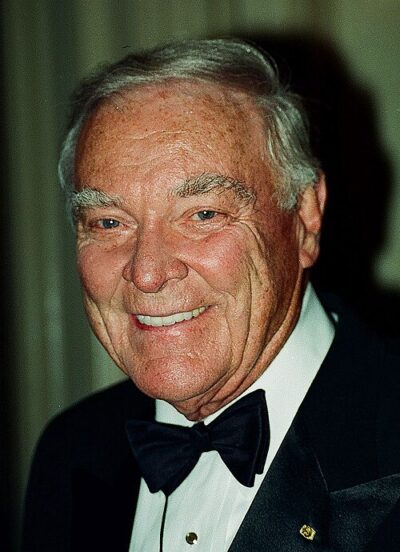
Alexander Haig
Alexander Haig was a former U.S. Secretary of State and U.S. Army general. Born December 2, 1924, in Philadelphia. Died February 20, 2010, in Baltimore. Positions held include United States Secretary of State (1981–1982), Deputy National Security Advisor (1970–1973) and White House Chief of Staff (1973–1974). Educated at United States Military Academy and Walsh School of Foreign Service. Awards include Distinguished Flying Cross, Bronze Star Medal and Legionnaire of Legion of Merit.
Facts
45 facts · 2 confirmed by two sources · 8 cited · 35 from one source
Where this comes from
Papalocal keeps its own record. It started from these sources; what each one said is kept here as it was copied, so a change on their side never changes this page by itself. Tap one to read its version.
What Wikipedia says · copied November 13, 2026 · revision 1384367348
Alexander Meigs Haig Jr. (; 2 December 1924 – 20 February 2010) was an American politician, diplomat, and military officer who served as the 59th United States secretary of state under President Ronald Reagan and previously as the 5th White House chief of staff under Presidents Richard Nixon and Gerald Ford, as well as United States Deputy National Security Advisor under President Nixon. A member of the Republican Party, he was a general in the U.S. Army prior to and in between these cabinet-level positions, serving first as the vice chief of staff of the Army and then as Supreme Allied Commander Europe. In 1973, Haig became the youngest four-star general in the U.S. Army's history.
Haig was born and raised in Pennsylvania. He graduated from the U.S. Military Academy and served in the Korean War, during which he served as an aide to Lt. General Alonzo Patrick Fox and Lt. General Edward Almond. Afterward, he served as an aide to defense secretary Robert McNamara. During the Vietnam War, Haig commanded a battalion and later a brigade of the 1st Infantry Division. For his service, Haig received the Distinguished Service Cross, the Silver Star with oak leaf cluster, and the Purple Heart.
In 1969, Haig became an assistant to national security advisor Henry Kissinger and served as United States Deputy National Security Advisor from 1970 to 1973. He became vice chief of staff of the Army, the Army's second-highest-ranking position, in 1972. After the 1973 resignation of H. R. Haldeman, Haig became President Nixon's chief of staff. Serving in the wake of the Watergate scandal, he became especially influential in the final months of Nixon's tenure, playing a role in persuading Nixon to resign in 1974. Haig continued to serve as chief of staff for the first month of President Ford's tenure. From 1974 to 1979, Haig served as Supreme Allied Commander Europe, commanding all NATO forces in Europe. He retired from the army in 1979 and pursued a career in business.
After Reagan won the 1980 U.S. presidential election, he nominated Haig to be his secretary of state. After the Reagan assassination attempt, Haig said "I am in control here, in the White House", despite not being next in the line of succession. During the Falklands War, Haig sought to broker peace between the United Kingdom and Argentina. He resigned from Reagan's cabinet in July 1982 and unsuccessfully sought the presidential nomination in the 1988 Republican primaries. Haig also served as the head of a consulting firm and hosted the television program World Business Review. He died at the age of 85 in February 2010.
- Born, in its opening lines
- December 2, 1924
- Died, in its opening lines
- February 20, 2010
From the Wikipedia article “Alexander Haig” (en.wikipedia.org/wiki/Alexander_Haig), by its contributors, under CC BY-SA 4.0 (creativecommons.org/licenses/by-sa/4.0/). Copied November 13, 2026; not changed.
What Wikidata says · copied November 14, 2026 · revision 2568975544
- Described as
- former U.S. Secretary of State and U.S. Army general (1924-2010)
- Other names
- Alexander Meigs Haig, Jr., Alexander Meigs "Al" Haig Jr.
- Born
- December 2, 1924 · 11 references
- Died
- February 20, 2010 · 10 references
- Born in
- Philadelphia · 1 reference
- Died in
- Baltimore · 3 references
- Buried in
- Arlington National Cemetery (2010) · 1 reference
- Cause of death
- infectious disease
- Citizen of
- United States
- Occupation
- diplomat · 1 reference; politician · 2 references; army officer; businessperson · 1 reference
- Positions held
- United States Secretary of State (1981–1982); Deputy National Security Advisor (1970–1973); White House Chief of Staff (1973–1974); Supreme Allied Commander Europe (1974–1979); Vice Chief of Staff of the United States Army (1973)
- Political party
- Republican Party
- Education
- United States Military Academy; Walsh School of Foreign Service; Columbia University; University of Notre Dame; United States Army War College; Columbia Business School
- Awards
- Distinguished Flying Cross; Bronze Star Medal; Legionnaire of Legion of Merit; Purple Heart; Air Medal; Silver Star; National Order of Vietnam; Doublespeak Award (1981); World War II Victory Medal; Distinguished Service Cross; Defense Distinguished Service Medal; National Defense Service Medal; Army of Occupation Medal; Gallantry Cross; Vietnam Campaign Medal
- Children
- Brian Haig
- Siblings
- Frank Haig · 1 reference
- Religion
- Catholicism
- Military branch
- United States Army
- Military rank
- general; general · 1 reference
- Lived in
- Philadelphia
- Wikipedias with a page
- 45
Wikidata item Q107957 (wikidata.org/wiki/Q107957), public domain (CC0). Copied November 14, 2026.
Confirmed Two sources agree. Cited One source, and it names where it got it. One source One source, without a reference of its own. Sources disagree The sources disagree. We show the best-supported value and keep theirs below.
