
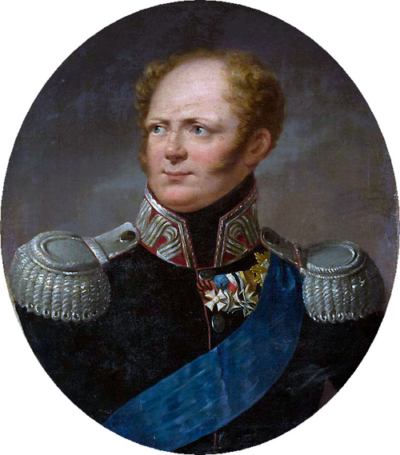
Alexander I of Russia
Alexander I of Russia was The tenth Emperor of Russia. Born December 12, 1777, in Saint Petersburg. Died November 19, 1825, in Taganrog. Positions held include Emperor of all the Russias (1801–1825). Awards include Grand Cross of the Legion of Honour, Knight of the Order of the Holy Spirit and Knight of the Order of Saint Michael.
Facts
51 facts · 0 confirmed by two sources · 13 cited · 36 from one source · 2 where the sources disagree
What’s different
- Born: we show December 12, 1777 (Sources disagree). Wikipedia says December 23, 1777
- Died: we show November 19, 1825 (Sources disagree). Wikipedia says December 1, 1825
Where this comes from
Papalocal keeps its own record. It started from these sources; what each one said is kept here as it was copied, so a change on their side never changes this page by itself. Tap one to read its version.
What Wikidata says · copied November 16, 2026 · revision 2568536845
- Described as
- The tenth Emperor of Russia (1777–1825)
- Other names
- Alexander the Blessed, Alexander I
- Born
- December 12, 1777 · 4 references
- Died
- November 19, 1825 · 4 references
- Born in
- Saint Petersburg · 5 references
- Died in
- Taganrog · 5 references
- Buried in
- Peter and Paul Cathedral (1826–) · 1 reference
- Cause of death
- typhoid fever
- Citizen of
- Russian Empire
- Occupation
- monarch
- Positions held
- Emperor of all the Russias (1801–1825)
- Awards
- Grand Cross of the Legion of Honour; Knight of the Order of the Holy Spirit; Knight of the Order of Saint Michael; Knight of the Order of the Golden Fleece (1814); Grand Cross of the Military Order of Maria Theresa; Knight of the Order of St. Alexander Nevsky; Order of the Black Eagle; Order of St. Andrew; Order of St. George, 4th class; Order of Saint Stanislaus; Knight Grand Cross of the Military Order of William (1818); Order of the Red Eagle 1st Class; Order of Saint John of Jerusalem; Order of the White Eagle; Order of Saint Louis
- Spouse
- Elizabeth Alexeievna (1793–1825) · 2 references
- Children
- Grand Duchess Maria Alexandrovna of Russia · 2 references; Nikolai Lukash · 1 reference; Grand Duchess Elizabeth Alexandrovna of Russia · 1 reference; Zenaida Narishkin · 1 reference; Sofya Naryshkina · 1 reference; Emmanuil Naryshkin · 1 reference; Mariya Parizhskaya · 1 reference; Wilhelmine Alexandrine Pauline Alexandrov · 1 reference; Gustaw Ehrenberg · 1 reference; Maria (?) · 1 reference; Nikolay Isakov · 1 reference
- Father
- Paul I of Russia · 1 reference
- Mother
- Sophie Dorothee of Württemberg · 1 reference
- Siblings
- Nicholas I of Russia; Grand Duke Konstantin Pavlovich of Russia · 1 reference; Grand Duke Michael Pavlovich of Russia; Anna Pavlovna of Russia; Grand Duchess Maria Pavlovna of Russia; Grand Duchess Alexandra Pavlovna of Russia; Catherine Pavlovna of Russia; Grand Duchess Elena Pavlovna of Russia; Grand Duchess Olga Pavlovna of Russia
- Religion
- Eastern Orthodoxy
- Military rank
- marshal; Generalfeldmarschall · 1 reference
- Lived in
- Winter Palace · 1 reference
- Wikipedias with a page
- 111
Wikidata item Q15193 (wikidata.org/wiki/Q15193), public domain (CC0). Copied November 16, 2026.
What Wikipedia says · copied November 16, 2026 · revision 1385728795
Alexander I of Russia (Russian: Александр I Павлович, romanized: Aleksandr I Pavlovich, IPA: [ɐlʲɪkˈsandr ˈpavləvʲɪtɕ]; 23 December [O.S. 12 December] 1777 – 1 December [O.S. 19 November] 1825), nicknamed "the Blessed", was Emperor of Russia from 1801, the first King of Congress Poland from 1815, and the Grand Duke of Finland from 1809 to his death in 1825. He ruled Russia during the period of the Napoleonic Wars.
The eldest son of Paul I of Russia and Sophie Dorothea of Württemberg, Alexander succeeded to the throne after his father was murdered. As prince and during the early years of his reign, he often used liberal rhetoric but continued Russia's absolutist policies in practice. In the first years of his reign, he initiated some minor social reforms and (in 1803–1804) major liberal educational reforms, such as building more universities. Alexander appointed Mikhail Speransky, the son of a village priest, as one of his closest advisors. The over-centralised Collegium ministries were abolished and replaced by the Committee of Ministers, State Council, and the Supreme Court to improve the legal system. Plans were made, but never consummated, to set up a parliament and sign a constitution. In contrast to his westernising predecessors, such as Peter the Great, Alexander was a Russian nationalist and Slavophile who wanted Russia to develop on the basis of Russian rather than European culture.
In foreign policy, he changed Russia's position towards France four times between 1804 and 1812, shifting among neutrality, opposition, and alliance. In 1805 he joined Britain in the War of the Third Coalition against Napoleon, but after suffering massive defeats at the battles of Austerlitz and Friedland, he switched sides and formed an alliance with Napoleon in the Treaty of Tilsit (1807) and joined Napoleon's Continental System. He fought a small-scale naval war against Britain between 1807 and 1812 and took Finland from Sweden in 1809 after Sweden's refusal to join the Continental System. Alexander and Napoleon hardly agreed, especially regarding Poland, and the alliance collapsed by 1810. Alexander's greatest triumph came in 1812 when Napoleon's invasion of Russia descended into a catastrophe for the French. As part of the winning coalition against Napoleon, he gained territory in Poland. He formed the Holy Alliance to suppress the revolutionary movements in Europe, which he saw as immoral threats to legitimate Christian monarchs.
During the second half of his reign, Alexander became increasingly arbitrary, reactionary, and fearful of plots against him; as a result, he ended many of the reforms he had made earlier in his reign. He purged schools of foreign teachers, as education became more religiously driven as well as politically conservative. Speransky was replaced as advisor with the strict artillery inspector Aleksey Arakcheyev, who oversaw the creation of military settlements. Alexander died of typhus in December 1825 while on a trip to southern Russia. He left no legitimate children, as his two daughters died in childhood. Neither of his brothers wanted to become emperor. After a period of great confusion (that presaged the failed Decembrist revolt of liberal army officers in the weeks after his death), he was succeeded by his younger brother, Nicholas I of Russia.
- Born, in its opening lines
- December 23, 1777
- Died, in its opening lines
- December 1, 1825
From the Wikipedia article “Alexander I of Russia” (en.wikipedia.org/wiki/Alexander_I_of_Russia), by its contributors, under CC BY-SA 4.0 (creativecommons.org/licenses/by-sa/4.0/). Copied November 16, 2026; not changed.
Confirmed Two sources agree. Cited One source, and it names where it got it. One source One source, without a reference of its own. Sources disagree The sources disagree. We show the best-supported value and keep theirs below.
