
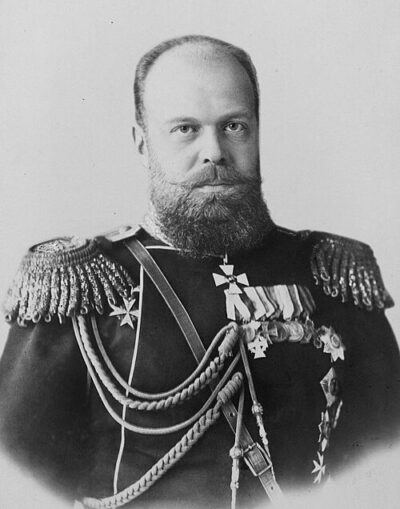
Alexander III of Russia
Alexander III of Russia was an Emperor of Russia from 1881 to 1894. Born February 26, 1845, in Anichkov Palace. Died October 20, 1894, in Livadia Palace. Positions held include Emperor of all the Russias (1881–1894), King of Poland and Grand Duke of Finland. Awards include Knight of the Order of the Golden Fleece, Knight of the Order of St. Alexander Nevsky and Order of the Black Eagle.
Facts
59 facts · 0 confirmed by two sources · 12 cited · 45 from one source · 2 where the sources disagree
What’s different
- Born: we show February 26, 1845 (Sources disagree). Wikipedia says March 10, 1845
- Died: we show October 20, 1894 (Sources disagree). Wikipedia says November 1, 1894
Where this comes from
Papalocal keeps its own record. It started from these sources; what each one said is kept here as it was copied, so a change on their side never changes this page by itself. Tap one to read its version.
What Wikidata says · copied November 16, 2026 · revision 2569041507
- Described as
- Emperor of Russia from 1881 to 1894
- Other names
- Alexander Alexandrovich, Alexander III
- Born
- February 26, 1845 · 2 references
- Died
- October 20, 1894 · 4 references
- Born in
- Anichkov Palace · 3 references
- Died in
- Livadia Palace · 4 references
- Buried in
- Peter and Paul Cathedral
- Cause of death
- nephritis · 1 reference
- Name at birth
- Александр Александрович
- Citizen of
- Russian Empire
- Occupation
- monarch; art collector
- Positions held
- Emperor of all the Russias (1881–1894) · 1 reference; King of Poland; Grand Duke of Finland; member of the State Council of the Russian Empire; Head of the House of Romanov
- Member of
- Saint Petersburg Academy of Sciences (1866–); Russian Geographical Society (1866–); Imperial Russian Historical Society (1867–); Imperial Society for the Encouragement of the Arts (1879–); Russian Imperial Family
- Awards
- Knight of the Order of the Golden Fleece; Knight of the Order of St. Alexander Nevsky; Order of the Black Eagle (1857); Godfather promotion of Special Military School of Saint-Cyr; Order of Saint Anna, 1st class (1845); Order of the White Eagle (1845); Order of Saint Stanislaus, 1st class (1865); Order of St. Vladimir, 1st class (1877); Order of the Star of Romania (1877); Order of St. Andrew (1845); Gold Sword for Bravery (1878); Knight Grand Cross of the Military Order of William (1881); Order of St. George, 2nd class (1877); Order of Ludwig I (1857); Order of St. Vladimir, 4th class (1864)
- Spouse
- Maria Feodorovna (Dagmar of Denmark) (1866–) · 3 references
- Children
- Nicholas II of Russia · 2 references; Grand Duke Alexander Alexandrovich of Russia; Grand Duke George Alexandrovich of Russia · 2 references; Grand Duchess Xenia Alexandrovna of Russia · 2 references; Grand Duke Michael Alexandrovich of Russia · 2 references; Grand Duchess Olga Alexandrovna of Russia · 2 references
- Father
- Alexander II of Russia · 1 reference
- Mother
- Maria Alexandrovna of Russia (Marie of Hesse) · 1 reference
- Siblings
- Grand Duchess Alexandra Alexandrovna of Russia; Nicholas Alexandrovich, Crown Prince of Russia; Grand Duke Vladimir Alexandrovich of Russia; Grand Duke Alexei Alexandrovich of Russia; Grand Duchess Maria Alexandrovna of Russia; Grand Duke Sergei Alexandrovich of Russia; Grand Duke Paul Alexandrovich of Russia; Prince George Alexandrovich Yuryevsky; Princess Olga Alexandrovna Yurievskaya; Prince Boris Alexandrovich Yuryevsky
- Religion
- Eastern Orthodoxy
- Military rank
- praporshchik (1852–); podporuchik (1853–); poruchik (1855–)
- Lived in
- Saint Petersburg
- Wikipedias with a page
- 99
Wikidata item Q120180 (wikidata.org/wiki/Q120180), public domain (CC0). Copied November 16, 2026.
What Wikipedia says · copied November 16, 2026 · revision 1384208980
Alexander III (Russian: Александр III Александрович, romanized: Aleksandr III Aleksandrovich; 10 March 1845 – 1 November 1894) was Emperor of Russia, King of Poland and Grand Duke of Finland from 13 March 1881 until his death in 1894. He was highly reactionary in domestic affairs and reversed some of the liberal reforms of his father, Alexander II, a policy of "counter-reforms" (Russian: контрреформы).
During his reign, Russia fought no major wars, and he came to be known as The Peacemaker (Russian: Царь-Миротворец, romanized: Tsar'-Mirotvorets
Russian pronunciation: [t͡sarʲ mʲɪrɐˈtvorʲɪt͡s]), a laudatory title enduring into 21st-century historiography. His major foreign policy achievement was the Franco-Russian Alliance, a major shift in international relations that eventually embroiled Russia in World War I. His political legacy represented a direct challenge to the European cultural order set forth by German statesman Otto von Bismarck, intermingling Russian influences with the shifting balances of power.
- Born, in its opening lines
- March 10, 1845
- Died, in its opening lines
- November 1, 1894
From the Wikipedia article “Alexander III of Russia” (en.wikipedia.org/wiki/Alexander_III_of_Russia), by its contributors, under CC BY-SA 4.0 (creativecommons.org/licenses/by-sa/4.0/). Copied November 16, 2026; not changed.
Confirmed Two sources agree. Cited One source, and it names where it got it. One source One source, without a reference of its own. Sources disagree The sources disagree. We show the best-supported value and keep theirs below.
