
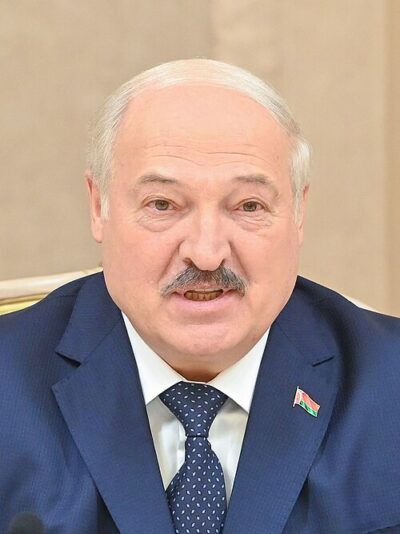
Alexander Lukashenka
Alexander Lukashenka is a President of the Republic of Belarus. Born August 30, 1954, in Kopyś. Positions held include President of Belarus (1994–), member of the Supreme Soviet of Belarus (1990–1994) and Chairman of the Council of CIS Heads of State (2 times) (2013–2021). Educated at Mahilyow State A. Kulyashow University and Faculty of Economy of the Belarusian State Agricultural Academy. Awards include Medal "In Commemoration of the 850th Anniversary of Moscow", Order of the Cross of St. Euphrosyne of Polotsk, 1st Class and Order of José Martí.
Facts
48 facts · 1 confirmed by two sources · 18 cited · 29 from one source
Where this comes from
Papalocal keeps its own record. It started from these sources; what each one said is kept here as it was copied, so a change on their side never changes this page by itself. Tap one to read its version.
What Wikidata says · copied November 16, 2026 · revision 2568539576
- Described as
- President of the Republic of Belarus
- Other names
- Alexander Ryhoravich Lukashenka, Lukashenko Aleksandr Grigorevich, Alaksandar Łukašenka, Alaksandar Ryhoravič Łukašenka, Alexander Grigorievich Lukashenko, Alexander Lukashenko
- Born
- August 30, 1954 · 7 references
- Born in
- Kopyś · 1 reference
- Citizen of
- Belarus (1991–) · 1 reference; Soviet Union (–1991)
- Occupation
- politician · 2 references; director · 1 reference; political commissar; teacher; economist
- Positions held
- President of Belarus (1994–); member of the Supreme Soviet of Belarus (1990–1994); Chairman of the Council of CIS Heads of State (2 times) (2013–2021); president · 1 reference
- Political party
- Communist Party of the Soviet Union (1979–1991) · 1 reference; independent politician (1992–)
- Education
- Mahilyow State A. Kulyashow University (–1975) · 1 reference; Faculty of Economy of the Belarusian State Agricultural Academy (–1985) · 1 reference; Alexandrya Secondary School · 1 reference
- Awards
- Medal "In Commemoration of the 850th Anniversary of Moscow" (1997); Order of the Cross of St. Euphrosyne of Polotsk, 1st Class (1998); Order of José Martí (2000); honorary citizen of Yerevan (2001); Order of St. Sergius of Radonezh 1st class (2002); Order of Saint Righteous Grand Duke Dmitry Donskoy (2005); Order of the Liberator (2007); Order of St. Prince Vladimir (2007); Order of Francisco de Miranda (2010); Order of the Republic of Serbia (2013); Presidential Order of Excellence (2013) · 1 reference; Order of St. Sava (2014); Order of Alexander Nevsky (2014); Order of St. Seraphim of Sarov, 1st class (2015); Order of the Republic (2016)
- Field
- politics · 1 reference
- Spouse
- Galina Lukashenko (1975–)
- Children
- Nikolai Lukashenko · 1 reference; Viktar Lukashenka · 1 reference; Dmitry Lukashenko · 1 reference
- Mother
- Kaciaryna Łukašenka · 1 reference
- Religion
- atheism
- Military branch
- Soviet Border Troops (1975–1977) · 1 reference; Belarusian Armed Forces (1994–) · 1 reference
- Military rank
- Lieutenant Colonel; podpolkovnik · 1 reference; reservist · 1 reference
- Lived in
- Independence Palace, Minsk · 1 reference
- Height
- 1.82 m (6 ft 0 in)
- Website
- https://president.gov.by · 1 reference
- Wikipedias with a page
- 158
Wikidata item Q2866 (wikidata.org/wiki/Q2866), public domain (CC0). Copied November 16, 2026.
What Wikipedia says · copied November 16, 2026 · revision 1385775670
Alexander Grigoryevich Lukashenko (also transliterated from Belarusian as Alyaksandr Ryhoravich Lukashenka; born 30 August 1954) is a Belarusian politician who has been the first and only president of Belarus since the office's establishment in 1994, making him the current longest-tenured European president.
Lukashenko was born in Kopys. After graduating from what is now the Mogilev State A. Kuleshov University, he worked as the director of a state farm (sovkhoz) and served in both the Soviet Border Troops and the Soviet Army before embarking on his political career. In 1990, Lukashenko was elected to the Supreme Soviet of the Byelorussian Soviet Socialist Republic. Following the dissolution of the Soviet Union, he assumed the position of head of the interim anti-corruption committee of the Supreme Council of Belarus. In 1994, he won the presidency in the country's inaugural presidential election after the adoption of a new constitution. Lukashenko opposed economic shock therapy during the 1990s post-Soviet transition, maintaining state ownership of key industries in Belarus. His supporters claim this spared Belarus from recessions as devastating as those in other post-Soviet states, whose political structures devolved into oligarchic crony capitalism. Lukashenko's maintenance of the socialist economic model is consistent with the retention of Soviet-era symbolism, including the Russian language, coat of arms, and national flag. These symbols were adopted after a controversial 1995 referendum.
Following the same referendum, Lukashenko acquired increased power, including the authority to dismiss the Supreme Council. Another referendum in 1996 further facilitated his consolidation of power. Lukashenko has since presided over an authoritarian government and has commonly been labelled as "Europe's last dictator". International monitors have not considered Belarusian elections as free and fair, except for his initial win. Additionally, the government harshly suppresses opponents and limits media freedom. Eventually, this has led multiple Western governments to impose sanctions on Lukashenko and other Belarusian officials. Lukashenko's contested victory in the 2020 presidential election preceded allegations of vote-rigging, amplifying anti-government protests, the largest seen during his rule. Consequently, the European Union, the United Kingdom, and the United States ceased to recognise Lukashenko as the legitimate president of Belarus following the disputed election. Lukashenko remained in power, which eventually led to a resumption of partial diplomatic relations. His re-election in the 2025 presidential election was described as a sham by the opposition and the European parliament.
Such isolation from parts of the West has, especially in the Putin era, increased his dependence on Russia, with whom Lukashenko had already maintained close ties despite past tensions, such as the so-called Milk War in 2009, allegedly stemming from Belarus' refusal to recognise the republics of Abkhazia and South Ossetia in exchange for a $500 million loan, in the aftermath of the Russo-Georgian War. Lukashenko played a crucial role in creating the Union State, enabling Belarusians and Russians to travel, work, and study unhindered between the two countries. He also reportedly played a crucial role in brokering a deal to end the Russian Wagner Group rebellion in 2023, allowing some Wagner soldiers to cross the country's border unhindered and settle in Belarus.
- Born, in its opening lines
- August 30, 1954
From the Wikipedia article “Alexander Lukashenko” (en.wikipedia.org/wiki/Alexander_Lukashenko), by its contributors, under CC BY-SA 4.0 (creativecommons.org/licenses/by-sa/4.0/). Copied November 16, 2026; not changed.
Confirmed Two sources agree. Cited One source, and it names where it got it. One source One source, without a reference of its own. Sources disagree The sources disagree. We show the best-supported value and keep theirs below.
