
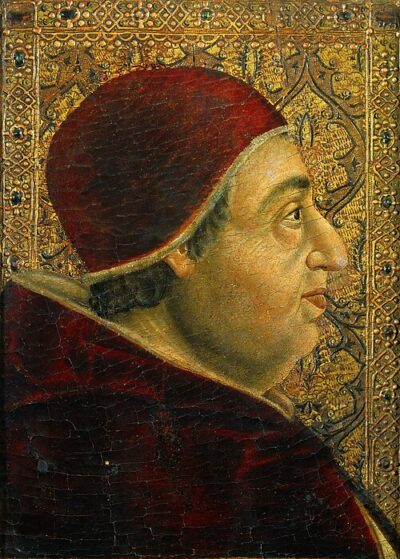
Alexander VI
Alexander VI was a pope of the Catholic Church 1492–1503 from the Borgia family (1430/32-1503). Born January 1, 1431, in Xàtiva. Died August 18, 1503, in Rome. Positions held include Pope (1492–1503), Dean of the College of Cardinals (1483–1492) and Camerlengo of the Sacred College of Cardinals (1472). Educated at University of Bologna.
Facts
37 facts · 2 confirmed by two sources · 9 cited · 26 from one source
Where this comes from
Papalocal keeps its own record. It started from these sources; what each one said is kept here as it was copied, so a change on their side never changes this page by itself. Tap one to read its version.
What Wikidata says · copied November 16, 2026 · revision 2569839398
- Described as
- pope of the Catholic Church 1492–1503 from the Borgia family (1430/32-1503)
- Other names
- Pope Alexander VI., Alexander Sixth, Roderic Llançol i de Borja, Alexander VI., Rodrigo Lanzol y de Borja, Rodrigo Borgia, Pope Alexander VI, Rodrigo de Borja
- Born
- January 1, 1431 · 3 references
- Died
- August 18, 1503 · 4 references
- Born in
- Xàtiva · 1 reference
- Died in
- Rome · 1 reference
- Buried in
- Santa Maria in Monserrato degli Spagnoli
- Cause of death
- malaria · 1 reference
- Citizen of
- Crown of Aragon
- Occupation
- Catholic priest (1471–) · 1 reference; transitional deacon (1468–) · 1 reference
- Positions held
- Pope (1492–1503); Dean of the College of Cardinals (1483–1492); Camerlengo of the Sacred College of Cardinals (1472); Cardinal-Bishop of Albano (1471–1476) · 1 reference; Roman Catholic Archbishop of Valencia (1492) · 1 reference; apostolic administrator (2 times) (1457–1492) · 1 reference; Apostolic Administrator of the Archdiocese of Valencia (1458–1492); Cardinal-Bishop of Porto e Santa Rufina (1476–1492); cardinal-deacon (1456–1492); cardinal protodeacon (1463–1471); abbot (1471–1492); Archpriest of the Basilica di Santa Maria Maggiore (1483–1492)
- Education
- University of Bologna
- Children
- Pier Luigi de Borgia; Cesare Borgia · 1 reference; Giovanni Borgia, 2nd Duke of Gandia; Lucrezia Borgia · 1 reference; Gioffre Borgia; Girolama Borgia; Isabella Borgia; Giovanni Borgia; Laura Orsini; Rodrigo Borgia
- Father
- Jofré Llançol i Escrivà
- Mother
- Isabel de Borja y Cavanilles · 1 reference
- Siblings
- Tecla de Borja; Pedro Luis de Borja
- Religion
- Catholic Church · 1 reference
- Wikipedias with a page
- 104
Wikidata item Q108316 (wikidata.org/wiki/Q108316), public domain (CC0). Copied November 16, 2026.
What Wikipedia says · copied November 16, 2026 · revision 1385886954
Pope Alexander VI (born Roderic de Borja y Llançol; c. 1431 – 18 August 1503) was head of the Catholic Church and sovereign of the Papal States from 11 August 1492 until his death in 1503. A member of the House of Borgia, he is one of several popes alleged to have been sexually active during their papacy. Alexander reigned as pope during the High Renaissance, a period in which nepotism and simony were widespread among the clergy.
Born into the prominent Borja family in Xàtiva in the Kingdom of Valencia under the Crown of Aragon (in present-day Spain), he was known as Roderic de Borja, and he is commonly referred to by the Italianized form as Rodrigo Borgia. He studied law at the University of Bologna. He was ordained deacon and made a cardinal in 1456 after the election of his uncle as Pope Callixtus III, and a year later he became vice-chancellor of the Catholic Church. He proceeded to serve in the Roman Curia under the next four popes, acquiring significant influence and wealth in the process. In 1492, Rodrigo was elected pope, taking the name Alexander VI.
Alexander's papal bulls of 1493 confirmed or reconfirmed the rights of the Spanish crown in the New World following the finds of Christopher Columbus in 1492. During the second Italian war, Alexander VI supported his son Cesare Borgia as a condottiero for the French king. The scope of his foreign policy was to gain the most advantageous terms for his family.
Alexander is one of the most controversial of the Renaissance popes, partly because he acknowledged fathering several children by his mistresses. As a result, his Italianized Valencian surname, Borgia, became a byword for libertinism and nepotism, which are traditionally considered as characterizing his pontificate.
- Born, in its opening lines
- c. 1431
- Died, in its opening lines
- August 18, 1503
From the Wikipedia article “Pope Alexander VI” (en.wikipedia.org/wiki/Pope_Alexander_VI), by its contributors, under CC BY-SA 4.0 (creativecommons.org/licenses/by-sa/4.0/). Copied November 16, 2026; not changed.
Confirmed Two sources agree. Cited One source, and it names where it got it. One source One source, without a reference of its own. Sources disagree The sources disagree. We show the best-supported value and keep theirs below.
