
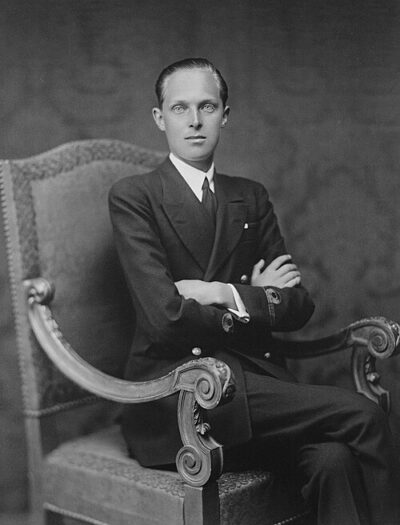
Alfonso, Prince of Asturias
Alfonso, Prince of Asturias was a Crown Prince of Spain (1907–1938); heir apparent to the throne until 1933. Born May 10, 1907, in Madrid. Died September 6, 1938, in Miami. Positions held include heir apparent. Awards include Knight of the Order of the Golden Fleece, Grand Cross of the Order of Isabella the Catholic and Collar of the Order of Charles III.
Facts
28 facts · 2 confirmed by two sources · 2 cited · 24 from one source
Where this comes from
Papalocal keeps its own record. It started from these sources; what each one said is kept here as it was copied, so a change on their side never changes this page by itself. Tap one to read its version.
What Wikidata says · copied November 16, 2026 · revision 2569278235
- Described as
- Crown Prince of Spain (1907–1938); heir apparent to the throne until 1933
- Other names
- Alfonso de Borbón y Battenberg, Alphonse de Bourbon, Alfons de Borbó i de Battenberg, Alfonso de Borbon y Battenberg, Alfons de Borbo i de Battenberg, Alfonso Pius de Borbón y Battenberg, Infante de España, Alfonso, Count of Covadonga, Infante Alfonso, Count of Covadonga
- Born
- May 10, 1907 · 3 references
- Died
- September 6, 1938 · 2 references
- Born in
- Madrid
- Died in
- Miami
- Buried in
- Pantheon of the Infantes of the Royal Monastery of San Lorenzo de El Escorial
- Cause of death
- car collision
- Name at birth
- Alfonso Pío Cristino Eduardo Francisco Guillermo Carlos Enrique Eugenio Fernando Antonio Venancio de Borbón y Battenberg
- Citizen of
- Spain
- Positions held
- heir apparent
- Awards
- Knight of the Order of the Golden Fleece (1907); Grand Cross of the Order of Isabella the Catholic (1907); Collar of the Order of Charles III (1907); Collar of the Order of Isabella the Catholic (1931); Order of Santiago (1928); Knight of the Seraphim (1927); Knight of the Order of the Elephant (1929); Knight of the Order of the Most Holy Annunciation (1924); Knight Grand Cross of the Order of Saints Maurice and Lazarus (1924); Knight grand cross of the order of the crown of Italy (1924)
- Spouse
- Edelmira Sampedro y Robato (1933–1937) · 1 reference; Marta Esther Rocafort Altuzarra (1937–1938) · 1 reference
- Children
- Alfonso de Bourbon
- Father
- Alfonso XIII · 1 reference
- Mother
- Victoria Eugenie of Battenberg · 1 reference
- Siblings
- Infante Jaime, Duke of Segovia; Infanta Beatriz of Spain; Infante Juan, Count of Barcelona; Infante Gonzalo of Spain
- Wikipedias with a page
- 32
Wikidata item Q518846 (wikidata.org/wiki/Q518846), public domain (CC0). Copied November 16, 2026.
What Wikipedia says · copied November 16, 2026 · revision 1384138389
Alfonso, Prince of Asturias (10 May 1907 – 6 September 1938), was heir apparent to the throne of Spain from birth until the abolition of the monarchy in 1931. He renounced his rights to the defunct throne in 1933. Alfonso was the eldest son of King Alfonso XIII of Spain and Victoria Eugenie of Battenberg.
Alfonso's renunciation of his rights as heir to the Spanish throne in order to marry Cuban commoner Edelmira Sampedro caused controversy at the time. A similar situation would take place three years later in Britain with his second cousin Edward VIII, who would abdicate as King of the United Kingdom and Emperor of India to marry an American divorcee, Wallis Simpson.
He died at the age of 31 as a result of a car crash. Though appearing to have sustained minor injuries, his haemophilia, inherited through his great-grandmother Queen Victoria, led to fatal internal bleeding.
- Born, in its opening lines
- May 10, 1907
- Died, in its opening lines
- September 6, 1938
From the Wikipedia article “Alfonso, Prince of Asturias (1907–1938)” (en.wikipedia.org/wiki/Alfonso,_Prince_of_Asturias_(1907–1938)), by its contributors, under CC BY-SA 4.0 (creativecommons.org/licenses/by-sa/4.0/). Copied November 16, 2026; not changed.
Confirmed Two sources agree. Cited One source, and it names where it got it. One source One source, without a reference of its own. Sources disagree The sources disagree. We show the best-supported value and keep theirs below.
