
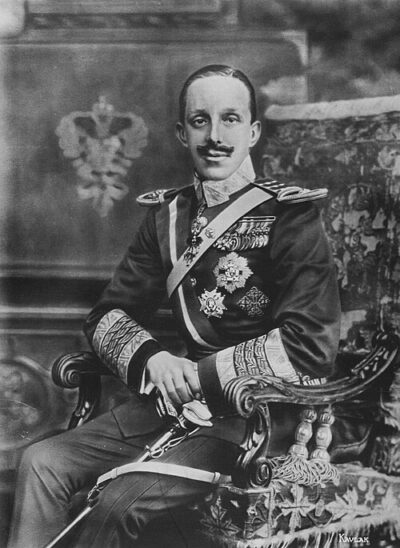
Alfonso XIII
Alfonso XIII was a King of Spain from 1886 to 1931. Born May 17, 1886, in Royal Palace of Madrid. Died February 28, 1941, in Rome. Positions held include Monarch of Spain (1886–1931), Head of State of Spain (1886–1931) and Pretender to the Spanish throne (1931–1941). Awards include Knight of the Order of the Golden Fleece, Knight Grand Cross of the Royal Victorian Order and Order of the White Eagle.
Facts
50 facts · 2 confirmed by two sources · 25 cited · 22 from one source · 1 where the sources disagree
What’s different
- Name at birth: we show Alfonso León Fernando María Jaime Isidro Pascual Antonio de Borbón y Austria-Lorena (Sources disagree). Wikidata also lists Alfonso XIII León Fernando María Santiago Isidro Pascual Antón de Borbón y Habsbourg Lorraine
Where this comes from
Papalocal keeps its own record. It started from these sources; what each one said is kept here as it was copied, so a change on their side never changes this page by itself. Tap one to read its version.
What Wikidata says · copied November 16, 2026 · revision 2569604177
- Described as
- King of Spain from 1886 to 1931 (1886–1941)
- Other names
- Alfonso León Fernando María Jaime Isidro Pascual Antonio de Borbón y Austria-Lorena, Don Alfonso de Borbón y Habsburgo, Alfonso Leon Fernando Maria Jaime Isidro Pascual Antonio de Borbon y Austria-Lorena, Don Alfonso de Borbon y Habsburgo, Alfonso XIII of Spain, The African
- Born
- May 17, 1886 · 1 reference
- Died
- February 28, 1941 · 11 references
- Born in
- Royal Palace of Madrid · 1 reference
- Died in
- Rome · 4 references
- Buried in
- Royal Crypt of the Royal Monastery of San Lorenzo de El Escorial (1980–) · 1 reference; Santa Maria in Monserrato degli Spagnoli (1941–1980) · 1 reference
- Cause of death
- angina pectoris · 1 reference
- Name at birth
- Alfonso León Fernando María Jaime Isidro Pascual Antonio de Borbón y Austria-Lorena · 1 reference; Alfonso XIII León Fernando María Santiago Isidro Pascual Antón de Borbón y Habsbourg Lorraine · 1 reference
- Citizen of
- Spain · 1 reference
- Occupation
- sovereign · 1 reference
- Positions held
- Monarch of Spain (1886–1931) · 1 reference; Head of State of Spain (1886–1931); Pretender to the Spanish throne (1931–1941)
- Member of
- Académie des beaux-arts; Alfonso XIII of Spain and Queen Victoria Eugenie
- Awards
- Knight of the Order of the Golden Fleece; Knight Grand Cross of the Royal Victorian Order; Order of the White Eagle; Knight Grand Cross in the Order of the Holy Sepulchre; Order of St. Andrew; Royal Victorian Chain (1905); honorary doctor of the University of Madrid Complutense (1927); Order of the White Lion (1925) · 1 reference; Knight Grand Cross of the Order of Saints Maurice and Lazarus; Collar of the Supreme Order of the Chrysanthemum; Knight of the Order of Saints Maurice and Lazarus; Order of Saint Ferdinand · 1 reference; Order of Calatrava · 1 reference; Order of the Most Holy Annunciation · 1 reference; Knight of the Garter (1902)
- Spouse
- Victoria Eugenie of Battenberg (1906–1931) · 2 references
- Children
- Infante Jaime, Duke of Segovia · 1 reference; Infanta Beatriz of Spain · 1 reference; Infante Juan, Count of Barcelona · 1 reference; Infante Gonzalo of Spain · 1 reference; Roger Marie Vincent Philippe Lévêque de Vilmorin · 1 reference; Fernando de Borbón y Battenberg · 1 reference; Alfonso, Prince of Asturias · 2 references; Infanta María Cristina of Spain · 1 reference; Juana Alfonsa Milán y Quiñones de León · 1 reference; Teresa de Borbón y Ruiz · 1 reference; Leandro de Borbón · 1 reference
- Father
- Alfonso XII of Spain · 1 reference
- Mother
- Maria Christina of Austria · 1 reference
- Siblings
- María de las Mercedes, Princess of Asturias · 1 reference; Infanta Maria Teresa Isabel of Spain · 1 reference
- Religion
- Catholic Church
- Military branch
- British Army
- Military rank
- field marshal
- Lived in
- Royal Palace of Madrid · 1 reference
- Wikipedias with a page
- 82
Wikidata item Q18363 (wikidata.org/wiki/Q18363), public domain (CC0). Copied November 16, 2026.
What Wikipedia says · copied November 16, 2026 · revision 1385183666
Alfonso XIII (Spanish: Alfonso León Fernando María Jaime Isidro Pascual Antonio de Borbón y Habsburgo-Lorena; French: Alphonse Léon Ferdinand Marie Jacques Isidore Pascal Antoine de Bourbon; 17 May 1886 – 28 February 1941), also known as El Africano or the African for his Africanist views, was King of Spain from his birth until 14 April 1931, when the Second Spanish Republic was proclaimed. He became a monarch at birth as his father, Alfonso XII, had died the previous year. Alfonso's mother, Maria Christina of Austria, served as regent until he assumed full powers on his sixteenth birthday in 1902.
Alfonso XIII's upbringing and public image were closely linked to the military estate; he often presented himself as a soldier-king. His effective reign started four years after the Spanish–American War, when various social milieus projected their expectations of national regeneration onto him. Like other European monarchs of his time he played a political role, entailing a controversial use of his constitutional executive powers. His wedding to Princess Victoria Eugenie of Battenberg in 1906 was marred by an attempt at regicide; he was unharmed.
With public opinion divided over World War I, and moreover a split between pro-German and pro-Entente sympathizers, Alfonso XIII used his relations with other European royal families to help preserve a stance of neutrality, as espoused by his government; however, several factors weakened the monarch's constitutional legitimacy: the rupture of the turno system, the deepening of the Restoration system crisis in the 1910s, a trio of crises in 1917, the spiral of violence in Morocco, and especially the lead-up to the 1923 installment of the dictatorship of Miguel Primo de Rivera, an event that succeeded by means of both military coup d'état and the king's acquiescence. Over the course of his reign, the monarch ended up favouring an authoritarian solution rather than constitutional liberalism.
Upon the political failure of the dictatorship, Alfonso XIII removed support from Primo de Rivera (who was thereby forced to resign in 1930) and favoured (during the dictablanda) an attempted return to the pre-1923 state of affairs. Nevertheless, he had lost most of his political capital along the way. He left Spain voluntarily after the municipal elections of April 1931 – which was understood as a plebiscite on maintaining the monarchy or declaring a republic – the result of which led to the proclamation of the Second Spanish Republic on 14 April 1931.
For his efforts with the European War Office during World War I, he earned a nomination for the Nobel Peace Prize in 1917, which was ultimately won by the Red Cross. As of 2026, he remains the only monarch known to have been nominated for a Nobel Prize.
- Born, in its opening lines
- May 17, 1886
- Died, in its opening lines
- February 28, 1941
From the Wikipedia article “Alfonso XIII” (en.wikipedia.org/wiki/Alfonso_XIII), by its contributors, under CC BY-SA 4.0 (creativecommons.org/licenses/by-sa/4.0/). Copied November 16, 2026; not changed.
Confirmed Two sources agree. Cited One source, and it names where it got it. One source One source, without a reference of its own. Sources disagree The sources disagree. We show the best-supported value and keep theirs below.
