
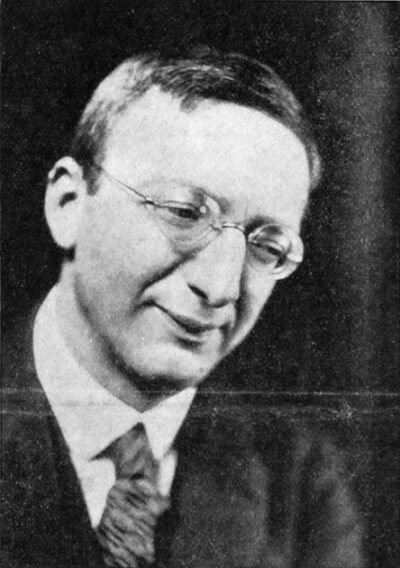
Alfred Döblin
Alfred Döblin was a German expressionist novelist. Born August 10, 1878, in Szczecin. Died June 26, 1957, in Emmendingen. Known for Berlin Alexanderplatz, The Three Leaps of Wang Lun and Wallenstein. Educated at Frederick William University Berlin and Humboldt-Universität zu Berlin. Awards include Literature Award of the Bavarian Academy of the Fine Arts.
Facts
37 facts · 2 confirmed by two sources · 11 cited · 24 from one source
What’s different
- Died: we show June 26, 1957 (Confirmed). Wikidata also lists June 24, 1957
Where this comes from
Papalocal keeps its own record. It started from these sources; what each one said is kept here as it was copied, so a change on their side never changes this page by itself. Tap one to read its version.
What Wikidata says · copied November 16, 2026 · revision 2569127701
- Described as
- German expressionist novelist (1878–1957)
- Other names
- Linke Poot
- Born
- August 10, 1878 · 14 references
- Died
- June 26, 1957 · 12 references; June 24, 1957 · 1 reference
- Born in
- Szczecin · 2 references
- Died in
- Emmendingen · 2 references
- Buried in
- Vosges
- Citizen of
- Germany · 1 reference; France (1936–) · 1 reference; Poland · 1 reference
- Occupation
- writer · 2 references; playwright; novelist; essayist; physician writer; journalist; neurologist; science fiction writer
- Education
- Frederick William University Berlin; Humboldt-Universität zu Berlin · 1 reference; University of Freiburg · 1 reference
- Member of
- Academy of Sciences and Literature Mainz
- Genre
- Exilliteratur
- Known for
- Berlin Alexanderplatz; The Three Leaps of Wang Lun; Wallenstein; Berge Meere und Giganten; November 1918: A German Revolution; Tales of a Long Night; Wadzeks Kampf mit der Dampfturbine
- Awards
- Literature Award of the Bavarian Academy of the Fine Arts (1957)
- Spouse
- Erna Döblin · 2 references
- Children
- Peter Doblin · 1 reference; Klaus Döblin · 2 references; Stefan Döblin · 2 references; Wolfgang Doeblin · 2 references
- Siblings
- Hugo Döblin · 1 reference
- Religion
- Catholic Church
- Website
- http://alfred-doeblin.de
- Wikipedias with a page
- 61
Wikidata item Q57389 (wikidata.org/wiki/Q57389), public domain (CC0). Copied November 16, 2026.
What Wikipedia says · copied November 16, 2026 · revision 1372533471
Bruno Alfred Döblin (German: [ˈalfʁeːt døːˈbliːn] ; 10 August 1878 – 26 June 1957) was a German novelist, essayist, and doctor, best known for his novel Berlin Alexanderplatz (1929). A prolific writer whose œuvre spans more than half a century and a wide variety of literary movements and styles, Döblin is one of the most important figures of German literary modernism. His complete works comprise over a dozen novels ranging in genre from historical novels to science fiction to novels about the modern metropolis; several dramas, radio plays, and screenplays; a true crime story; a travel account; two book-length philosophical treatises; scores of essays on politics, religion, art, and society; and numerous letters—his complete works, republished by Deutscher Taschenbuch Verlag and Fischer Verlag, span more than thirty volumes. His first published novel, Die drei Sprünge des Wang-lung (The Three Leaps of Wang Lun), appeared in 1915 and his final novel, Hamlet oder Die lange Nacht nimmt ein Ende (Tales of a Long Night) was published in 1956, one year before his death.
Born in Stettin, Germany (now Szczecin, Poland), to assimilated Jews, Döblin moved with his mother and siblings to Berlin when he was ten years old after his father had abandoned them. Döblin would live in Berlin for almost all of the next forty-five years, engaging with such key figures of the prewar and Weimar-era German cultural scene as Herwarth Walden and the circle of Expressionists, Bertolt Brecht, and Thomas Mann. Only a few years after his rise to literary celebrity with the 1929 publication of Berlin Alexanderplatz, Döblin was forced into exile by the rise of the Nazi dictatorship. Works by Döblin were also considered "Asphalt literature". He spent 1933–1940 in France and then was forced to flee again at the start of the Second World War. Like many other German émigrés he spent the war years in Los Angeles, where he converted to Catholicism. He moved to West Germany after the war but did not feel at home in postwar Germany's conservative cultural climate and returned to France. His final years were marked by poor health and financial difficulties, and his literary work was met with relative neglect.
Despite the canonic status of Berlin Alexanderplatz, Döblin is often characterized as an under-recognized or even as a forgotten author; while his work has received increasing critical attention (mostly in German) over the last few decades, he is much less well known by the reading public than other German novelists such as Thomas Mann, Günter Grass or Franz Kafka.
- Born, in its opening lines
- August 10, 1878
- Died, in its opening lines
- June 26, 1957
From the Wikipedia article “Alfred Döblin” (en.wikipedia.org/wiki/Alfred_Döblin), by its contributors, under CC BY-SA 4.0 (creativecommons.org/licenses/by-sa/4.0/). Copied November 16, 2026; not changed.
Confirmed Two sources agree. Cited One source, and it names where it got it. One source One source, without a reference of its own. Sources disagree The sources disagree. We show the best-supported value and keep theirs below.
