
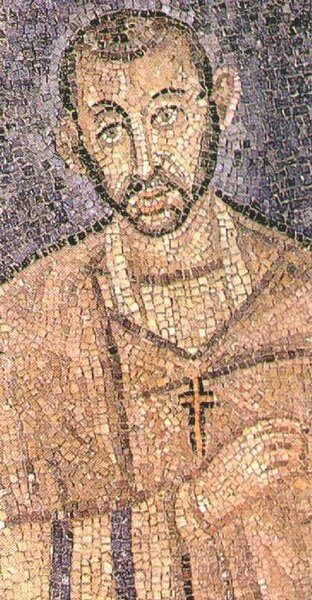
Ambrose
Ambrose was a Roman theologian and Bishop of Milan (c. 340–397). Born 339, in Augusta Treverorum. Died April 4, 397, in Mediolanum. Positions held include Roman governor, Roman Catholic Archbishop of Milan (374–397) and bishop. Known for Hymns, Hexaemeron and De virginibus.
Facts
29 facts · 2 confirmed by two sources · 7 cited · 20 from one source
Where this comes from
Papalocal keeps its own record. It started from these sources; what each one said is kept here as it was copied, so a change on their side never changes this page by itself. Tap one to read its version.
What Wikidata says · copied November 16, 2026 · revision 2568951457
- Described as
- Roman theologian and Bishop of Milan (c. 340–397)
- Other names
- Ambrosius Mediolanensis, St. Ambrosius, Saint, Bishop of Milan Ambroise, St. Ambrose, Saint, Bishop of Milan Aurelio Ambrogio, Saint, Bishop of Milan Ambrogio, Saint, Bishop of Milan Ambrose, Saint Ambrose, Saint, Bishop of Milan Aurelius Ambrosius, Saint Ambrose Bishop of Milan, Ambrose of Milan, St Ambrose
- Born
- 339 · 8 references
- Died
- April 4, 397 · 2 references
- Born in
- Augusta Treverorum
- Died in
- Mediolanum
- Buried in
- Basilica of Sant'Ambrogio
- Citizen of
- Ancient Rome
- Occupation
- writer · 3 references; philosopher · 1 reference; theologian · 2 references; Catholic priest; politician · 1 reference; Catholic bishop · 2 references
- Positions held
- Roman governor · 1 reference; Roman Catholic Archbishop of Milan (374–397) · 1 reference; bishop · 2 references
- Known for
- Hymns; Hexaemeron; De virginibus; Versus de naturis rerum; De Abraham; De bono mortis; De fuga saeculi; De fide; De officiis ministrorum; De Spiritu Sancto
- Father
- Ambrosius
- Siblings
- Satyrus of Milan; Saint Marcellina
- Religion
- Catholic Church · 1 reference
- Wikipedias with a page
- 99
Wikidata item Q43689 (wikidata.org/wiki/Q43689), public domain (CC0). Copied November 16, 2026.
What Wikipedia says · copied November 16, 2026 · revision 1385568183
Ambrose of Milan (Latin: Aurelius Ambrosius; c. 339 – 4 April 397), canonized as Saint Ambrose, was a Roman theologian, statesman, preacher, and Bishop of Milan from 374 until his death. Trained in rhetoric and law, he served as Roman civil governor of Aemilia-Liguria at Milan before being unexpectedly chosen as bishop by popular acclamation in 374. His preaching, ecclesiastical activity, and writings made him one of the most influential Christian figures of the 4th century.
As bishop, Ambrose became a prominent defender of Christian orthodoxy, particularly against Arianism, while also attempting to mediate the conflict between the emperors Theodosius I and Magnus Maximus. He opposed the execution of Priscillianist heretics and later excommunicated Theodosius following a massacre, maintaining that "an emperor is within the church, not over it." He was also a strong advocate of monasticism and asceticism, and his theological activity helped interpret and transmit Eastern Christian theology to the Latin West.
Ambrose left a substantial body of writings. Among his important works were De Virginibus (377), on the literal and metaphorical significance of virginity and purity; De Sacramentis, which contains the earliest witness to the present Roman Canon of the Mass; and the ethical treatise De officiis ministrorum (377–391), concerned especially with the conduct of the clergy. His exegetical writings include the Exameron (386–390). Ambrose was also the author of at least four hymns, including "Veni redemptor gentium", which form the core of the corpus known as the Ambrosian hymns, alongside other hymns traditionally attributed to him. He exercised a notable influence on Augustine of Hippo, whom he helped convert to Christianity.
In Western Christianity, Ambrose came to be recognized alongside Augustine, Jerome, and Pope Gregory the Great as one of the four Great Latin Church Fathers. He was also one of the four original Western Doctors of the Church, formally declared Doctors in 1298. He is venerated as a saint in the Catholic Church, Eastern Orthodox Church, Anglican Communion, and various Lutheran denominations, and is the patron saint of Milan and beekeepers. His feast day is usually observed on 7 December.
- Born, in its opening lines
- c. 339
- Died, in its opening lines
- April 4, 397
From the Wikipedia article “Ambrose” (en.wikipedia.org/wiki/Ambrose), by its contributors, under CC BY-SA 4.0 (creativecommons.org/licenses/by-sa/4.0/). Copied November 16, 2026; not changed.
Confirmed Two sources agree. Cited One source, and it names where it got it. One source One source, without a reference of its own. Sources disagree The sources disagree. We show the best-supported value and keep theirs below.
