
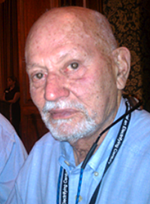
Amnon Yariv is an American electrical engineer. Born April 13, 1930, in Tel Aviv. Educated at University of California, Berkeley. Awards include Frederic Ives Medal, Harold Pender Award and Harvey Prize.
Facts
22 facts · 1 confirmed by two sources · 8 cited · 13 from one source
Where this comes from
Papalocal keeps its own record. It started from these sources; what each one said is kept here as it was copied, so a change on their side never changes this page by itself. Tap one to read its version.
What Wikidata says · copied November 19, 2026 · revision 2566916271
- Described as
- American electrical engineer
- Born
- April 13, 1930 · 1 reference
- Born in
- Tel Aviv · 1 reference
- Citizen of
- Israel; United States
- Occupation
- physicist; engineer; electrotechnician · 1 reference; university teacher · 1 reference
- Worked for
- California Institute of Technology; Bell Labs
- Education
- University of California, Berkeley
- Member of
- National Academy of Sciences (1991–); American Academy of Arts and Sciences; National Academy of Engineering (1976–)
- Awards
- Frederic Ives Medal (1986) · 1 reference; Harold Pender Award (1985) · 1 reference; Harvey Prize (1992) · 1 reference; IEEE Quantum Electronics Award (1980); National Medal of Science (2009); IEEE Photonics Award (2011) · 1 reference; Esther Hoffman Beller Medal (1998) · 1 reference
- Field
- optoelectronics
- Wikipedias with a page
- 13
Wikidata item Q328691 (wikidata.org/wiki/Q328691), public domain (CC0). Copied November 19, 2026.
What Wikipedia says · copied November 19, 2026 · revision 1360658387
Amnon Yariv (Hebrew: אמנון יריב; born April 13, 1930) is an Israeli-American professor of applied physics and electrical engineering at Caltech, known for innovations in optoelectronics. Yariv obtained his B.S., M.S. and PhD. in electrical engineering from the University of California, Berkeley in 1954, 1956 and 1958, respectively.
- Born, in its opening lines
- April 13, 1930
From the Wikipedia article “Amnon Yariv” (en.wikipedia.org/wiki/Amnon_Yariv), by its contributors, under CC BY-SA 4.0 (creativecommons.org/licenses/by-sa/4.0/). Copied November 19, 2026; not changed.
Confirmed Two sources agree. Cited One source, and it names where it got it. One source One source, without a reference of its own. Sources disagree The sources disagree. We show the best-supported value and keep theirs below.
