
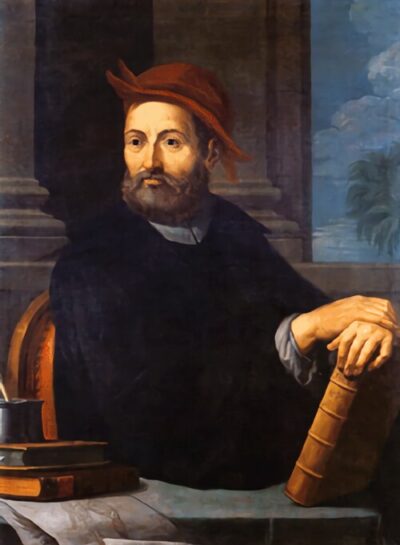
Andrea Cesalpino
Andrea Cesalpino was an Italian physician, botanist and philosopher. Born 1524, in Arezzo. Died February 23, 1603, in Rome. Educated at University of Pisa.
Facts
13 facts · 0 confirmed by two sources · 6 cited · 7 from one source
Where this comes from
Papalocal keeps its own record. It started from these sources; what each one said is kept here as it was copied, so a change on their side never changes this page by itself. Tap one to read its version.
What Wikidata says · copied November 16, 2026 · revision 2568065105
- Described as
- Italian physician, botanist and philosopher (1524–1603)
- Other names
- Cesalpino
- Born
- 1524 · 1 reference
- Died
- February 23, 1603 · 6 references
- Born in
- Arezzo · 2 references
- Died in
- Rome · 2 references
- Occupation
- philosopher; botanist; university teacher (1555–); physician · 2 references
- Worked for
- University of Pisa; Sapienza University of Rome; Clement VIII · 1 reference
- Education
- University of Pisa
- Religion
- Catholic Church
- Wikipedias with a page
- 33
Wikidata item Q346523 (wikidata.org/wiki/Q346523), public domain (CC0). Copied November 16, 2026.
What Wikipedia says · copied November 16, 2026 · revision 1385565904
Andrea Cesalpino (Latinized as Andreas Cæsalpinus) (1524/1525 – 23 February 1603) was a Florentine physician, philosopher and botanist.
In his works he classified plants according to their fruits and seeds, rather than alphabetically or by medicinal properties. In 1555, he succeeded Luca Ghini as director of the botanical garden in Pisa. The botanist Pietro Castelli was one of his students. Cesalpino also did limited work in the field of plant and animal physiology. In medicine, he envisioned a "chemical circulation" consisting of repeated evaporation and condensation of blood, and for this reason historians have conceived him as a forerunner of William Harvey (1578–1657), who theorized the "physical circulation" of blood in 1628.
From the Wikipedia article “Andrea Cesalpino” (en.wikipedia.org/wiki/Andrea_Cesalpino), by its contributors, under CC BY-SA 4.0 (creativecommons.org/licenses/by-sa/4.0/). Copied November 16, 2026; not changed.
Confirmed Two sources agree. Cited One source, and it names where it got it. One source One source, without a reference of its own. Sources disagree The sources disagree. We show the best-supported value and keep theirs below.
