
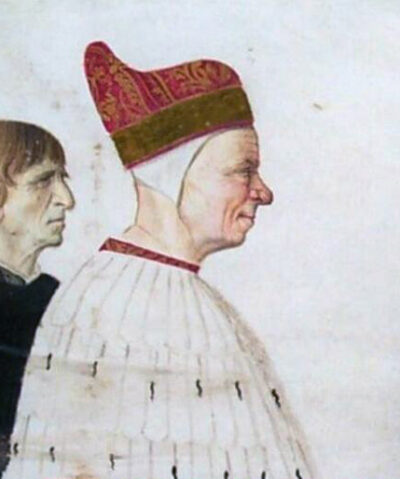
Andrea Vendramin was a Doge of Venice 1476-8. Born 1393, in Venice. Died May 5, 1478, in Venice. Positions held include Doge of Venice (1476–1478).
Facts
9 facts · 2 confirmed by two sources · 0 cited · 6 from one source · 1 where the sources disagree
What’s different
- Buried in: we show Santi Giovanni e Paolo (Sources disagree). Wikidata also lists Tomb of the Dodge Andrea Vendramin
Where this comes from
Papalocal keeps its own record. It started from these sources; what each one said is kept here as it was copied, so a change on their side never changes this page by itself. Tap one to read its version.
What Wikidata says · copied November 18, 2026 · revision 2521222401
- Described as
- Doge of Venice 1476-8
- Born
- 1393
- Died
- May 5, 1478
- Born in
- Venice
- Died in
- Venice
- Buried in
- Santi Giovanni e Paolo · 1 reference; Tomb of the Dodge Andrea Vendramin · 1 reference
- Cause of death
- plague
- Citizen of
- Republic of Venice
- Occupation
- diplomat
- Positions held
- Doge of Venice (1476–1478)
- Wikipedias with a page
- 21
Wikidata item Q495242 (wikidata.org/wiki/Q495242), public domain (CC0). Copied November 18, 2026.
What Wikipedia says · copied November 18, 2026 · revision 1373658213
Andrea Vendramin (1393 – May 5, 1478, both Venice) was Doge of Venice from 1476 until his death in 1478, at the height of Venetian power, the only member of the Vendramin family to do so. His mother, Maria Michiel, and his wife Regina Gradenigo, both came from Dogal families. He had served as Venetian Procurator in Rome, and his brief reign was largely concerned with the end of the Second Turkish–Venetian War. He probably died of plague.
The process of his election as Doge resulted in a divisive split in the council, that resulted in bad feelings: in 1477 Antonio Feleto was imprisoned, then banished, for remarking in public that the Council of the Forty-One must have been hard-pressed to elect a cheesemonger Doge. The diarist Malipiero noted that Andrea Vendramin at the time of his election was worth 160,000 ducats, after allowing for 6 to 7000 ducats with which he had endowed each of six daughters, in order to procure politically influential sons-in-law. In his youth, he and his brother Luca, in joint ventures, used to ship from Alexandria enough goods to fill a galley or a galley and a half, Malipiero recorded in retrospect: even his factors grew rich managing his affairs.
He has a large monumental wall-tomb, generally agreed to be "the most lavish funerary monument of Renaissance Venice", in the basilica of Santi Giovanni e Paolo, the usual burial-place of Doges, which was executed by Tullio Lombardo (1493), though Andrea del Verrocchio competed for the commission. It was originally intended for the church of Santa Maria dei Servi. However the portrait in the Frick Collection by Gentile Bellini, inscribed with his name, is now considered to be of his successor, Doge Giovanni Mocenigo.
He was interred in the Basilica di San Giovanni e Paolo, a traditional burial place of the doges. After Andrea's death, his widow married his brother, Luca.
- Born, in its opening lines
- 1393
- Died, in its opening lines
- May 5, 1478
From the Wikipedia article “Andrea Vendramin” (en.wikipedia.org/wiki/Andrea_Vendramin), by its contributors, under CC BY-SA 4.0 (creativecommons.org/licenses/by-sa/4.0/). Copied November 18, 2026; not changed.
Confirmed Two sources agree. Cited One source, and it names where it got it. One source One source, without a reference of its own. Sources disagree The sources disagree. We show the best-supported value and keep theirs below.
