
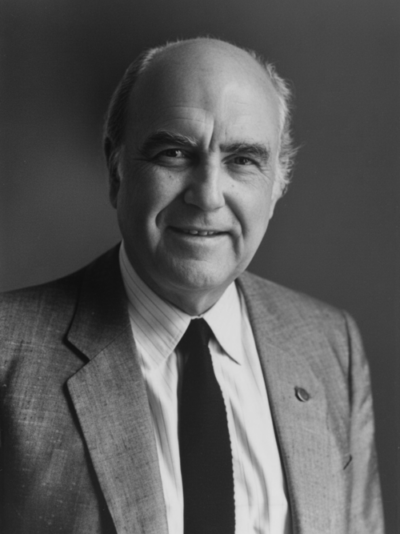
Andreas Papandreou
Andreas Papandreou was a Greek economist and politician. Born February 5, 1919, in Chios. Died June 23, 1996, in Athens. Positions held include Prime Minister of Greece (2 times) (1981–1996), Minister for National Defence of Greece (1981–1986) and Leader of the Opposition (2 times) (1977–1993). Educated at National and Kapodistrian University of Athens and Harvard University. Awards include Grand Cross of the Order of Isabella the Catholic, Grand Cross of the Order of Liberty and honorary doctor of the Jagiellonian University of Krakow.
Facts
51 facts · 2 confirmed by two sources · 11 cited · 38 from one source
Where this comes from
Papalocal keeps its own record. It started from these sources; what each one said is kept here as it was copied, so a change on their side never changes this page by itself. Tap one to read its version.
What Wikidata says · copied November 13, 2026 · revision 2567393285
- Described as
- Greek economist and politician (1919–1996)
- Other names
- Andreas Georgios Papandreou, Andreas Georgiou Papandreou
- Born
- February 5, 1919 · 9 references
- Died
- June 23, 1996 · 9 references
- Born in
- Chios · 1 reference
- Died in
- Athens · 1 reference
- Buried in
- First Cemetery of Athens · 1 reference
- Cause of death
- cardiovascular disease
- Citizen of
- Greece; United States (–1964)
- Occupation
- politician · 1 reference; economist · 1 reference; university teacher · 1 reference
- Positions held
- Prime Minister of Greece (2 times) (1981–1996); Minister for National Defence of Greece (1981–1986); Leader of the Opposition (2 times) (1977–1993); member of the Hellenic Parliament (1974–1996) · 1 reference; Minister at the Presidency of the Government of Greece (1964); Ministry of Coordination of Greece (1964–1965); chairperson (1974–1996)
- Political party
- Centre Union; Panhellenic Socialist Movement
- Worked for
- Harvard University; University of California, Berkeley; Stockholm University; University of Minnesota; York University; University of Toronto · 1 reference
- Education
- National and Kapodistrian University of Athens; Harvard University; Athens College; University of Minnesota
- Member of
- Panhellenic Liberation Movement; Friends of Music Society
- Awards
- Grand Cross of the Order of Isabella the Catholic (1983) · 1 reference; Grand Cross of the Order of Liberty · 1 reference; honorary doctor of the Jagiellonian University of Krakow; Guggenheim Fellowship · 1 reference; Grand Star of People's Friendship · 1 reference
- Field
- politics · 1 reference; economics · 1 reference
- Spouse
- Christina Rassia (1941–1951); Margaret Papandreou (1951–1989); Dimitra Liani (1989–1996)
- Children
- Giorgos Papandreou · 1 reference; Níkos Papandréou; Andreas Papandreou; Sofia Papandreou; Emilia Nyblom
- Father
- Georgios Papandreou · 1 reference
- Mother
- Sofia Mineyko
- Siblings
- Georgios G. Papandreou
- Religion
- Greek Orthodoxy
- Wikipedias with a page
- 54
Wikidata item Q219256 (wikidata.org/wiki/Q219256), public domain (CC0). Copied November 13, 2026.
What Wikipedia says · copied November 13, 2026 · revision 1380674673
Andreas Georgiou Papandreou (Greek: Ανδρέας Γεωργίου Παπανδρέου, pronounced [anˈðreas papanˈðreu]; 5 February 1919 – 23 June 1996) was a Greek academic and economist who was prime minister of Greece from 1981 to 1989 and again from 1993 to 1996. He founded PASOK, the Panhellenic Socialist Movement.
Born in Chios, Papandreou was the son of prime minister Georgios Papandreou. In 1938, Papandreou left Greece for the United States to escape the 4th of August Regime and became a prominent academic. He returned to Greece in 1959 after years of resisting his father's entreaties to prepare him as successor. After joining the now-ruling Centre Union party in 1963, Papandreou's rapid ascension during his father's premiership, together with his uncompromising radical rhetoric, amplified Greece's post–Civil War political instability leading to Iouliana, which created the conditions for a group of colonels to stage a coup d'état followed by a seven-year junta. Papandreou was imprisoned, then exiled by the Junta, while many politicians, including his father, blamed him as responsible for the fall of democracy. In exile, Papandreou developed and spread an anti-American, conspiratorial narrative in which he and his father were victims of the Greek right-wing establishment supported by the United States.
In 1974, Papandreou founded PASOK, the first organized Greek democratic socialist party. Papandreou's populist rhetoric resonated with the Greek people who sought a change from the politics of the past and the 1970s energy crisis. PASOK won the 1981 elections and Papandreou implemented a transformative social agenda, expanding access to education and healthcare, reinforcing workers' rights, and passing a new family law that elevated the position of women in society and the economy. In 1982, he secured official recognition of all the resistance groups, including EAM-ELAS and the return of Greek communist refugees of the Civil War. His governance was tarnished by numerous corruption scandals, a soft stance on terrorism, democratic backsliding, a public divorce and subsequent marriage to an air stewardess half his age, controversial foreign policy decisions, and a constitutional crisis which he had instigated. Under Papandreou, the Greek economy diverged from the European average because of large-scale patronage, misuse of European Union funds, and excessive foreign borrowing, which resulted in Greece earning the reputation of Europe's "black sheep" and "lost cause".
Papandreou resigned from the premiership in January 1996 due to ill health and died in June of that year. He transformed Greece's post-junta liberal democracy into a populist democracy that continued after his death, including his administrations. His eldest son, George Papandreou, became the leader of PASOK in February 2004 and served as prime minister from 2009 to 2011.
- Born, in its opening lines
- February 5, 1919
- Died, in its opening lines
- June 23, 1996
From the Wikipedia article “Andreas Papandreou” (en.wikipedia.org/wiki/Andreas_Papandreou), by its contributors, under CC BY-SA 4.0 (creativecommons.org/licenses/by-sa/4.0/). Copied November 13, 2026; not changed.
Confirmed Two sources agree. Cited One source, and it names where it got it. One source One source, without a reference of its own. Sources disagree The sources disagree. We show the best-supported value and keep theirs below.
