
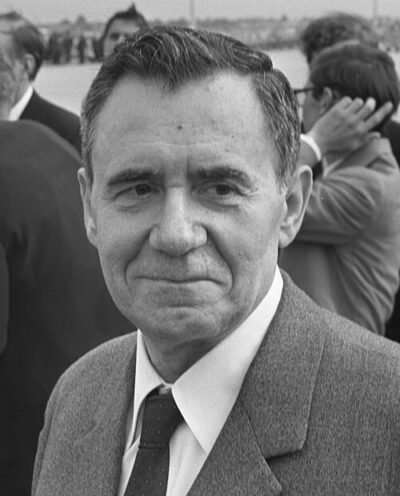
Andrei Gromyko
Andrei Gromyko was a Soviet diplomat. Born July 5, 1909, in Staryja Hramykі. Died July 2, 1989, in Moscow. Positions held include First Deputy Chairman of the Council of Ministers of the USSR (1983–1985), Permanent Representative of the USSR to the United Nations and to the UN Security Council (1946–1948) and Chairman of the Presidium of the Supreme Soviet of the Soviet Union (1985–1988). Educated at Belarusian State Economic University. Awards include USSR State Prize, Order of Lenin (7 times) and Order of the Badge of Honour.
Facts
41 facts · 1 confirmed by two sources · 7 cited · 32 from one source · 1 where the sources disagree
What’s different
- Born: we show July 5, 1909 (Sources disagree). Wikipedia says July 18, 1909
Where this comes from
Papalocal keeps its own record. It started from these sources; what each one said is kept here as it was copied, so a change on their side never changes this page by itself. Tap one to read its version.
What Wikidata says · copied November 16, 2026 · revision 2565548802
- Described as
- Soviet diplomat
- Other names
- Andrei Andreyevich Gromyko
- Born
- July 5, 1909
- Died
- July 2, 1989 · 5 references
- Born in
- Staryja Hramykі · 1 reference
- Died in
- Moscow · 2 references
- Buried in
- Novodevichy Cemetery
- Citizen of
- Russian Empire; Soviet Union
- Occupation
- politician · 2 references; diplomat · 2 references; economist · 1 reference; memoirist; agricultural economist · 1 reference
- Positions held
- First Deputy Chairman of the Council of Ministers of the USSR (1983–1985) · 1 reference; Permanent Representative of the USSR to the United Nations and to the UN Security Council (1946–1948) · 2 references; Chairman of the Presidium of the Supreme Soviet of the Soviet Union (1985–1988) · 2 references; Soviet Ambassador to the United States (1943–1946); ambassador of the Soviet Union to the United Kingdom (1952–1953); Minister of Foreign Affairs of USSR (1957–1985); Member of the Politburo of the CPSU Central Committee (1973–1988) · 1 reference
- Political party
- Communist Party of the Soviet Union (1931–1989)
- Education
- Belarusian State Economic University
- Member of
- Politburo of the Central Committee of the Communist Party of the Soviet Union
- Awards
- USSR State Prize (1984); Order of Lenin (7 times) (1944, 1945, 1959, 1966, 1969, 1979, 1984); Order of the Badge of Honour (1954); Order of the Red Banner of Labour (1948); Medal "Veteran of Labour"; Medal "For Valiant Labour in the Great Patriotic War 1941–1945"; Lenin Prize (1982); Order of the Patriotic War, 1st class (1985); Jubilee Medal "In Commemoration of the 100th Anniversary of the Birth of Vladimir Ilyich Lenin"; Jubilee Medal "Thirty Years of Victory in the Great Patriotic War 1941–1945"; Jubilee Medal "Forty Years of Victory in the Great Patriotic War 1941–1945"; Jubilee Medal "60 Years of the Armed Forces of the USSR"; Medal "In Commemoration of the 800th Anniversary of Moscow"; Order of the Sun of Liberty; Order of José Martí
- Spouse
- Lydia Gromyko
- Children
- Anatoly Gromyko · 1 reference; Emilia Andreevna Gromyko
- Religion
- atheism
- Wikipedias with a page
- 74
Wikidata item Q184267 (wikidata.org/wiki/Q184267), public domain (CC0). Copied November 16, 2026.
What Wikipedia says · copied November 16, 2026 · revision 1385407566
Andrei Andreyevich Gromyko (18 July [O.S. 5 July] 1909 – 2 July 1989) was a Soviet politician and diplomat during the Cold War. He served as Minister of Foreign Affairs (1957–1985) and as Chairman of the Presidium of the Supreme Soviet (1985–1988). Gromyko was responsible for many top decisions on Soviet foreign policy until he retired in 1988. In the 1940s, Western pundits called him Mr. Nyet ("Mr. No"), or Grim Grom, because of his frequent use of the Soviet veto in the United Nations Security Council.
Gromyko's political career started in 1939 in the People's Commissariat for Foreign Affairs (renamed Ministry of Foreign Affairs in 1946). He became the Soviet ambassador to the United States in 1943, leaving that position in 1946 to become the Soviet Permanent Representative to the United Nations in New York. Upon his return to Moscow he became a Deputy Minister of Foreign Affairs and later First Deputy Minister of Foreign Affairs and eventually Foreign Minister. He went on to become the Soviet ambassador to the United Kingdom in 1952.
As Foreign Minister of the Soviet Union, Gromyko was directly involved in deliberations with the Americans during the Cuban Missile Crisis and helped broker a peace treaty ending the 1965 Indo-Pakistani War. Under the leadership of Leonid Brezhnev, he played a central role in the establishment of détente with the United States by negotiating the ABM Treaty, the Partial Nuclear Test Ban Treaty and the SALT I & II, among others. As Brezhnev's health deteriorated from the mid-1970s onward, Gromyko began to increasingly dictate Soviet policy alongside Defense Minister Dmitry Ustinov and KGB Chairman Yuri Andropov. Even after Brezhnev's death in 1982, Gromyko's rigid conservatism and distrust of the West continued to underlie the Soviet Union's foreign policy until Mikhail Gorbachev's rise to power in 1985.
Upon Konstantin Chernenko's selection as General Secretary on 13 February 1984, Andrei Gromyko formed an unofficial triumvirate along with Ustinov and Chernenko that governed the Soviet Union through the end of the year. However, following Gorbachev's election as General Secretary in March 1985, Gromyko was removed from office as foreign minister and appointed to the largely ceremonial post of Chairman of the Presidium of the Supreme Soviet of the USSR. He ultimately retired from political life in 1988, and died the following year in Moscow.
- Born, in its opening lines
- July 18, 1909
- Died, in its opening lines
- July 2, 1989
From the Wikipedia article “Andrei Gromyko” (en.wikipedia.org/wiki/Andrei_Gromyko), by its contributors, under CC BY-SA 4.0 (creativecommons.org/licenses/by-sa/4.0/). Copied November 16, 2026; not changed.
Confirmed Two sources agree. Cited One source, and it names where it got it. One source One source, without a reference of its own. Sources disagree The sources disagree. We show the best-supported value and keep theirs below.
