
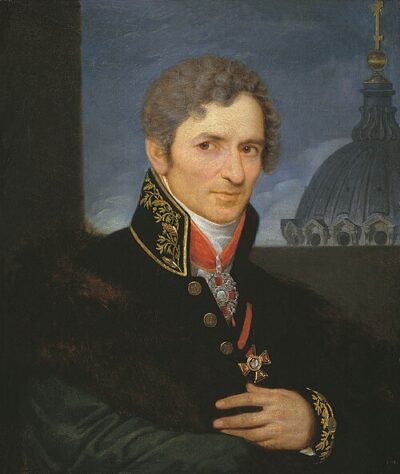
Andrey Voronikhin
Andrey Voronikhin was a Russian architect and painter. Born October 17, 1759, in Usolye. Died February 21, 1814, in Saint Petersburg. Known for Kazan Cathedral and Saint Petersburg Mining University. Educated at Imperial Academy of Arts. Awards include Order of St. Vladimir, 4th class, Order of St. Vladimir, 3rd class and Order of Saint Anna, 2nd class.
Facts
20 facts · 1 confirmed by two sources · 3 cited · 15 from one source · 1 where the sources disagree
What’s different
- Born: we show October 17, 1759 (Sources disagree). Wikipedia says October 28, 1759
Where this comes from
Papalocal keeps its own record. It started from these sources; what each one said is kept here as it was copied, so a change on their side never changes this page by itself. Tap one to read its version.
What Wikidata says · copied November 18, 2026 · revision 2568957776
- Described as
- Russian architect and painter (1759-1814)
- Other names
- Andrej Nikiforovič Voronihin, Andrey Nikiforovich Voronikhin, Andrey Nikiforovitch Voronikhin, Andry Nikiforowitsch Woronichin, Andrei Nikiforovich Voronikhin, Andreĭ Nikiforovich Voronikhin, Andrei Nikiforowitsch Woronischin, Andrej Nikiforovic Voronichin
- Born
- October 17, 1759
- Died
- February 21, 1814
- Born in
- Usolye · 2 references
- Died in
- Saint Petersburg · 2 references
- Buried in
- Lazarev Cemetery
- Citizen of
- Russian Empire · 1 reference
- Occupation
- architect; painter · 2 references; sculptor · 1 reference
- Worked for
- Imperial Academy of Arts
- Education
- Imperial Academy of Arts
- Known for
- Kazan Cathedral; Saint Petersburg Mining University · 1 reference
- Awards
- Order of St. Vladimir, 4th class; Order of St. Vladimir, 3rd class; Order of Saint Anna, 2nd class; Order of St. Vladimir · 1 reference; Order of Saint Anna · 1 reference
- Field
- painting; architecture
- Wikipedias with a page
- 24
Wikidata item Q51199 (wikidata.org/wiki/Q51199), public domain (CC0). Copied November 18, 2026.
What Wikipedia says · copied November 18, 2026 · revision 1372432061
Andrey (Andrei) Nikiforovich Voronikhin (Russian: Андрей Никифорович Воронихин; 28 October 1759, Novoe Usolye, Perm Oblast – 21 February 1814, Saint Petersburg) was a Russian architect and painter. As a representative of classicism he was also one of the founders of the monumental Russian Empire style. Born a serf of the Stroganov family, he is best known for his work on Kazan Cathedral in Saint Petersburg.
Andrey Voronikhin was born in the village of Novoa Usolye (now Perm Krai) to a family who were the serfs of count Alexander Sergeyevich Stroganov, a longtime President of the Imperial Academy of Arts. It is generally believed that he was fathered by Alexander Stroganov. Voronikhin trained in painting in the workshop of Ural icon painter Gabriel Yushkov. The talents of his youth attracted Stroganov's attention, and in 1777 the count sent Voronikhin to study in Moscow. Among his teachers were Vasili Ivanovich Bazhenov and Matvey Fyodorovich Kazakov. After 1779 Voronikhin worked in Saint Petersburg.
In 1785, Voronikhin was liberated. From 1786 through 1790 he studied architecture, mechanics and mathematics in France and Switzerland.
In 1797, the artist obtained the academic title of «перспективной живописи» from the Academy of Fine Arts for the pictures «Вид картинной галереи в Строгановском дворце» (1793, Hermitage) and «Вид Строгановской дачи» (1797, Russian museum, Saint Petersburg). From the beginning of the 19th century he taught at the Academy of Fine Arts.
The earliest architecture of Voronikhin includes finishing the interiors of Stroganov Palace (1793). The magnificent baroque forms, proposed by Rastrelli, were replaced by Voronikhin with a strict classical order, characterized by simplicity and refinement. Furthermore, he reconstructed the interiors of the Stroganov Dacha on the Black River (1795 - 1796), and also built estates in Gorodnya (1798).
The main creation of Voronikhin was Kazan Cathedral in Saint Petersburg. The construction began on 27 March 1801, and work was finished in 1811. On the occasion of renovating the temple, Voronikhin was granted a pension and the order of St. Anna of the second degree.
A number of other works of Voronikhin were the house of the Department of the Treasury, the building of the Saint Petersburg Mining Institute, the colonnade of the Peterhof, and palaces in Strelna, Gatchina and Pavlovsk.
The architect died on 5 March 1814 in Saint Petersburg.
Voronikhin's nephew, Nikolay Ilyich Voronikhin, was an architect based in Ryazan. He inherited Andrey Voronikhin's archive; Ascension Cathedral in Kasimov (photo) by Nikolay Voronikhin is remotely based on Andrey Voronikhin's unrealized draft for Cathedral of Christ the Saviour in Moscow.
- Born, in its opening lines
- October 28, 1759
- Died, in its opening lines
- February 21, 1814
From the Wikipedia article “Andrey Voronikhin” (en.wikipedia.org/wiki/Andrey_Voronikhin), by its contributors, under CC BY-SA 4.0 (creativecommons.org/licenses/by-sa/4.0/). Copied November 18, 2026; not changed.
Confirmed Two sources agree. Cited One source, and it names where it got it. One source One source, without a reference of its own. Sources disagree The sources disagree. We show the best-supported value and keep theirs below.
