
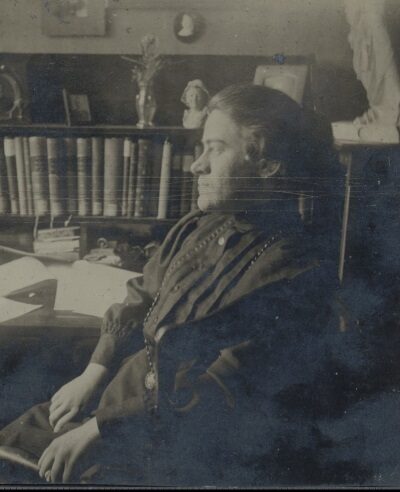
Anna Tumarkin
Anna Tumarkin was a Swiss professor. Born February 16, 1875, in Dubroŭna. Died August 7, 1951, in Muri bei Bern. Educated at University of Bern.
Facts
15 facts · 2 confirmed by two sources · 3 cited · 10 from one source
Where this comes from
Papalocal keeps its own record. It started from these sources; what each one said is kept here as it was copied, so a change on their side never changes this page by itself. Tap one to read its version.
What Wikidata says · copied November 18, 2026 · revision 2568867684
- Described as
- Swiss professor (1875-1951)
- Other names
- Anna-Ester Pavlovna Tumarkin
- Born
- February 16, 1875 · 2 references
- Died
- August 7, 1951 · 3 references
- Born in
- Dubroŭna
- Died in
- Muri bei Bern · 1 reference
- Cause of death
- elephantiasis
- Name at birth
- Хана-Эстер Палтиэловна Тумаркина
- Citizen of
- Russian Empire; Switzerland
- Occupation
- professor · 1 reference; psychologist; suffragette; philosopher · 2 references
- Worked for
- University of Bern
- Education
- University of Bern (–1895)
- Field
- philosophy
- Wikipedias with a page
- 22
Wikidata item Q124439 (wikidata.org/wiki/Q124439), public domain (CC0). Copied November 18, 2026.
What Wikipedia says · copied November 18, 2026 · revision 1372662685
Anna Tumarkin (Belarusian: Анна-Эстер Паўлаўна Тумаркін; Hebrew: אנה-אסתר פבלובנה טומרקין; 16 February 1875 – 7 August 1951) was a Russian-born, naturalized Swiss academic, who was the first woman to become a professor of philosophy at the University of Bern. She was the first woman in Europe to be allowed to examine doctoral and professorial candidates and the first woman to sit as a member of a University Senate anywhere in Europe.
- Born, in its opening lines
- February 16, 1875
- Died, in its opening lines
- August 7, 1951
From the Wikipedia article “Anna Tumarkin” (en.wikipedia.org/wiki/Anna_Tumarkin), by its contributors, under CC BY-SA 4.0 (creativecommons.org/licenses/by-sa/4.0/). Copied November 18, 2026; not changed.
Confirmed Two sources agree. Cited One source, and it names where it got it. One source One source, without a reference of its own. Sources disagree The sources disagree. We show the best-supported value and keep theirs below.
