
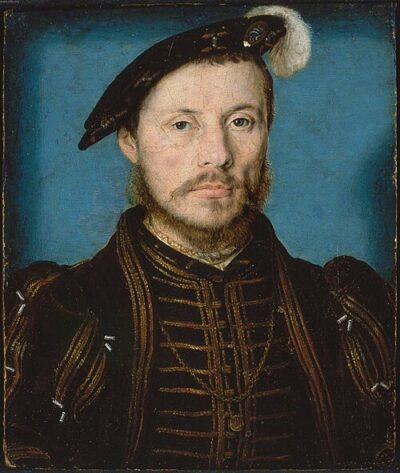
Anne de Montmorency
Anne de Montmorency was a First Duke of Montmorency. Born March 15, 1493, in Chantilly. Died November 12, 1567, in Paris. Positions held include ambassador, minister and Grand Master of France (1526–1558). Awards include Marshal of France and Knight of the Garter.
Facts
33 facts · 2 confirmed by two sources · 9 cited · 22 from one source
Where this comes from
Papalocal keeps its own record. It started from these sources; what each one said is kept here as it was copied, so a change on their side never changes this page by itself. Tap one to read its version.
What Wikidata says · copied November 16, 2026 · revision 2561536799
- Described as
- First Duke of Montmorency
- Other names
- Constable of France Montmorency, Anne, Duc de Montmorency, Anne Montmorency Duc de, Anne de la Trémoille, Duc de Montmorency
- Born
- March 15, 1493 · 2 references
- Died
- November 12, 1567 · 4 references
- Born in
- Chantilly · 1 reference
- Died in
- Paris · 1 reference
- Citizen of
- Kingdom of France
- Occupation
- diplomat; military personnel · 1 reference; politician · 2 references; art historian · 2 references; military officer · 1 reference
- Positions held
- ambassador; minister; Grand Master of France (1526–1558) · 1 reference; Constable of France (1538–1567)
- Awards
- Marshal of France; Knight of the Garter (1532)
- Spouse
- Madeleine of Savoy
- Children
- Henri I de Montmorency; François de Montmorency; Charles de Montmorency-Damville; Guillaume de Montmorency-Thoré · 1 reference; Gabriel de Montmorency; Eléonore de Montmorency · 1 reference; Jeanne de Montmorency; Catherine de Montmorency; Marie de Montmorency
- Father
- Guillaume de Montmorency
- Mother
- Anne Pot
- Siblings
- Anne de Montmorency; Philippe de Montmorency; Louise de Montmorency · 1 reference
- Military branch
- army · 1 reference
- Military rank
- Marshal of France · 1 reference
- Wikipedias with a page
- 29
Wikidata item Q356952 (wikidata.org/wiki/Q356952), public domain (CC0). Copied November 16, 2026.
What Wikipedia says · copied November 16, 2026 · revision 1381586788
Anne de Montmorency, duc de Montmorency (c. 1493 – 12 November 1567) was a French noble, governor, royal favourite and Constable of France during the mid to late Italian Wars and early French Wars of Religion. He served under five French kings (Louis XII, François I, Henri II, François II and Charles IX). He began his career in the latter Italian Wars of Louis XII, seeing service at Ravenna. When François, his childhood friend, ascended to the throne in 1515 he advanced as governor of the Bastille and Novara, then in 1522 was made a Marshal of France. He fought at the French defeat at La Bicocca in that year, and after assisting in rebuffing the invasion of Constable Bourbon he was captured at the disastrous Battle of Pavia. Quickly freed, he then worked to free first the king and then the king's sons. In 1526, he was made Grand Maître (Grand Master), granting him authority over the king's household. In the same year, he was also made governor of Languedoc. He aided in the marriage negotiations for the king's son, the duc d'Orléans to Catherine de' Medici in 1533. In the mid 1530s he found himself opposed to the war party at court led by Admiral Chabot and therefore retired. He returned to the fore after the Holy Roman Emperor invaded Provence, leading the royal effort that foiled his invasion, and leading the counter-attack. In 1538 he was rewarded by being made Constable of France, this made him the supreme authority over the French military. For the next two years he led the efforts to secure Milan for France through negotiation with the Emperor, however this proved a failure and Montmorency was disgraced, retiring from court in 1541.
He spent the next several years at his estates, relieved of the exercise and incomes of his charges, and removed as governor of Languedoc. He allied with the dauphin, the future Henri II during this time in his rivalry with the king's third son. Upon the dauphin's ascent in 1547 Montmorency was recalled from his exile and restored to all his offices, with his enemies disgraced. He now found himself opposed at court by the king's mistress Diane de Poitiers and her allies the duc de Guise and Cardinal de Lorraine. He led the crushing of the gabelle revolt of 1548 and then the effort to reconquer Boulogne from the English which was accomplished by negotiated settlement. In 1551 he was elevated from a baron to the first duc de Montmorency. In 1552 he led the royal campaign to seize the Three Bishoprics from the Holy Roman Empire, though was overshadowed by the glory Guise attained in the defence of Metz. Montmorency led the inconclusive northern campaigns of 1553 and 1554 and was increasingly criticised for his cautious style of campaign. From 1555 he led the drive to peace that secured the Truce of Vaucelles in mid 1556, however the peace would be shortlived. In 1557 he was again tasked with fighting on the northern frontier, and was drawn into the disastrous battle of Saint-Quentin at which he was captured and the French army destroyed. Guise was thus made lieutenant-general of the kingdom, while Montmorency tried to negotiate peace from his captivity. The king supported him in this from late 1558 and in April 1559 he would help bring about the Peace of Cateau-Cambrésis which brought the Italian Wars to an end.
When Henri II died in July 1559, Montmorency was sidelined by the new Guise-led government of François II, which relieved him of the office of Grand Maître. He would not participate in the Conspiracy of Amboise that attempted to overthrow the Guise regime however. When François in turn died in December 1560, he was recalled to a central position in the government, though subordinate to the role granted to the king of Navarre who was made lieutenant-general by the new king's mother, the regent Catherine. He quickly became disenchanted with the new government and entered opposition alongside Guise and Marshal Saint-André, forming an agreement known to history as the 'Triumvirate' in 'defence of Catholicism'. When the French Wars of Religion erupted the following year, he and his Triumvirate colleagues secured the royal family for their cause and fought against the Protestants led by Navarre's brother, the prince de Condé. In the climactic battle of the war at Dreux Montmorency was again made prisoner, and from his captivity negotiated the peace with the likewise captive Condé. During the peace, he joined Catherine and the court for the grand tour of the kingdom and feuded with his former ally Guise. In 1567 the Protestant aristocracy led a new coup against the crown and Montmorency led the defence of Paris against their army. Pushed to confront the Protestants, Montmorency died as a result of wounds sustained at the battle of Saint Denis on 12 November 1567.
- Born, in its opening lines
- c. 1493
- Died, in its opening lines
- November 12, 1567
From the Wikipedia article “Anne de Montmorency, 1st Duke of Montmorency” (en.wikipedia.org/wiki/Anne_de_Montmorency,_1st_Duke_of_Montmorency), by its contributors, under CC BY-SA 4.0 (creativecommons.org/licenses/by-sa/4.0/). Copied November 16, 2026; not changed.
Confirmed Two sources agree. Cited One source, and it names where it got it. One source One source, without a reference of its own. Sources disagree The sources disagree. We show the best-supported value and keep theirs below.
