
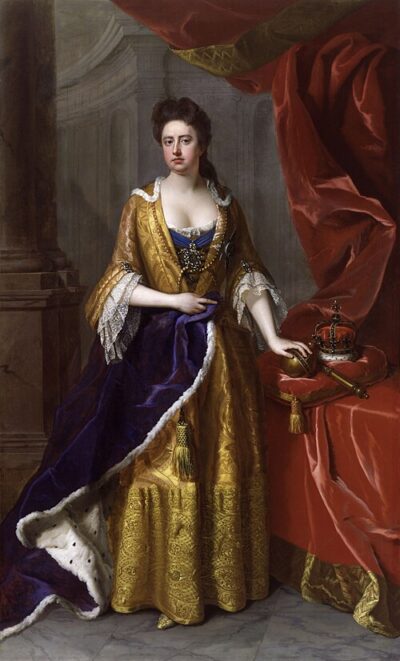
Anne of Great Britain
Anne of Great Britain was a Queen of Great Britain and Ireland from 1702 to 1714. Born February 6, 1665, in London. Died August 1, 1714, in London. Positions held include queen regnant (1702–1707), Monarch of England (1702–1707) and Monarch of Scotland (1702–1707). Awards include Knight Companion of the Order of the Thistle.
Facts
47 facts · 2 confirmed by two sources · 16 cited · 27 from one source · 2 where the sources disagree
What’s different
- Born in: we show London (Sources disagree). Wikidata also lists St James's Palace
- Died in: we show London (Sources disagree). Wikidata also lists Kensington Palace
Where this comes from
Papalocal keeps its own record. It started from these sources; what each one said is kept here as it was copied, so a change on their side never changes this page by itself. Tap one to read its version.
What Wikidata says · copied November 16, 2026 · revision 2568745888
- Described as
- Queen of Great Britain and Ireland from 1702 to 1714 (1665–1714)
- Other names
- The Lady Anne of England, Queen Anne of Great Britain, Anne, Queen of Ireland, Lady Anne Stuart, Anne, Lord of Ireland, Lady Anne of England, Anne, Queen of England, Anne, Queen of Scotland, Queen Anne, The Lady Anne Stuart, Anne Stuart
- Born
- February 6, 1665 · 2 references; February 6, 1665 · 2 references
- Died
- August 1, 1714 · 2 references; August 1, 1714 · 2 references
- Born in
- St James's Palace; London · 1 reference
- Died in
- Kensington Palace; London · 1 reference
- Buried in
- Westminster Abbey
- Cause of death
- stroke
- Citizen of
- Kingdom of Great Britain
- Occupation
- aristocrat; politician; queen regnant; ruler; statesperson; monarch
- Positions held
- queen regnant (1702–1707); Monarch of England (1702–1707); Monarch of Scotland (1702–1707); Monarch of Great Britain (1707–1714); King of Ireland (1702–1714); Lord High Admiral (1708)
- Awards
- Knight Companion of the Order of the Thistle (1702)
- Spouse
- Prince George, Duke of Cumberland (1683–) · 3 references
- Children
- Prince William, Duke of Gloucester · 1 reference; Mary Anne of Great Britain · 1 reference; first stillborn daughter of Anne of Great Britain · 1 reference; first stillborn son of Anne of Great Britain · 1 reference; Mary Oldenburg · 1 reference; Anne Sophia Oldenburg · 1 reference; second stillborn daughter of Anne of Great Britain · 1 reference; George Oldenburg · 1 reference; third stillborn son of Anne of Great Britain · 1 reference; third stillborn daughter of Anne of Great Britain · 1 reference; third miscarried child of Anne of Great Britain · 1 reference; fourth stillborn son of Anne of Great Britain · 1 reference
- Father
- James II of England · 3 references
- Mother
- Anne, Duchess of York · 2 references
- Siblings
- Louisa Maria Stuart; Henrietta FitzJames; Princess Isabel of York; Mary II of England · 1 reference; James FitzJames, 1st Duke of Berwick; Henry FitzJames; James Francis Edward Stuart, Prince of Wales; Prince James, Duke of Cambridge; Charles Stuart, Duke of Cambridge; Charles Stuart, Duke of Cambridge
- Religion
- Anglicanism
- Nickname
- Brandy Nan
- Wikipedias with a page
- 94
Wikidata item Q119702 (wikidata.org/wiki/Q119702), public domain (CC0). Copied November 16, 2026.
What Wikipedia says · copied November 16, 2026 · revision 1385531299
Anne (6 February 1665 – 1 August 1714) was Queen of England, Scotland, and Ireland from 8 March 1702, and Queen of Great Britain and Ireland following the ratification of the Acts of Union 1707 merging the kingdoms of England and Scotland, until her death in 1714.
Anne was born during the reign of her uncle King Charles II. Her father was Charles's younger brother and heir presumptive, James, whose suspected Roman Catholicism was unpopular in England. On Charles's instructions, Anne and her elder sister Mary were raised as Anglicans. Mary married her Dutch Protestant cousin, William III of Orange, in 1677, and Anne married Prince George of Denmark, a Lutheran, in 1683. On Charles's death in 1685, James succeeded to the throne, but three years later he was deposed in the Glorious Revolution of 1688. Mary and William became joint monarchs. Although the sisters had been close, disagreements over Anne's finances, status, and choice of acquaintances arose shortly after Mary's accession and they became estranged. William and Mary had no children. After Mary's death in 1694, William reigned alone until his own death in 1702, when Anne succeeded him.
During her reign, Anne favoured moderate Tory politicians, who were more likely to share her Anglican religious views than their opponents, the Whigs. The Whigs grew more powerful during the course of the War of the Spanish Succession, until 1710 when Anne dismissed many of them from office. Her close friendship with Sarah Churchill, Duchess of Marlborough, turned sour as the result of political differences. The Duchess took revenge with an unflattering description of the Queen in her memoirs, which was widely accepted by historians until Anne was reassessed in the late 20th century.
Anne was plagued by poor health throughout her life, and from her thirties she grew increasingly ill and obese. Despite 17 pregnancies, she died without surviving issue, and was the last monarch of the House of Stuart. The death of her young son, Prince William, precipitated a potential succession crisis. Under the Act of Settlement 1701, which excluded all Catholics from the succession, Anne was succeeded by her second cousin George I, of the German House of Hanover.
- Born, in its opening lines
- February 6, 1665
- Died, in its opening lines
- August 1, 1714
From the Wikipedia article “Anne, Queen of Great Britain” (en.wikipedia.org/wiki/Anne,_Queen_of_Great_Britain), by its contributors, under CC BY-SA 4.0 (creativecommons.org/licenses/by-sa/4.0/). Copied November 16, 2026; not changed.
Confirmed Two sources agree. Cited One source, and it names where it got it. One source One source, without a reference of its own. Sources disagree The sources disagree. We show the best-supported value and keep theirs below.
