
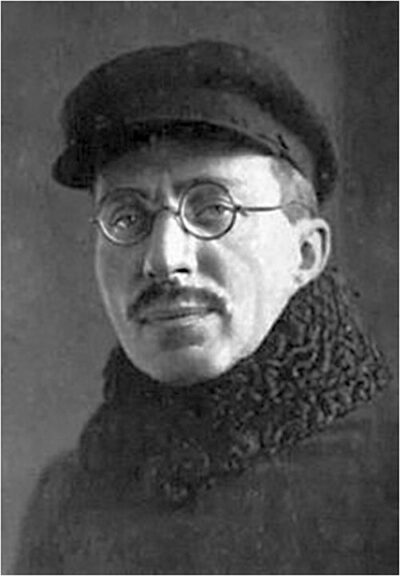
Anton Makarenko
Anton Makarenko was an Ukrainian and Soviet educator and writer. Born March 13, 1888, in Bilopillia. Died April 1, 1939, in Golitsyno. Known for The Pedagogical Poem. Educated at Poltava National Pedagogical University. Awards include Order of the Red Banner of Labour.
Facts
19 facts · 2 confirmed by two sources · 4 cited · 13 from one source
Where this comes from
Papalocal keeps its own record. It started from these sources; what each one said is kept here as it was copied, so a change on their side never changes this page by itself. Tap one to read its version.
What Wikidata says · copied November 16, 2026 · revision 2567482589
- Described as
- Ukrainian and Soviet educator and writer
- Other names
- Anton Semyonovich Makarenko, Anton Semenovich Makarenko
- Born
- March 13, 1888 · 5 references
- Died
- April 1, 1939 · 10 references
- Born in
- Bilopillia
- Died in
- Golitsyno
- Buried in
- Novodevichy Cemetery
- Cause of death
- heart failure
- Citizen of
- Soviet Union; Russian Empire
- Occupation
- pedagogue · 1 reference; educator; pedagogical writer; writer · 2 references; teacher · 1 reference
- Education
- Poltava National Pedagogical University
- Member of
- USSR Union of Writers
- Known for
- The Pedagogical Poem
- Awards
- Order of the Red Banner of Labour · 1 reference
- Siblings
- Vitaly Makarenko
- Website
- http://www.makarenko.edu.ru/
- Wikipedias with a page
- 56
Wikidata item Q297448 (wikidata.org/wiki/Q297448), public domain (CC0). Copied November 16, 2026.
What Wikipedia says · copied November 16, 2026 · revision 1371337755
Anton Semyonovich Makarenko (Russian: Анто́н Семёнович Мака́ренко, Ukrainian: Антон Семенович Макаренко, romanized: Anton Semenovych Makarenko; 13 March [O.S. 1 March] 1888 – 1 April 1939), was a Soviet educator, social worker and writer. He became the most influential educational theorist in the Soviet Union; along with promoting principles in educational theory and practice. As one of the founders of Soviet pedagogy, he elaborated the theory and methodology of upbringing in self-governing child collectives and introduced the concept of productive labor into the educational system. Makarenko's books have appeared in many countries.
In the aftermath of the Revolution of 1917, he established self-supporting orphanages for street children — including juvenile delinquents — left orphaned by the Russian Civil War of 1917-1923. These establishments included the Gorky Colony and later the Dzerzhinsky labor commune (where the FED camera was produced) in Kharkiv. Makarenko wrote several books, of which The Pedagogical Poem (Педагогическая поэма; published in English as The Road to Life), a fictionalized story of the Gorky Colony, became especially popular in the Soviet Union. A 1955 Soviet movie with English title Road to Life was based on this book. Makarenko died under unclear circumstances in 1939.
In 1988 UNESCO ranked Makarenko as one of four educators (along with John Dewey, Georg Kerschensteiner, and Maria Montessori) who determined the world's pedagogical thinking of the 20th century.
- Born, in its opening lines
- March 13, 1888
- Died, in its opening lines
- April 1, 1939
From the Wikipedia article “Anton Makarenko” (en.wikipedia.org/wiki/Anton_Makarenko), by its contributors, under CC BY-SA 4.0 (creativecommons.org/licenses/by-sa/4.0/). Copied November 16, 2026; not changed.
Confirmed Two sources agree. Cited One source, and it names where it got it. One source One source, without a reference of its own. Sources disagree The sources disagree. We show the best-supported value and keep theirs below.
