
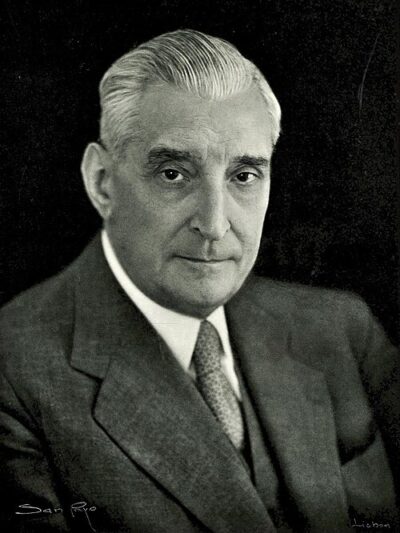
António de Oliveira Salazar
António de Oliveira Salazar was a Prime Minister of Portugal. Born April 28, 1889, in Freguesia de Vimieiro. Died July 27, 1970, in Lisbon. Positions held include Prime Minister of Portugal (1932–1968) and Interim President of the Portuguese Republic (1951). Educated at University of Coimbra. Awards include Collar of the Order of Isabella the Catholic, Knight Grand Cross with Collar of the Order of Alfonso X and Grand Collar of the Order of Prince Henry.
Facts
31 facts · 2 confirmed by two sources · 12 cited · 17 from one source
Where this comes from
Papalocal keeps its own record. It started from these sources; what each one said is kept here as it was copied, so a change on their side never changes this page by itself. Tap one to read its version.
What Wikidata says · copied November 16, 2026 · revision 2562786242
- Described as
- Prime Minister of Portugal (1889-1970)
- Other names
- Antonio de Oliveira Salazar
- Born
- April 28, 1889 · 9 references
- Died
- July 27, 1970 · 9 references
- Born in
- Freguesia de Vimieiro
- Died in
- Lisbon · 2 references
- Buried in
- Santa Comba Dão
- Cause of death
- pulmonary embolism
- Citizen of
- Portugal; Kingdom of Portugal
- Occupation
- economist; politician · 1 reference; pedagogue; university teacher; Master's Degree in Economics · 1 reference; jurist · 1 reference; head of government · 1 reference; author · 1 reference
- Positions held
- Prime Minister of Portugal (1932–1968); Interim President of the Portuguese Republic (1951)
- Political party
- National Union; Catholic Centre Party · 1 reference
- Worked for
- University of Coimbra
- Education
- University of Coimbra
- Awards
- Collar of the Order of Isabella the Catholic (1939) · 2 references; Knight Grand Cross with Collar of the Order of Alfonso X (1949) · 1 reference; Grand Collar of the Order of Prince Henry · 1 reference; honorary doctor of the University of Madrid Complutense (1952); Grand Cross 1st class of the Order of Merit of the Federal Republic of Germany (1953); Grand Cross of the Military Order of the Tower and Sword · 1 reference; Grand Cross of the Military Order of Saint James of the Sword · 1 reference; Grand Cross of the Order of the Colonial Empire · 1 reference
- Religion
- Catholic Church
- Wikipedias with a page
- 94
Wikidata item Q151394 (wikidata.org/wiki/Q151394), public domain (CC0). Copied November 16, 2026.
What Wikipedia says · copied November 16, 2026 · revision 1385089725
António de Oliveira Salazar (28 April 1889 – 27 July 1970) was a Portuguese dictator, academic, and economist who served as the Prime Minister of Portugal from 1932 to 1968. Having come to power under the Ditadura Nacional ("National Dictatorship"), he reframed the regime as the corporatist Estado Novo ("New State"), with himself as dictator. The regime he created lasted until 1974, making it one of the longest-lived authoritarian dictatorships in modern Europe.
A political economy professor at the University of Coimbra, Salazar entered public life as finance minister with the support of President Óscar Carmona after the 28 May 1926 coup d'état. The military of 1926 saw themselves as the guardians of the nation in the wake of the instability and perceived failure of the First Republic, but they lacked the means to address the critical challenges of the hour. Armed with broad powers to restructure state finances, within one year Salazar balanced the budget and stabilised Portugal's currency, producing the first of many budgetary surpluses. In a period when authoritarian regimes elsewhere in Europe were merging political power with militarism, and leaders were adopting military titles and uniforms, Salazar enforced strict separation of the armed forces from politics. Salazar's aim was the de-politicisation of society, rather than the mobilisation of the populace.
Opposed to democracy, communism, socialism, syndicalism and liberalism, Salazar's rule was conservative, corporatist and Portuguese nationalist in nature; it was also opposed to capitalism, which it regarded as plutocratic in nature. Salazar distanced himself from Nazism and fascism, which he described as a "pagan Caesarism" that did not recognise legal, religious or moral limits. Throughout his life Salazar avoided populist rhetoric. He was generally opposed to the concept of political parties when, in 1930, he created the National Union. Salazar described and promoted the Union as a "non-party", and proclaimed that the National Union would be the antithesis of a political party. He promoted Catholicism but argued that the role of the Church was social, not political, and negotiated the Concordat of 1940 that kept the church at arm's length. One of the mottos of the Salazar regime was Deus, Pátria e Família ("God, Fatherland and Family"), although Catholicism was never the state religion. The doctrine of pluricontinentalism was the basis of Salazar's territorial policy, a conception of the Portuguese Empire as a unified state that spanned multiple continents. From the 1950s onward, during the later phase of Salazar’s rule, Portugal recorded sustained growth in GDP per capita and a decline in illiteracy. However, by the end of the Estado Novo in 1974, Portugal still had the lowest per capita income and the lowest literacy rate in Western Europe.
Salazar supported Francisco Franco in the Spanish Civil War and played a key role in keeping Portugal neutral during World War II, providing aid and assistance to the Allies, but also becoming the second receiver of Nazi gold. Despite being a dictatorship, Portugal under his rule took part in the founding of some international organisations. The country was one of the 12 founding members of the North Atlantic Treaty Organization (NATO) in 1949, joined the European Payments Union in 1950, and was one of the founding members of the European Free Trade Association (EFTA) in 1960; it was also a founding member of the Organisation for Economic Co-operation and Development in 1961. Under his rule, Portugal also became a member of the United Nations in 1955 and joined the General Agreement on Tariffs and Trade in 1961. The Portuguese Colonial War broke out in 1961, leading to the independence of Angola, Guinea-Bissau and Mozambique in 1974. The annexation of Goa by India also occurred in 1961.
With the Estado Novo enabling him to exercise vast political powers, Salazar used censorship and the PIDE secret police to quell opposition. One opposition leader, Humberto Delgado, who openly challenged Salazar's regime in the 1958 presidential election, was first exiled and became involved in several violent actions aimed at overthrowing the regime, including the hijacking of the Portuguese cruise liner Santa Maria and the Beja Revolt. These actions ultimately led to his assassination by the PIDE, in 1965. After Salazar fell into a coma in 1968, President Américo Tomás dismissed him from the position of President of the Council of Ministers. The Estado Novo collapsed during the Carnation Revolution of 1974, four years after Salazar's death.
- Born, in its opening lines
- April 28, 1889
- Died, in its opening lines
- July 27, 1970
From the Wikipedia article “António de Oliveira Salazar” (en.wikipedia.org/wiki/António_de_Oliveira_Salazar), by its contributors, under CC BY-SA 4.0 (creativecommons.org/licenses/by-sa/4.0/). Copied November 16, 2026; not changed.
Confirmed Two sources agree. Cited One source, and it names where it got it. One source One source, without a reference of its own. Sources disagree The sources disagree. We show the best-supported value and keep theirs below.
