
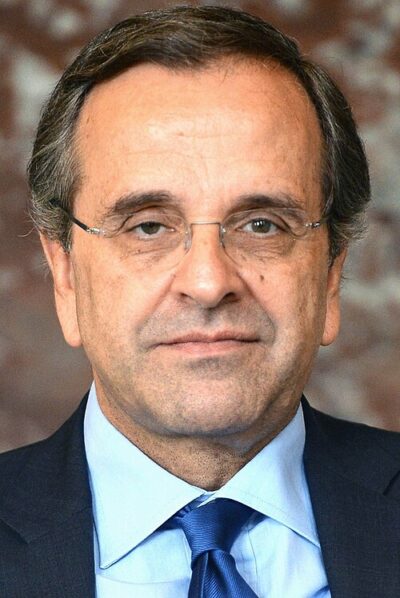
Antonis Samaras
Antonis Samaras is a Prime Minister of Greece. Born May 23, 1951, in Athens. Positions held include Prime Minister of Greece (2012–2015), Minister for Foreign Affairs of Greece (1989–1992) and Minister of Finance of Greece (1989). Educated at Harvard Business School and Amherst College.
Facts
28 facts · 1 confirmed by two sources · 5 cited · 22 from one source
Where this comes from
Papalocal keeps its own record. It started from these sources; what each one said is kept here as it was copied, so a change on their side never changes this page by itself. Tap one to read its version.
What Wikidata says · copied November 16, 2026 · revision 2569149391
- Described as
- Prime Minister of Greece (2012–2015)
- Other names
- Antonios C. Samaras, Antonis C. Samaras, Antoine Samaras
- Born
- May 23, 1951 · 6 references
- Born in
- Athens · 1 reference
- Citizen of
- Greece
- Occupation
- economist; politician · 3 references; diplomat; head of government · 1 reference
- Positions held
- Prime Minister of Greece (2012–2015); Minister for Foreign Affairs of Greece (1989–1992); Minister of Finance of Greece (1989); Minister of Culture of Greece (2009); Leader of the Opposition (2 times) (2009–2015); Member of the European Parliament (2004–2007) · 1 reference; President of the New Democracy (2009–2015); substitute member of the Parliamentary Assembly of the Council of Europe (1978) · 1 reference
- Political party
- independent politician (2024–); New Democracy (2 times) (1977–2024); Political Spring (1993–2004)
- Education
- Harvard Business School (–1976); Amherst College (–1974); Athens College (–1970)
- Spouse
- Georgia Kritikou (1990–)
- Children
- Lena Samara; Kostas Samaras
- Father
- Konstantinos Samaras
- Mother
- Lena Zannas
- Siblings
- Alexandros Samaras
- Religion
- Greek Orthodoxy
- Wikipedias with a page
- 56
Wikidata item Q57806 (wikidata.org/wiki/Q57806), public domain (CC0). Copied November 16, 2026.
What Wikipedia says · copied November 16, 2026 · revision 1382407008
Antonis Samaras (Greek: Αντώνης Σαμαράς, pronounced [anˈdonis samaˈɾas]; born 23 May 1951) is a Greek politician who served as Prime Minister of Greece from 2012 to 2015. A member of the New Democracy party, he was its president from 2009 until 2015. He also founded the Political Spring party, which he led as president from 1993 to 2004, when he returned to New Democracy. He has been Member of the Greek Parliament (MP) for Messenia since 2007, having previously served at the same role from 1977 to 1996. He was also a Member of the European Parliament for Greece from 2004 to 2007.
Samaras started his national political career as Minister of Finance in 1989; he served as Minister of Foreign Affairs from 1989 to 1992 (with a brief interruption in 1990) and Minister of Culture in 2009. Samaras was expelled from the ruling party in November 2024.
In September 1993, two New Democracy MPs defected from the parliamentary group, aligning with Samaras's party, causing Konstantinos Mitsotakis's government to lose its parliamentary majority and resign, triggering new elections. Samaras's role in the government's fall led to a complete rift between the two politicians, Mitsotakis and Samaras. In spite of this, he rejoined the party in 2004 and was elected to its leadership in a closely fought intra-party election in late 2009. He was the seventh party leader since it was founded in 1974.
In the years that followed, he remained a member of parliament representing the region of Messenia, until November 2024 when he was again expelled from the party's parliamentary group and from New Democracy, due to his criticism of the foreign policy of the government of Kyriakos Mitsotakis.
- Born, in its opening lines
- May 23, 1951
From the Wikipedia article “Antonis Samaras” (en.wikipedia.org/wiki/Antonis_Samaras), by its contributors, under CC BY-SA 4.0 (creativecommons.org/licenses/by-sa/4.0/). Copied November 16, 2026; not changed.
Confirmed Two sources agree. Cited One source, and it names where it got it. One source One source, without a reference of its own. Sources disagree The sources disagree. We show the best-supported value and keep theirs below.
