
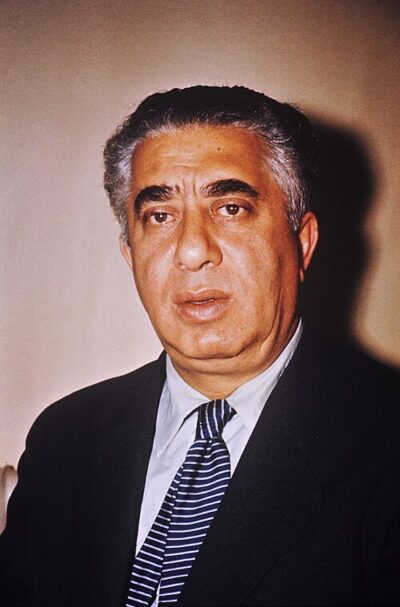
Aram Khachaturian
Aram Khachaturian was a Soviet Armenian composer. Born May 24, 1903, in Tbilisi. Died May 1, 1978, in Moscow. Positions held include deputy of the Supreme Soviet of the Soviet Union. Known for Piano Concerto and Masquerade. Educated at Moscow Conservatory and Lomonosov Moscow State University. Awards include Stalin Prize, 2nd degree, USSR State Prize and Order of Lenin (3 times).
Facts
61 facts · 1 confirmed by two sources · 11 cited · 47 from one source · 2 where the sources disagree
What’s different
- Born: we show May 24, 1903 (Sources disagree). Wikipedia says June 6, 1903
- Born in: we show Tbilisi (Sources disagree). Wikidata also lists Kojori
Where this comes from
Papalocal keeps its own record. It started from these sources; what each one said is kept here as it was copied, so a change on their side never changes this page by itself. Tap one to read its version.
What Wikidata says · copied November 16, 2026 · revision 2566531630
- Described as
- Soviet Armenian composer (1903–1978)
- Other names
- Aram Ilyich Khachaturian, Aram E. Khachaturyan, Aram Ilich Khachaturian
- Born
- May 24, 1903 · 3 references
- Died
- May 1, 1978 · 12 references
- Born in
- Tbilisi · 4 references; Kojori
- Died in
- Moscow · 6 references
- Buried in
- Komitas Pantheon
- Citizen of
- Soviet Union
- Occupation
- classical composer · 3 references; conductor · 3 references; music educator · 2 references; choreographer; musicologist; university teacher; pianist; film score composer
- Positions held
- deputy of the Supreme Soviet of the Soviet Union
- Political party
- Communist Party of the Soviet Union (1943–1978) · 1 reference
- Worked for
- Moscow Conservatory (1950–1978) · 2 references; Gnessin Russian Academy of Music (1950–1978)
- Education
- Moscow Conservatory (1929–1936); Lomonosov Moscow State University; Gnessin State Musical College (–1929); Gnessin Russian Academy of Music · 1 reference
- Member of
- Union of Soviet Composers; Academy of Arts of the GDR; Soviet Peace Committee (1962–1978) · 1 reference; National Academy of Sciences of Armenia (1963–) · 1 reference
- Genre
- art music · 1 reference; ballet · 1 reference; concerto · 1 reference; symphony · 1 reference; chamber music · 1 reference
- Instrument
- cello; piano · 1 reference; violin · 1 reference
- Known for
- Piano Concerto; Masquerade
- Awards
- Stalin Prize, 2nd degree (1941); USSR State Prize (1971); Order of Lenin (3 times) (1939, 1963, 1973); Hero of Socialist Labour (1973); Order of the October Revolution (1971); People's Artist of the USSR (1954); Lenin Prize (1959); Honored Art Worker of the Armenian SSR (1938); People's Artist of the Armenian SSR (1955); Medal "For the Defence of Moscow" (1944); Medal "For the Defence of the Caucasus" (1944); Medal "For Valiant Labour in the Great Patriotic War 1941–1945" (1945); Order of the Red Banner of Labour (2 times) (1945, 1966); State Stalin Prize, 1st degree (3 times) (1943, 1946, 1950); People's Artist of the RSFSR (1947)
- Field
- film score; art music; ballet · 3 references; symphony; chamber music · 3 references; incidental music · 3 references
- Spouse
- Nina Makarova (1933–1976)
- Siblings
- Suren Khachatryan
- Religion
- atheism
- Website
- http://www.khachaturian.am/
- Wikipedias with a page
- 80
Wikidata item Q152293 (wikidata.org/wiki/Q152293), public domain (CC0). Copied November 16, 2026.
What Wikipedia says · copied November 16, 2026 · revision 1382318074
Aram Ilyich Khachaturian (; 6 June [O.S. 24 May] 1903 – 1 May 1978) was a Soviet Armenian composer and conductor. He is considered one of the leading Soviet composers.
Born and raised in Tbilisi (now the capital of Georgia), he moved to Moscow in 1921 following the Sovietization of the Caucasus. Without prior music training, he enrolled in the Gnessin Musical Institute, and subsequently studied at the Moscow Conservatory in the class of Nikolai Myaskovsky, among others. His first major work, the Piano Concerto (1936), popularized his name within and outside the Soviet Union. It was followed by the Violin Concerto (1940) and the Cello Concerto (1946). His other significant compositions include the Masquerade Suite (1941), the Anthem of the Armenian SSR (1944), three symphonies (1935, 1943, 1947), and around 25 film scores. Khachaturian is best known for his ballet music: Gayane (1942) and Spartacus (1954). His most popular piece, the "Sabre Dance" from Gayane, has been used extensively in popular culture and has been performed by a number of musicians worldwide. His style is "characterized by colorful harmonies, captivating rhythms, virtuosity, improvisations, and sensuous melodies".
During most of his career, Khachaturian was approved by the Soviet government and held several high posts in the Union of Soviet Composers from the late 1930s, although he joined the Communist Party only in 1943. Along with Sergei Prokofiev and Dmitri Shostakovich, he was officially denounced as a "formalist" and his music dubbed "anti-people" in 1948 but was restored later that year. After 1950 he taught at the Gnessin Institute and the Moscow Conservatory and turned to conducting. He traveled to Europe, Latin America, and the United States with concerts of his own works. In 1957 Khachaturian became the Secretary of the Union of Soviet Composers, a position he held until his death.
Khachaturian composed the first Armenian ballet music, symphony, concerto, and film score. He is considered the most renowned Armenian composer of the 20th century. While following the established musical traditions of Russia, he broadly incorporated Armenian and, to a lesser extent, Caucasian, Eastern and Central European, and Middle Eastern peoples' folk music into his works. He is highly regarded in Armenia, where he is considered a "national treasure".
- Born, in its opening lines
- June 6, 1903
- Died, in its opening lines
- May 1, 1978
From the Wikipedia article “Aram Khachaturian” (en.wikipedia.org/wiki/Aram_Khachaturian), by its contributors, under CC BY-SA 4.0 (creativecommons.org/licenses/by-sa/4.0/). Copied November 16, 2026; not changed.
Confirmed Two sources agree. Cited One source, and it names where it got it. One source One source, without a reference of its own. Sources disagree The sources disagree. We show the best-supported value and keep theirs below.
