
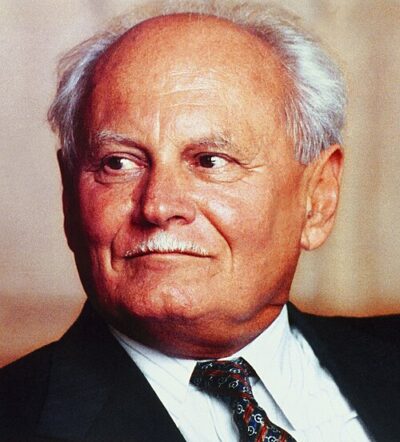
Árpád Göncz
Árpád Göncz was a Hungarian politician, writer, translator, President of Hungary. Born February 10, 1922, in Budapest. Died October 6, 2015, in Budapest. Positions held include member of the National Assembly of Hungary (1990), Speaker of the National Assembly of Hungary (1990) and President of Hungary (1990–2000). Educated at Eötvös Loránd University. Awards include Order of the White Eagle, Grand cross of the Order of the White Lion and József Attila Prize.
Facts
40 facts · 2 confirmed by two sources · 15 cited · 23 from one source
Where this comes from
Papalocal keeps its own record. It started from these sources; what each one said is kept here as it was copied, so a change on their side never changes this page by itself. Tap one to read its version.
What Wikidata says · copied November 16, 2026 · revision 2557797266
- Described as
- Hungarian politician, writer, translator, President of Hungary (1922-2015)
- Other names
- Arpad Goncz
- Born
- February 10, 1922 · 5 references
- Died
- October 6, 2015 · 6 references
- Born in
- Budapest · 1 reference
- Died in
- Budapest · 2 references
- Buried in
- Óbuda Cemetery · 2 references
- Citizen of
- Hungary
- Occupation
- politician · 1 reference; writer · 1 reference; translator · 1 reference; poet; lawyer
- Positions held
- member of the National Assembly of Hungary (1990); Speaker of the National Assembly of Hungary (1990); President of Hungary (1990–2000)
- Political party
- Alliance of Free Democrats · 1 reference
- Education
- Eötvös Loránd University (–1944) · 1 reference
- Member of
- Committee for Historical Justice; Hungarian Writers' Union; Hungarian PEN Club; Hungarian Tolkien Society
- Awards
- Order of the White Eagle; Grand cross of the Order of the White Lion (2003) · 1 reference; József Attila Prize (1983) · 1 reference; Grand Cross of the Legion of Honour (1997) · 1 reference; Collar of the Order of the Star of Romania; Golden Plate Award; Order of Freedom of the Republic of Slovenia; Grand Cross with Chain of the Order of Merit of the Republic of Hungary (civil); Knight Grand Cross of the Order of St. Olav; Grand Cross of the Order of the White Double Cross (2000) · 1 reference; Collar of the Order of the Cross of Terra Mariana (1997) · 1 reference; Grand Cross Special Class of the Order of Merit of the Federal Republic of Germany (2000); Knight Grand Cross with Collar of the Order of Merit of the Italian Republic (1991) · 1 reference; Grand Cross of the Order of Good Hope (1999) · 1 reference; Grand Star of the Decoration for Services to the Republic of Austria (1999) · 1 reference
- Spouse
- Mária Zsuzsanna Göntér
- Children
- Kinga Göncz · 1 reference
- Father
- Lajos Göncz
- Religion
- Catholic Church
- Website
- http://www.gonczarpad.hu
- Wikipedias with a page
- 49
Wikidata item Q102200 (wikidata.org/wiki/Q102200), public domain (CC0). Copied November 16, 2026.
What Wikipedia says · copied November 16, 2026 · revision 1378176126
Árpád Göncz (10 February 1922 – 6 October 2015) was a Hungarian writer, translator, lawyer and liberal politician who served as President of Hungary from 2 May 1990 to 4 August 2000. Göncz played a role in the Hungarian Revolution of 1956, for which he was imprisoned for six years. After his release, he worked as a translator of English-language literary works.
He was also a founding member of the Alliance of Free Democrats (SZDSZ) and Speaker of the National Assembly of Hungary (de facto head of state) before becoming president. He was Hungary's first freely elected head of state, as well as the first in 42 years who was not a communist or a fellow traveller.
He was a member of the international advisory council of the Victims of Communism Memorial Foundation.
- Born, in its opening lines
- February 10, 1922
- Died, in its opening lines
- October 6, 2015
From the Wikipedia article “Árpád Göncz” (en.wikipedia.org/wiki/Árpád_Göncz), by its contributors, under CC BY-SA 4.0 (creativecommons.org/licenses/by-sa/4.0/). Copied November 16, 2026; not changed.
Confirmed Two sources agree. Cited One source, and it names where it got it. One source One source, without a reference of its own. Sources disagree The sources disagree. We show the best-supported value and keep theirs below.
