
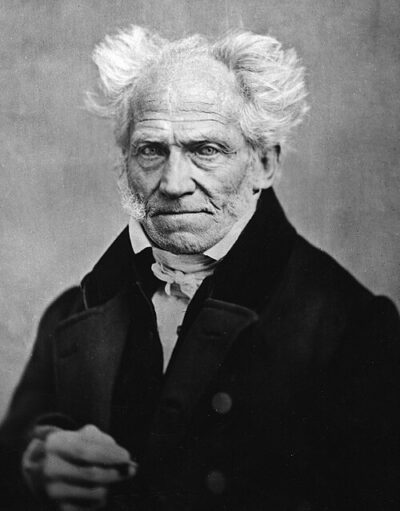
Arthur Schopenhauer
Arthur Schopenhauer was a German philosopher. Born February 22, 1788, in Gdańsk. Died September 21, 1860, in Frankfurt. Known for The World as Will and Representation and Parerga and Paralipomena. Educated at University of Göttingen and Humboldt-Universität zu Berlin.
Facts
32 facts · 2 confirmed by two sources · 10 cited · 20 from one source
Where this comes from
Papalocal keeps its own record. It started from these sources; what each one said is kept here as it was copied, so a change on their side never changes this page by itself. Tap one to read its version.
What Wikidata says · copied November 16, 2026 · revision 2568600421
- Described as
- German philosopher (1788-1860)
- Born
- February 22, 1788 · 15 references
- Died
- September 21, 1860 · 15 references
- Born in
- Gdańsk · 1 reference
- Died in
- Frankfurt · 4 references
- Buried in
- Frankfurt Main Cemetery · 1 reference
- Cause of death
- respiratory failure
- Citizen of
- Kingdom of Prussia
- Occupation
- university teacher · 1 reference; philosopher · 2 references; writer · 1 reference; musicologist; translator · 1 reference
- Worked for
- University of Berlin; Humboldt-Universität zu Berlin
- Education
- University of Göttingen (1809–); Humboldt-Universität zu Berlin (1811–); Ernestinum Gotha
- Instrument
- flute
- Known for
- The World as Will and Representation; Parerga and Paralipomena
- Field
- metaphysics; ethics; aesthetics; psychology; history of philosophy
- Father
- Heinrich Floris Schopenhauer · 1 reference
- Mother
- Johanna Schopenhauer · 1 reference
- Siblings
- Adele Schopenhauer · 1 reference
- Religion
- atheism · 1 reference
- Lived in
- Gdańsk; Hamburg; Frankfurt
- Wikipedias with a page
- 177
Wikidata item Q38193 (wikidata.org/wiki/Q38193), public domain (CC0). Copied November 16, 2026.
What Wikipedia says · copied November 16, 2026 · revision 1384925534
Arthur Schopenhauer (22 February 1788 – 21 September 1860), also known as the "Philosopher of Pessimism", was a German philosopher and writer. He is known for his 1818 work The World as Will and Representation (expanded in 1844), which characterizes the phenomenal world as the manifestation of a blind and irrational noumenal will. Building on the transcendental idealism of Immanuel Kant, Schopenhauer developed an atheistic, metaphysical and ethical system that rejected the contemporaneous ideas of German idealism.
Schopenhauer was among the first philosophers in the Western tradition to share and affirm significant tenets of Indian philosophy, such as asceticism, denial of the self, and the notion of the world-as-appearance. His work has been described as an exemplary manifestation of philosophical pessimism. Though his work failed to garner substantial attention during his lifetime, he had a posthumous impact across various disciplines, including philosophy, literature, and science. His writing on aesthetics, morality, and psychology has influenced many thinkers and artists.
- Born, in its opening lines
- February 22, 1788
- Died, in its opening lines
- September 21, 1860
From the Wikipedia article “Arthur Schopenhauer” (en.wikipedia.org/wiki/Arthur_Schopenhauer), by its contributors, under CC BY-SA 4.0 (creativecommons.org/licenses/by-sa/4.0/). Copied November 16, 2026; not changed.
Confirmed Two sources agree. Cited One source, and it names where it got it. One source One source, without a reference of its own. Sources disagree The sources disagree. We show the best-supported value and keep theirs below.
