
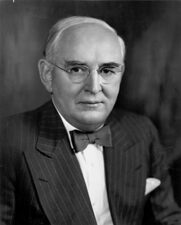
Arthur Vandenberg
Arthur Vandenberg was an American politician. Born March 22, 1884, in Grand Rapids. Died April 18, 1951, in Grand Rapids. Positions held include President pro tempore of the United States Senate (1947–1949), Republican Conference Chairman of the United States Senate (1945–1947) and United States senator (1928–1951). Educated at University of Michigan and University of Michigan Law School.
Facts
25 facts · 2 confirmed by two sources · 10 cited · 13 from one source
Where this comes from
Papalocal keeps its own record. It started from these sources; what each one said is kept here as it was copied, so a change on their side never changes this page by itself. Tap one to read its version.
What Wikidata says · copied November 18, 2026 · revision 2563950306
- Described as
- American politician (1884–1951)
- Other names
- Arthur H. Vandenberg, Arthur Hendrick Vandenberg
- Born
- March 22, 1884 · 5 references
- Died
- April 18, 1951 · 5 references
- Born in
- Grand Rapids · 1 reference
- Died in
- Grand Rapids · 1 reference
- Buried in
- Oakhill Cemetery · 1 reference
- Cause of death
- lung cancer
- Citizen of
- United States
- Occupation
- politician · 1 reference; publisher (1906–1928); newspaper editor (1906–1928); author; journalist · 1 reference
- Positions held
- President pro tempore of the United States Senate (1947–1949); Republican Conference Chairman of the United States Senate (1945–1947); United States senator (1928–1951) · 1 reference
- Political party
- Republican Party
- Education
- University of Michigan; University of Michigan Law School; primary school · 1 reference; Innovation Central High School · 1 reference
- Member of
- Delta Upsilon
- Field
- politics · 1 reference; journalism · 1 reference; publishing · 1 reference
- Religion
- Congregational churches
- Wikipedias with a page
- 18
Wikidata item Q4388292 (wikidata.org/wiki/Q4388292), public domain (CC0). Copied November 18, 2026.
What Wikipedia says · copied November 18, 2026 · revision 1383716124
Arthur Hendrick Vandenberg Sr. (March 22, 1884 – April 18, 1951) was an American politician who served as a United States senator from Michigan from 1928 to 1951. A member of the Republican Party, he participated in the creation of the United Nations. He is best known for leading the Republican Party from a foreign policy of isolationism to one of internationalism, and supporting the Cold War, the Truman Doctrine, the Marshall Plan, and NATO. He served as president pro tempore of the United States Senate from 1947 to 1949.
Born and raised in Grand Rapids, Michigan, in a family of Dutch Americans, Vandenberg began his career as a newspaper editor and publisher. In 1928, Republican governor Fred W. Green appointed Vandenberg to the U.S. Senate to fill the vacancy that arose after the death of Woodbridge N. Ferris. Vandenberg won election to a full term later that year and remained in the Senate until his death in 1951. He supported the early New Deal programs but came to oppose most of President Franklin D. Roosevelt's domestic policies. During the late 1930s, Vandenberg also opposed the United States' becoming involved in World War II and urged Roosevelt to reach an accommodation with Japan.
Vandenberg abandoned his isolationism after the Japanese attack on Pearl Harbor. He became chairman of the Senate Foreign Relations Committee in 1947 and supported Democratic president Harry Truman's Cold War policies, asserting that "politics stops at the water's edge." Vandenberg also served as the chairman of the Republican Senate Conference from 1945 to 1947 and as the president pro tempore of the Senate from 1947 to 1949. He unsuccessfully sought the Republican nomination for president in 1940 and 1948.
- Born, in its opening lines
- March 22, 1884
- Died, in its opening lines
- April 18, 1951
From the Wikipedia article “Arthur Vandenberg” (en.wikipedia.org/wiki/Arthur_Vandenberg), by its contributors, under CC BY-SA 4.0 (creativecommons.org/licenses/by-sa/4.0/). Copied November 18, 2026; not changed.
Confirmed Two sources agree. Cited One source, and it names where it got it. One source One source, without a reference of its own. Sources disagree The sources disagree. We show the best-supported value and keep theirs below.
