
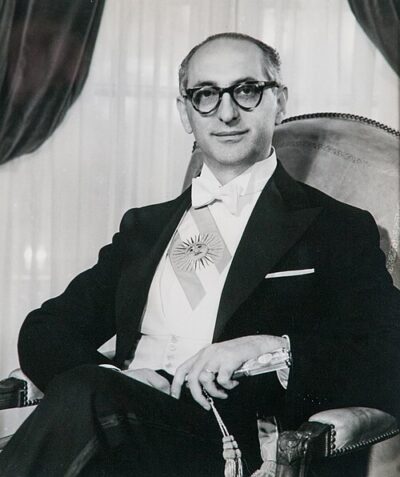
Arturo Frondizi
Arturo Frondizi was a President of Argentina. Born October 28, 1908, in Paso de los Libres. Died April 18, 1995, in Buenos Aires. Positions held include member of the Argentine Chamber of Deputies (1946–1951) and President of Argentina (1958–1962). Educated at Faculty of Law, Universidad de Buenos Aires and University of Buenos Aires. Awards include Knight Grand Cross with Collar of the Order of Merit of the Italian Republic, Collar of the Order of Isabella the Catholic and honorary doctor of the University of Madrid Complutense.
Facts
29 facts · 2 confirmed by two sources · 6 cited · 21 from one source
Where this comes from
Papalocal keeps its own record. It started from these sources; what each one said is kept here as it was copied, so a change on their side never changes this page by itself. Tap one to read its version.
What Wikidata says · copied November 16, 2026 · revision 2567396367
- Described as
- President of Argentina (1908–1995)
- Born
- October 28, 1908 · 5 references
- Died
- April 18, 1995 · 5 references
- Born in
- Paso de los Libres
- Died in
- Buenos Aires · 1 reference
- Buried in
- Olivos Cemetery
- Citizen of
- Argentina
- Occupation
- journalist; university teacher; lawyer; jurist · 1 reference; politician · 2 references
- Positions held
- member of the Argentine Chamber of Deputies (1946–1951); President of Argentina (1958–1962)
- Political party
- Radical Civic Union; Intransigent Radical Civic Union · 1 reference
- Education
- Faculty of Law, Universidad de Buenos Aires; University of Buenos Aires
- Awards
- Knight Grand Cross with Collar of the Order of Merit of the Italian Republic (1960) · 1 reference; Collar of the Order of Isabella the Catholic (1960) · 1 reference; honorary doctor of the University of Madrid Complutense (1960); Grand Cross Special Class of the Order of Merit of the Federal Republic of Germany (1960); Honorary doctor of the University of Ottawa
- Field
- law · 1 reference; politics · 1 reference
- Spouse
- Elena Frondizi
- Siblings
- Silvio Frondizi; Risieri Frondizi
- Religion
- Catholicism
- Website
- http://fundacionfrondizi.org.ar · 1 reference
- Wikipedias with a page
- 42
Wikidata item Q346658 (wikidata.org/wiki/Q346658), public domain (CC0). Copied November 16, 2026.
What Wikipedia says · copied November 16, 2026 · revision 1378163088
Arturo Frondizi Ércoli (Paso de los Libres, October 28, 1908 – Buenos Aires, April 18, 1995) was an Argentine lawyer, journalist, teacher, statesman, and politician. He was elected president of Argentina and governed from May 1, 1958, to March 29, 1962, when he was overthrown in a military coup. His government was characterized by its strong developmentalist policies (inspired by Rogelio Frigerio), that was less promoted by the State and more oriented to the development of heavy industry as a consequence of the entry of multinational companies.
A member of the Unión Cívica Radical (UCR) from the 1930s, Frondizi was one of the leaders who revived that party in the 1940s by founding the Intransigence and Renewal Movement, which opposed the military's role in politics. In 1946, he became national deputy for the city of Buenos Aires and unsuccessfully ran for vice president in the 1951 elections. After the Revolución Libertadora that overthrew President Juan Perón in 1955, Frondizi led the radical faction within the UCR that criticized the dictatorship against the faction led by Ricardo Balbín, which was closer to it. This led to the split of the party and the formation of the Intransigent Radical Civic Union (UCRI). Frondizi and Balbín faced off in the 1958 presidential elections with Peronism banned, and Frondizi won by a landslide, thanks to an agreement he or his entourage made with Perón, under circumstances that remain unclear.
Frondizi's labor, oil and education policies sparked sharp conflicts, with large demonstrations and strikes by the labor and student movements, as well as numerous attacks against the government. Frondizi responded by signing the Conintes Plan, which placed protesters under the jurisdiction of military tribunals and prohibited strikes. His foreign policy sought closer relations with the United States under John F. Kennedy, but maintained an independent line, supporting the Cuban Revolution, receiving Fidel Castro in Buenos Aires, and even meeting secretly with Che Guevara to try to mediate conflicts between the United States and Cuba, without success. He deepened international relations with Asian countries by making his first presidential visit to Indonesia, India, and Israel, and signed economic agreements with the Soviet Union. Following repeated pressures from the military, Frondizi was overthrown by a coup on March 29, 1962. He was detained by the military and prevented from participating in the 1963 elections.
During the National Reorganization Process, Frondizi maintained a wait-and-see attitude toward the military regime, while also being critical of some of the economic measures adopted by the regime. During the Falklands War in 1982, Frondizi and Raúl Alfonsín were the exception in the Argentine political landscape in opposing the conflict.
On April 18, 1995, Frondizi died of natural causes at the age of 86 in Buenos Aires.
- Born, in its opening lines
- October 28, 1908
- Died, in its opening lines
- April 18, 1995
From the Wikipedia article “Arturo Frondizi” (en.wikipedia.org/wiki/Arturo_Frondizi), by its contributors, under CC BY-SA 4.0 (creativecommons.org/licenses/by-sa/4.0/). Copied November 16, 2026; not changed.
Confirmed Two sources agree. Cited One source, and it names where it got it. One source One source, without a reference of its own. Sources disagree The sources disagree. We show the best-supported value and keep theirs below.
