
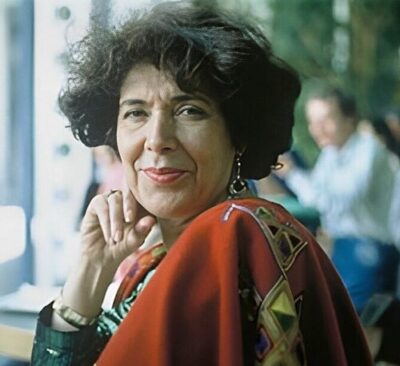
Assia Djebar
Assia Djebar was a French Algerian writer, translator and film director. Born June 30, 1936, in Cherchell. Died February 6, 2015, in 19th arrondissement of Paris. Positions held include Member of the Académie française (2005–2015). Known for La Femme sans sépulture, Nowhere in my Father's House and Fantasia: An Algerian Cavalcade. Educated at École Normale Supérieure and Lycée Fénelon, Paris. Awards include Commandeur des Arts et des Lettres, Neustadt International Prize for Literature and Peace Prize of the German Publishers' and Booksellers' Association.
Facts
35 facts · 2 confirmed by two sources · 20 cited · 13 from one source
Where this comes from
Papalocal keeps its own record. It started from these sources; what each one said is kept here as it was copied, so a change on their side never changes this page by itself. Tap one to read its version.
What Wikidata says · copied November 16, 2026 · revision 2565537496
- Described as
- French Algerian writer, translator and film director (1936-2015)
- Other names
- Fatima-Zohra Imalayen
- Born
- June 30, 1936 · 4 references
- Died
- February 6, 2015 · 6 references
- Born in
- Cherchell · 1 reference
- Died in
- 19th arrondissement of Paris · 1 reference
- Name at birth
- Fatima-Zohra Imalhayène · 1 reference
- Citizen of
- France · 1 reference; Algeria · 1 reference
- Occupation
- linguist; film director; professor · 1 reference; translator; writer · 1 reference; historian · 1 reference
- Positions held
- Member of the Académie française (2005–2015) · 1 reference
- Political party
- Workers' Party
- Worked for
- New York University · 1 reference; University of Algiers 1 · 1 reference
- Education
- École Normale Supérieure; Lycée Fénelon, Paris; École normale supérieure de jeunes filles
- Member of
- Académie Française (2005–2015) · 1 reference; Academie Royale de Langue et de littérature Françaises (1999–2015) · 1 reference
- Known for
- La Femme sans sépulture (2002) · 1 reference; Nowhere in my Father's House (2007) · 1 reference; Fantasia: An Algerian Cavalcade (1985) · 1 reference; Women of Algiers in Their Apartment (1980) · 1 reference
- Awards
- Commandeur des Arts et des Lettres; Neustadt International Prize for Literature (1996) · 1 reference; Peace Prize of the German Publishers' and Booksellers' Association (2000) · 1 reference; Knight of the Legion of Honour; Grand prix de la francophonie (1999) · 1 reference; honorary doctor of the University of Vienna · 1 reference; honorary doctorate of Concordia University · 1 reference; Prize of the Magazine Études françaises (1999) · 1 reference
- Spouse
- Malek Alloula · 1 reference
- Wikipedias with a page
- 63
Wikidata item Q157313 (wikidata.org/wiki/Q157313), public domain (CC0). Copied November 16, 2026.
What Wikipedia says · copied November 16, 2026 · revision 1371326893
Fatima-Zohra Imalayen (Arabic: فاطمة الزهراء إيمالاين; 30 June 1936 – 6 February 2015), known by her pen name Assia Djebar (Arabic: آسيا جبار), was an Algerian novelist, translator and filmmaker. Most of her works deal with obstacles faced by women, and she is noted for her feminist stance. She is "frequently associated with women's writing movements, her novels are clearly focused on the creation of a genealogy of Algerian women, and her political stance is virulently anti-patriarchal as much as it is anti-colonial." Djebar is considered to be one of North Africa's pre-eminent and most influential writers. She was elected to the Académie Française on 16 June 2005, the first writer from the Maghreb to achieve such recognition. For the entire body of her work she was awarded the 1996 Neustadt International Prize for Literature. She was often named as a contender for the Nobel Prize for Literature.
- Born, in its opening lines
- June 30, 1936
- Died, in its opening lines
- February 6, 2015
From the Wikipedia article “Assia Djebar” (en.wikipedia.org/wiki/Assia_Djebar), by its contributors, under CC BY-SA 4.0 (creativecommons.org/licenses/by-sa/4.0/). Copied November 16, 2026; not changed.
Confirmed Two sources agree. Cited One source, and it names where it got it. One source One source, without a reference of its own. Sources disagree The sources disagree. We show the best-supported value and keep theirs below.
