
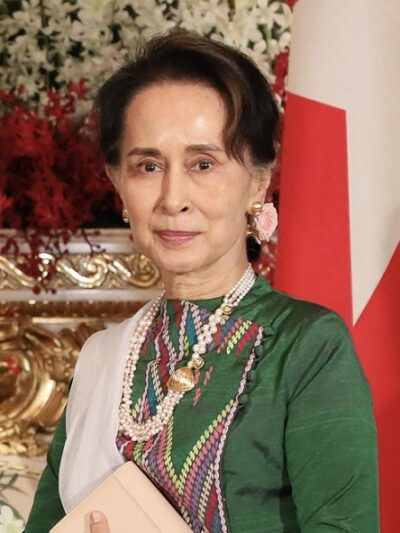
Aung San Suu Kyi
Aung San Suu Kyi is a former State Counsellor of Myanmar and Leader of the National League for Democracy. Born June 19, 1945, in Yangon. Positions held include chairperson, Minister of the President's Office (2016–) and Minister of Foreign Affairs (Myanmar) (2016–2021). Known for Freedom from Fear. Educated at Lady Shri Ram College for Women and Basic Education High School No. 1 Dagon. Awards include Nobel Peace Prize, Commander of the Legion of Honour and Sakharov Prize.
Facts
54 facts · 1 confirmed by two sources · 22 cited · 31 from one source
Where this comes from
Papalocal keeps its own record. It started from these sources; what each one said is kept here as it was copied, so a change on their side never changes this page by itself. Tap one to read its version.
What Wikidata says · copied November 16, 2026 · revision 2568666994
- Described as
- former State Counsellor of Myanmar and Leader of the National League for Democracy
- Other names
- aung hcan: cu. krany, Daw Aung San Suu Kyi, Daw Suu, Amay Suu, Dr. Suu Kyi, Ms. Suu Kyi, Miss Suu Kyi, The lady, Daw Aung San Su Kyi, Aung San Su Kyi
- Born
- June 19, 1945 · 10 references
- Born in
- Yangon · 1 reference
- Citizen of
- Myanmar
- Occupation
- politician · 1 reference; writer · 1 reference; human rights defender; foreign minister · 1 reference
- Positions held
- chairperson; Minister of the President's Office (2016–) · 1 reference; Minister of Foreign Affairs (Myanmar) (2016–2021) · 1 reference; Minister of Education (Myanmar) (2016) · 1 reference; Minister of Electric Power (Myanmar) (2016) · 1 reference; State Counsellor of Myanmar (2016–2021); Member of the House of Representatives of Burma
- Political party
- National League for Democracy
- Worked for
- United Nations
- Education
- Lady Shri Ram College for Women (1960–1964) · 1 reference; Basic Education High School No. 1 Dagon; St Hugh's College (1964–1967) · 1 reference; SOAS, University of London (1987–) · 1 reference; University of Delhi · 1 reference; Convent of Jesus and Mary
- Member of
- International Institute for Democracy and Electoral Assistance · 1 reference; ARTICLE 19; The Elders (2007–2012) · 1 reference; Club of Madrid (2008–)
- Known for
- Freedom from Fear · 1 reference
- Awards
- Nobel Peace Prize (1991) · 2 references; Commander of the Legion of Honour; Sakharov Prize (1990–2020) · 1 reference; Rafto Prize (1990); International Simón Bolívar Prize (1992) · 1 reference; Wallenberg Medal (2011); Congressional Gold Medal (2017); Václav Havel Prize (2012); Presidential Medal of Freedom (2000) · 1 reference; Olof Palme Prize (2005); UNESCO-Madanjeet Singh Prize (2002); Four Freedoms Award – Freedom from Fear; Chatham House Prize (2011); Giuseppe Motta Medal (2013); Gwangju Prize for Human Rights
- Spouse
- Michael Aris (1972–1999) · 1 reference
- Children
- Alexander Aris; Dannian Kim Arundel Aris
- Father
- Aung San · 1 reference
- Mother
- Khin Kyi · 1 reference
- Siblings
- Aung San Oo · 1 reference
- Religion
- Theravāda · 1 reference
- Lived in
- Inya Lake; New Delhi (1960–1964) · 1 reference; Oxford (1964–); New York City (1969–) · 1 reference; London
- Wikipedias with a page
- 172
Wikidata item Q36740 (wikidata.org/wiki/Q36740), public domain (CC0). Copied November 16, 2026.
What Wikipedia says · copied November 16, 2026 · revision 1385418946
Aung San Suu Kyi (born 19 June 1945) is a Burmese politician, diplomat, and author who served as the state counsellor of Myanmar and minister of foreign affairs from 2016 to 2021. She has served as the general secretary of the National League for Democracy (NLD) since the party's founding in 1988 and was registered as its chairperson while it was a legal party from 2011 to 2023. She played a vital role in Myanmar's transition from military junta to partial democracy in the 2010s. She has been widely described as the de facto leader of Myanmar from 2016 to 2021. She was awarded the 1991 Nobel Peace Prize.
The youngest daughter of Aung San, Father of the Nation of modern-day Myanmar, and Khin Kyi, Aung San Suu Kyi was born in Rangoon, British Burma. After graduating from the University of Delhi in 1964 and St Hugh's College, Oxford, in 1968, she worked at the United Nations for three years. She married Michael Aris in 1972, with whom she had two children. Aung San Suu Kyi rose to prominence in the 8888 Uprising of 8 August 1988 and became the General Secretary of the NLD, which she had newly formed with the help of several retired army officials who criticised the military junta. In the 1990 general election, the NLD won 81% of the seats in Parliament. Still, the results were nullified, as the State Peace and Development Council (SPDC), the military government, refused to hand over power, resulting in an international outcry. She had been detained before the elections and remained under house arrest for almost 15 of the 21 years from 1989 to 2010, becoming one of the world's most prominent political prisoners. In 1999, Time magazine named her one of the "Children of Gandhi" and his spiritual heir to nonviolence. She survived an assassination attempt in the 2003 Depayin massacre when at least 70 people associated with the NLD were killed.
Her party boycotted the 2010 general election, resulting in a decisive victory for the military-backed Union Solidarity and Development Party (USDP). Aung San Suu Kyi became a member of the Pyithu Hluttaw (House of Representatives) while her party won 43 of the 45 vacant seats in the 2012 by-elections. In the 2015 general election, her party won a landslide victory, taking 86% of the seats in the Pyidaungsu Hluttaw, well more than the 67% supermajority needed to ensure that its preferred candidates were elected president and vice president in the Presidential Electoral College. Although she was prohibited from becoming president owing to a clause in the Myanmar Constitution—her late husband and children are foreign citizens—she assumed the newly created role of State Counsellor of Myanmar, a role akin to a prime minister or a head of government.
When she ascended to the office of state counsellor, Aung San Suu Kyi drew criticism from several countries, organisations and figures over Myanmar's inaction in response to the Rohingya genocide in Rakhine State and refusal to acknowledge that the Tatmadaw (armed forces) had committed massacres. Under her leadership, Myanmar also drew criticism for prosecutions of journalists. In 2019, Aung San Suu Kyi appeared in the International Court of Justice where she defended the Myanmar military against allegations of genocide against the Rohingya people.
Aung San Suu Kyi, whose party had won the November 2020 general election, was arrested on 1 February 2021, after a coup d'état that returned the Tatmadaw to power and sparked protests across the country. Several charges were filed against her, and on 6 December 2021, she was sentenced to four years in prison on two of them. On 10 January 2022, she was sentenced to an additional four years on another set of charges. On 12 October 2022, she was convicted of two further charges of corruption. She was sentenced to two terms of three years' imprisonment to be served concurrently. On 30 December 2022, her trials ended with another conviction and an additional sentence of seven years' imprisonment for corruption. Aung San Suu Kyi's final sentence was of 33 years in prison, later reduced to 27 years. In 2026, the government further reduced her sentence and commuted it to house arrest. The United Nations, most European countries, and the United States condemned the arrests, trials, and sentences as politically motivated.
- Born, in its opening lines
- June 19, 1945
From the Wikipedia article “Aung San Suu Kyi” (en.wikipedia.org/wiki/Aung_San_Suu_Kyi), by its contributors, under CC BY-SA 4.0 (creativecommons.org/licenses/by-sa/4.0/). Copied November 16, 2026; not changed.
Confirmed Two sources agree. Cited One source, and it names where it got it. One source One source, without a reference of its own. Sources disagree The sources disagree. We show the best-supported value and keep theirs below.
