
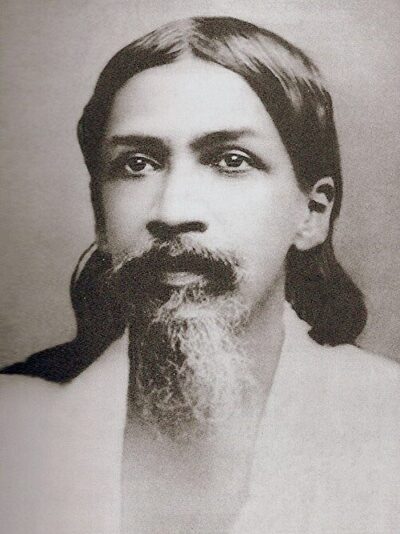
Aurobindo Ghosh
Aurobindo Ghosh was an Indian Bengali philosopher, yogi, maharishi, poet and nationalist. Born August 15, 1872, in Sri Aurobindo Bhawan. Died December 5, 1950, in Pondicherry. Known for Savitri, The Life Divine and The Synthesis of Yoga. Educated at St Paul's School and King's College.
Facts
40 facts · 2 confirmed by two sources · 5 cited · 33 from one source
Where this comes from
Papalocal keeps its own record. It started from these sources; what each one said is kept here as it was copied, so a change on their side never changes this page by itself. Tap one to read its version.
What Wikidata says · copied November 16, 2026 · revision 2568673848
- Described as
- Indian Bengali philosopher, yogi, maharishi, poet and nationalist (1872–1950)
- Other names
- Sri Aurobindo Ghose, Sri Orobindo, Orobindo Ghosh, Shri Aurobindo, Aurobindo Ghose, Aravinda Ackroyd Ghose, A.A.Ghosh, A.G., Maharshi Aravind Babu, Aurobindo, Sri Aurobindo
- Born
- August 15, 1872 · 8 references
- Died
- December 5, 1950 · 8 references
- Born in
- Sri Aurobindo Bhawan · 1 reference
- Died in
- Pondicherry
- Name at birth
- অরবিন্দ ঘোষ
- Citizen of
- British Raj (–1947); India (1950–) · 1 reference; Dominion of India (1947–1950)
- Occupation
- poet · 1 reference; translator; philosopher · 1 reference; essayist; writer; literary critic; professor (1897–); politician · 1 reference
- Worked for
- Maharaja Sayajirao University of Baroda
- Education
- St Paul's School (1884–1889); King's College; Loreto Convent
- Known for
- Savitri; The Life Divine; The Synthesis of Yoga; The Mother With Letters on the Mother; The Secret of the Veda; Isha Upanishad; Essays on the Gita
- Field
- philosophy; Integral yoga; poetry; yoga
- Spouse
- Mrinalini Devi
- Father
- Krishnadhan Ghosh
- Mother
- Swarnalata Devi
- Siblings
- Barindra Kumar Ghosh; Manmohan Ghose; Sarojini Ghosh; Benoy Bhushan Ghosh
- Religion
- Hinduism
- Website
- http://www.sriaurobindoashram.org
- Wikipedias with a page
- 102
Wikidata item Q192207 (wikidata.org/wiki/Q192207), public domain (CC0). Copied November 16, 2026.
What Wikipedia says · copied November 16, 2026 · revision 1384526803
Sri Aurobindo (born Aurobindo Ghosh; 15 August 1872 – 5 December 1950) was an Indian philosopher, yogi, and nationalist who is noted for his participation in the movement for India's independence from British rule; he advocated for complete autonomy through his writings and political activity. Following his imprisonment and acquittal, he withdrew to Pondicherry to devote himself to spiritual practice, eventually formulating the path of Integral Yoga. His extensive literary output includes the treatises The Life Divine and The Synthesis of Yoga and the epic poem Savitri.
Aurobindo studied for the Indian Civil Service at King's College, in Cambridge, England from 1890 until his departure in 1892. After returning to India, he took up various civil service work under the Maharaja of the princely state of Baroda. He became increasingly involved in nationalist politics in the Indian National Congress and the nascent revolutionary movement in Bengal with the Anushilan Samiti. He was arrested in the aftermath of a number of bombings linked to the revolutionary group he was associated with. He faced charges in a public trial for treason in the Alipore Conspiracy and was then released; after that, he moved to Pondicherry and developed a spiritual practice he called Integral Yoga. He wrote The Life Divine, which deals with the philosophical aspect of Integral Yoga and Synthesis of Yoga, which deals with the principles and methods of Integral Yoga. In 1926, he and Mirra Alfassa founded Sri Aurobindo Ashram.
Sri Aurobindo created a major literary corpus in English. His work synthesizes the histories of Eastern and Western philosophy, religion, literature, and psychology into a complex vision of the transition of humanity to divinity. His principal philosophical writings are The Life Divine and The Synthesis of Yoga, while his principal poetic work is Savitri: a Legend and a Symbol. He wrote translations and commentaries on the Vedas, Upanishads, and the Gita, among others; plays; literary, social, political, and historical criticism; devotional works; and an extensive collection of correspondence. Several volumes of his conversations have also been recorded.
- Born, in its opening lines
- August 15, 1872
- Died, in its opening lines
- December 5, 1950
From the Wikipedia article “Sri Aurobindo” (en.wikipedia.org/wiki/Sri_Aurobindo), by its contributors, under CC BY-SA 4.0 (creativecommons.org/licenses/by-sa/4.0/). Copied November 16, 2026; not changed.
Confirmed Two sources agree. Cited One source, and it names where it got it. One source One source, without a reference of its own. Sources disagree The sources disagree. We show the best-supported value and keep theirs below.
