
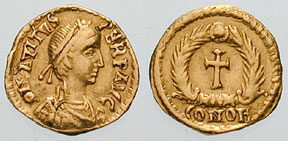
Avitus was a Roman Emperor (455–456). Born 395, in Clermont-Ferrand. Died August 18, 457, in Gaul. Positions held include Western Roman emperor (455–456), bishop and ancient Roman senator.
Facts
18 facts · 0 confirmed by two sources · 2 cited · 16 from one source
Where this comes from
Papalocal keeps its own record. It started from these sources; what each one said is kept here as it was copied, so a change on their side never changes this page by itself. Tap one to read its version.
What Wikidata says · copied November 16, 2026 · revision 2563579543
- Described as
- Roman Emperor (455–456) (395-457)
- Other names
- Eparchius Avitus, Marcus Flavius Maecilius Eparchius Avitus, Marcus Maecilius Flavius Eparchius Avitus, Marcus Maecilius, Flavius Maecilius, Marcus Maecilius Avithus
- Born
- 395 · 1 reference
- Died
- August 18, 457
- Born in
- Clermont-Ferrand
- Died in
- Gaul · 1 reference
- Buried in
- Brioude
- Citizen of
- Ancient Rome
- Occupation
- politician; Catholic priest; bishop · 1 reference
- Positions held
- Western Roman emperor (455–456); bishop; ancient Roman senator; Roman consul
- Children
- Papianilla; Ecdicius; Agricola
- Father
- Agricola
- Religion
- Catholic Church
- Wikipedias with a page
- 57
Wikidata item Q203198 (wikidata.org/wiki/Q203198), public domain (CC0). Copied November 16, 2026.
What Wikipedia says · copied November 16, 2026 · revision 1381445961
Eparchius Avitus (died 456/7) was Roman emperor of the Western Empire from July 455 to October 456. He was a senator of Gallic extraction and a high-ranking officer both in the civil and military administration, as well as Bishop of Piacenza.
He opposed the reduction of the Western Roman Empire to Italy alone, both politically and from an administrative point of view. For this reason, as Emperor he introduced several Gallic senators in the Imperial administration; this policy, however, was opposed by the senatorial aristocracy and by the people of Rome, who had suffered from the sack of the city by the Vandals in 455.
Avitus had a good relationship with the Visigoths, in particular with their king Theodoric II, who was a friend of his and who acclaimed Avitus Emperor. The possibility of a strong and useful alliance between the Visigoths and Romans faded, however, when Theodoric invaded Hispania at Avitus's behest, which rendered him unable to help Avitus against the rebel Roman generals who deposed him.
From the Wikipedia article “Avitus” (en.wikipedia.org/wiki/Avitus), by its contributors, under CC BY-SA 4.0 (creativecommons.org/licenses/by-sa/4.0/). Copied November 16, 2026; not changed.
Confirmed Two sources agree. Cited One source, and it names where it got it. One source One source, without a reference of its own. Sources disagree The sources disagree. We show the best-supported value and keep theirs below.
