
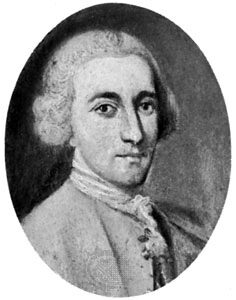
Baldassare Galuppi
Baldassare Galuppi was an Italian composer. Born October 18, 1706, in Burano. Died January 3, 1785, in Venice. Positions held include chapelmaster.
Facts
13 facts · 2 confirmed by two sources · 6 cited · 5 from one source
Where this comes from
Papalocal keeps its own record. It started from these sources; what each one said is kept here as it was copied, so a change on their side never changes this page by itself. Tap one to read its version.
What Wikidata says · copied November 16, 2026 · revision 2567356341
- Described as
- Italian composer (1706-1785)
- Other names
- Baldassarre, detto il Buranello Galuppi, Buranello
- Born
- October 18, 1706 · 7 references
- Died
- January 3, 1785 · 11 references
- Born in
- Burano · 1 reference
- Died in
- Venice · 3 references
- Citizen of
- Republic of Venice
- Occupation
- composer · 1 reference; organist; conductor · 1 reference
- Positions held
- chapelmaster
- Genre
- opera
- Instrument
- organ
- Field
- music · 1 reference; opera · 1 reference
- Wikipedias with a page
- 43
Wikidata item Q208338 (wikidata.org/wiki/Q208338), public domain (CC0). Copied November 16, 2026.
What Wikipedia says · copied November 16, 2026 · revision 1373517017
Baldassare Galuppi (18 October 1706 – 3 January 1785) was a Venetian composer, born on the island of Burano in the Venetian Republic. He belonged to a generation of composers, including Johann Adolph Hasse, Giovanni Battista Sammartini, and C. P. E. Bach, whose works are emblematic of the prevailing galant music that developed in Europe throughout the 18th century. He achieved international success, spending periods of his career in Vienna, London and Saint Petersburg, but his main base remained Venice, where he held a succession of leading appointments.
In his early career, Galuppi made a modest success in opera seria, but from the 1740s, together with the playwright and librettist Carlo Goldoni, he became famous throughout Europe for his comic operas in the new dramma giocoso style. To the succeeding generation of composers, he was known as "the father of comic opera". Some of his mature opere serie, for which his librettists included the poet and dramatist Metastasio, were also widely popular.
Throughout his career, Galuppi held official positions with charitable and religious institutions in Venice, the most prestigious of which was maestro di cappella at the Doge's chapel, St Mark's Basilica. In these various capacities, he composed a large amount of sacred music. He was also highly regarded as a virtuoso performer on and composer for keyboard instruments.
In the latter half of the 18th century, Galuppi's music was largely forgotten outside of Italy, and Napoleon's invasion of Venice in 1797 resulted in Galuppi's manuscripts being scattered around Western Europe, and in many cases, destroyed or lost. Galuppi's name persists in the English poet Robert Browning's 1855 poem "A Toccata of Galuppi's", but this has not helped maintain the composer's work in the general repertoire. Some of Galuppi's works were occasionally performed in the 200 years after his death, but it was not until the last years of the 20th century that his compositions were extensively revived in live performance and on recordings.
- Born, in its opening lines
- October 18, 1706
- Died, in its opening lines
- January 3, 1785
From the Wikipedia article “Baldassare Galuppi” (en.wikipedia.org/wiki/Baldassare_Galuppi), by its contributors, under CC BY-SA 4.0 (creativecommons.org/licenses/by-sa/4.0/). Copied November 16, 2026; not changed.
Confirmed Two sources agree. Cited One source, and it names where it got it. One source One source, without a reference of its own. Sources disagree The sources disagree. We show the best-supported value and keep theirs below.
