
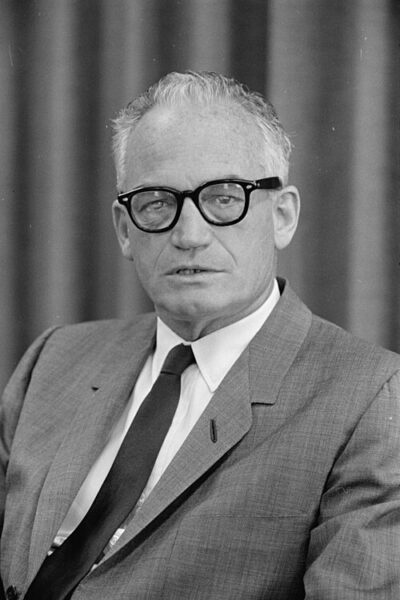
Barry Goldwater
Barry Goldwater was an American politician and military officer. Born January 2, 1909, in Phoenix. Died May 29, 1998, in Paradise Valley. Positions held include United States senator (2 times) (1953–1987) and senator. Known for The Conscience of a Conservative. Educated at University of Arizona and Arizona State University. Awards include Presidential Medal of Freedom, Harmon Trophy and Legionnaire of Legion of Merit.
Facts
27 facts · 2 confirmed by two sources · 8 cited · 17 from one source
Where this comes from
Papalocal keeps its own record. It started from these sources; what each one said is kept here as it was copied, so a change on their side never changes this page by itself. Tap one to read its version.
What Wikidata says · copied November 13, 2026 · revision 2565540018
- Described as
- American politician and military officer (1909–1998)
- Other names
- Barry Morris Goldwater
- Born
- January 2, 1909 · 4 references
- Died
- May 29, 1998 · 10 references
- Born in
- Phoenix · 1 reference
- Died in
- Paradise Valley · 1 reference
- Cause of death
- stroke
- Citizen of
- United States
- Occupation
- politician · 1 reference; military officer; photographer · 1 reference; businessperson · 1 reference; aircraft pilot · 1 reference
- Positions held
- United States senator (2 times) (1953–1987) · 1 reference; senator · 1 reference
- Political party
- Republican Party
- Education
- University of Arizona; Arizona State University; Staunton Military Academy
- Known for
- The Conscience of a Conservative
- Awards
- Presidential Medal of Freedom (1986) · 1 reference; Harmon Trophy; Legionnaire of Legion of Merit; National Aviation Hall of Fame (1982) · 1 reference; Langley Gold Medal (1987)
- Children
- Barry Goldwater Jr. · 2 references
- Religion
- Episcopal Church
- Military branch
- United States Air Force
- Military rank
- general
- Wikipedias with a page
- 51
Wikidata item Q319129 (wikidata.org/wiki/Q319129), public domain (CC0). Copied November 13, 2026.
What Wikipedia says · copied November 13, 2026 · revision 1385395517
Barry Morris Goldwater (January 2, 1909 – May 29, 1998) was an American politician and major general in the Air Force Reserve who served as a United States senator from Arizona from 1953 to 1965 and 1969 to 1987, and was the Republican nominee for president in the 1964 election.
Goldwater was born in Phoenix, Arizona, where he helped manage his family's department store. During World War II, he flew aircraft between the U.S. and India. After the war, Goldwater served in the Phoenix City Council. In 1952, he was elected to the U.S. Senate, where he rejected the legacy of the New Deal and, along with the conservative coalition, fought against the New Deal coalition. Goldwater also challenged his party's moderate to liberal wing on policy issues. He supported the Civil Rights Acts of 1957 and 1960 and the 24th Amendment to the U.S. Constitution but opposed the Civil Rights Act of 1964, disagreeing with Title II and Title VII. In the 1964 U.S. presidential election, Goldwater mobilized a large conservative constituency to win the Republican nomination, but then lost the general election to incumbent Democratic president Lyndon B. Johnson in a landslide.
Goldwater returned to the Senate in 1969 and specialized in defense and foreign policy. Along with representatives John Jacob Rhodes and Hugh Scott, he successfully urged president Richard Nixon to resign in 1974 when evidence of a cover-up in the Watergate scandal became overwhelming and impeachment was imminent. In 1986, he oversaw passage of the Goldwater–Nichols Act, which strengthened civilian authority in the U.S. Department of Defense. Near the end of his career, Goldwater's views on social and cultural issues grew increasingly libertarian.
Many political pundits and historians believe he laid the foundation for the conservative revolution to follow as the grassroots organization and conservative takeover of the Republican Party began a long-term realignment in American politics, which helped to bring about the presidency of Ronald Reagan in the 1980s. He also had a substantial impact on the American libertarian movement. After leaving the Senate, Goldwater became supportive of environmental protection, gay rights, including military service and adoption rights for same-sex couples, abortion rights, and the legalization of marijuana.
- Born, in its opening lines
- January 2, 1909
- Died, in its opening lines
- May 29, 1998
From the Wikipedia article “Barry Goldwater” (en.wikipedia.org/wiki/Barry_Goldwater), by its contributors, under CC BY-SA 4.0 (creativecommons.org/licenses/by-sa/4.0/). Copied November 13, 2026; not changed.
Confirmed Two sources agree. Cited One source, and it names where it got it. One source One source, without a reference of its own. Sources disagree The sources disagree. We show the best-supported value and keep theirs below.
