
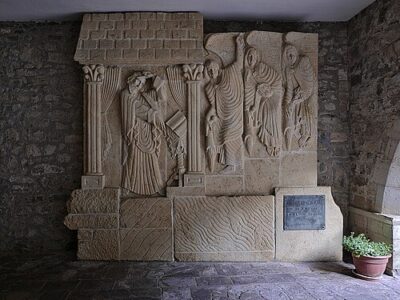
Beatus of Liébana
Beatus of Liébana was a Spanish saint and theologian. Born 731, in Liébana. Died February 19, 798, in Monastery of Santo Toribio de Liébana. Known for Saint-Sever Beatus.
Facts
12 facts · 0 confirmed by two sources · 5 cited · 5 from one source · 2 where the sources disagree
What’s different
- Born: we show 731 (Sources disagree). Wikidata also lists 8th century
- Died: we show February 19, 798 (Sources disagree). Wikidata also lists 800
Where this comes from
Papalocal keeps its own record. It started from these sources; what each one said is kept here as it was copied, so a change on their side never changes this page by itself. Tap one to read its version.
What Wikidata says · copied November 18, 2026 · revision 2568730876
- Described as
- Spanish saint and theologian
- Other names
- Beyo, San Beato de Liébana, Bieyo, Bieco, Sanctus Beatus Liebanensis, Beato de Liébana, Beato de Liévana, Sanctus Beatus, Beco, San Beato, Obeco, Beatus of Liebana
- Born
- 731 · 1 reference; 8th century · 1 reference
- Died
- February 19, 798 · 1 reference; 800 · 1 reference
- Born in
- Liébana
- Died in
- Monastery of Santo Toribio de Liébana
- Citizen of
- Kingdom of Asturias
- Occupation
- Catholic priest · 1 reference; monk · 1 reference; writer · 1 reference; theologian · 1 reference; illuminator · 1 reference
- Known for
- Saint-Sever Beatus
- Religion
- Catholic Church
- Wikipedias with a page
- 21
Wikidata item Q553113 (wikidata.org/wiki/Q553113), public domain (CC0). Copied November 18, 2026.
What Wikipedia says · copied November 18, 2026 · revision 1355566573
Beatus of Liébana (Spanish: Beato; c. 730 – c. after 785) was a monk, theologian, and author of the Commentary on the Apocalypse, mostly a compendium of previous authorities' views on the biblical Book of Revelation or Apocalypse of John. This had a local influence, mostly in the Iberian Peninsula, up to about the 13th century, but is today remembered mainly for the 27 surviving manuscript copies that are heavily illustrated in an often spectacular series of miniatures that are outstanding monuments of Mozarabic art. Examples include the Morgan Beatus and Saint-Sever Beatus; these are covered further at the article on the book. Most unusually for a work of Christian theology, it appears that Beatus always intended his book to be illustrated, and he is attributed with the original designs, and possibly the execution, of the first illustrations, which have not survived.
Aside from his work, almost nothing is known about Beatus. He was a monk and probably an abbot at the monastery of Santo Toribio de Liébana, Cantabria, in the Kingdom of Asturias, the only region of Spain remaining outside of Muslim control. It is thought that he was probably one the large number of monastic refugees who moved north, to lands remaining under Christian rule after the Muslim conquest of southern and central Spain. Beatus appears to have been well known by his contemporaries. He was a correspondent with the notable Christian scholar, Alcuin, and a confidant of queen Adosinda, daughter of Alfonso I of Asturias and wife of Silo of Asturias. He was present when Adosinda took her vows as a nun in 785, the last record we have of his life. A supposed biography, the Life of Beatus, has been identified as a 17th-century fraud with no historical value.
For Beatus, the observation and reading of such works was a sacred action, akin to communion. Beatus treats the reading of the book as the same as the body, and so by reading the book, the reader is one with Christ. He also led the opposition against a Spanish variant of Adoptionism, the heretical belief that Christ was the son of God by adoption, an idea first propounded in Spain by Elipandus, the bishop of Toledo.
An important, and enduring, influence of Beatus seems to be that he established the idea in Spain that Iberia had been converted by the Apostle James.
From the Wikipedia article “Beatus of Liébana” (en.wikipedia.org/wiki/Beatus_of_Liébana), by its contributors, under CC BY-SA 4.0 (creativecommons.org/licenses/by-sa/4.0/). Copied November 18, 2026; not changed.
Confirmed Two sources agree. Cited One source, and it names where it got it. One source One source, without a reference of its own. Sources disagree The sources disagree. We show the best-supported value and keep theirs below.
