
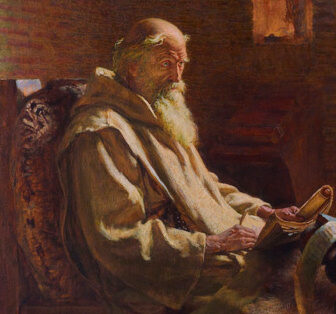
Bede was an Anglo-Saxon monk, writer and saint (672/3–735). Born 672, in Jarrow. Died May 25, 735, in Jarrow. Known for Ecclesiastical History of the English People, Chronica minora and The Reckoning of Time.
Facts
28 facts · 0 confirmed by two sources · 12 cited · 16 from one source
Where this comes from
Papalocal keeps its own record. It started from these sources; what each one said is kept here as it was copied, so a change on their side never changes this page by itself. Tap one to read its version.
What Wikidata says · copied November 16, 2026 · revision 2567828061
- Described as
- Anglo-Saxon monk, writer and saint (672/3–735)
- Other names
- Bede le Venerable, Beda Anglicus, Saint Bede the Venerable, Doctor of the English, Doctor Anglorum, Saint Bede, Bede the Venerable, Beda, Beda Venerabilis, Venerable Bede
- Born
- 672 · 2 references
- Died
- May 25, 735 · 2 references
- Born in
- Jarrow · 1 reference
- Died in
- Jarrow · 2 references
- Buried in
- Durham Cathedral · 1 reference
- Citizen of
- Kingdom of Northumbria
- Occupation
- hagiographer; poet; church historian; translator; theologian · 2 references; writer · 2 references; Bible translator; historian · 2 references
- Known for
- Ecclesiastical History of the English People · 1 reference; Chronica minora; The Reckoning of Time; On times; De natura rerum; De die iudicii; Sermons; Explanatio Apocalypsis; Commentarium super Lucam; Hexaemeron
- Field
- Christianity · 1 reference; history of Christianity · 1 reference; theology · 1 reference
- Religion
- Catholic Church
- Wikipedias with a page
- 87
Wikidata item Q154938 (wikidata.org/wiki/Q154938), public domain (CC0). Copied November 16, 2026.
What Wikipedia says · copied November 16, 2026 · revision 1385558442
Bede, OSB (; Old English: Bēda [ˈbeːdɑ]; 672/3 – 26 May 735), also known as the Venerable Bede or Bede the Venerable, was an English Benedictine monk, author and scholar. He was one of the best known writers during the Early Middle Ages, and his most famous work, Ecclesiastical History of the English People, gained him the title "The Father of English History". He served at the monastery of St Peter and its companion monastery of St Paul in the Kingdom of Northumbria of the Angles.
Born on lands belonging to the twin monastery of Monkwearmouth–Jarrow in present-day Tyne and Wear, England, Bede was sent to Monkwearmouth at the age of seven and later joined Abbot Ceolfrith at Jarrow. Both of them survived a plague that struck in 686 and killed the majority of the population there. While Bede spent most of his life in the monastery, he travelled to several abbeys and monasteries across the British Isles, even visiting the Archbishop of York and King Ceolwulf of Northumbria.
His theological writings were extensive and included a number of Biblical commentaries and other works of exegesis. Another important area of study for Bede was the academic discipline of computus, otherwise known to his contemporaries as the science of calculating calendar dates. One of the more important dates Bede tried to compute was Easter, an effort that was mired in controversy. He also helped to popularise the practice of dating forward from the birth of Christ (Anno Domini—in the year of our Lord), a practice which eventually became commonplace in medieval Europe. He is considered by many historians to be the most important scholar of antiquity for the period between the death of Pope Gregory I in 604 and the coronation of Charlemagne in 800. Bede was moreover a skilled linguist and translator, and his work made the Greek and Latin writings of the early Church Fathers much more accessible to his fellow Anglo-Saxons, which contributed significantly to English Christianity. Bede's monastery had access to a library that included works by Eusebius, Orosius, and many others.
A cult formed around Bede by the 10th century and was widespread in England by the fourteenth. His body was translated to Durham Cathedral in 1020 and placed in the same tomb as Saint Cuthbert, before being moved to an independent shrine in 1370. The shrine was demolished during the English Reformation, but Bede was reburied in the cathedral. In 1899, Pope Leo XIII canonised him and declared him a Doctor of the Church. He is the first native of Great Britain to achieve this designation.
From the Wikipedia article “Bede” (en.wikipedia.org/wiki/Bede), by its contributors, under CC BY-SA 4.0 (creativecommons.org/licenses/by-sa/4.0/). Copied November 16, 2026; not changed.
Confirmed Two sources agree. Cited One source, and it names where it got it. One source One source, without a reference of its own. Sources disagree The sources disagree. We show the best-supported value and keep theirs below.
