
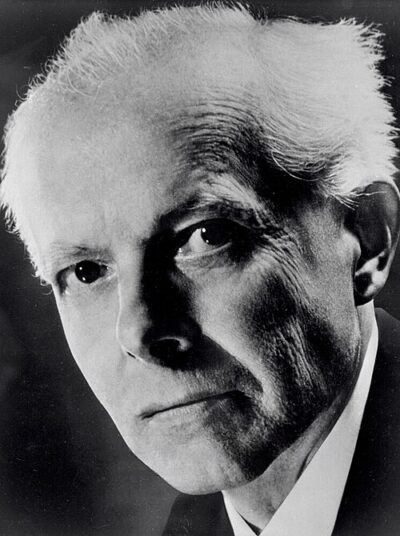
Béla Bartók
Béla Bartók was a Hungarian composer and pianist. Born March 25, 1881, in Sânnicolau Mare. Died September 26, 1945, in New York City. Positions held include member of the Provisional National Assembly (1945). Known for Bluebeard's Castle, String Quartet No. 2 and String Quartet No. 1. Educated at Franz Liszt Academy of Music and Gymnasium Grösslingová. Awards include Kossuth Prize, Grammy Trustees Award and Knight of the Legion of Honour.
Facts
50 facts · 2 confirmed by two sources · 14 cited · 34 from one source
Where this comes from
Papalocal keeps its own record. It started from these sources; what each one said is kept here as it was copied, so a change on their side never changes this page by itself. Tap one to read its version.
What Wikidata says · copied November 13, 2026 · revision 2568730783
- Described as
- Hungarian composer and pianist (1881–1945)
- Other names
- Béla Viktor János Bartók, Bela Bartok, Bela Bartók, Bartók, Bartok, Béla Bartok
- Born
- March 25, 1881 · 16 references
- Died
- September 26, 1945 · 16 references
- Born in
- Sânnicolau Mare · 1 reference
- Died in
- New York City · 3 references
- Buried in
- Ferncliff Cemetery (1945–1988); Farkasréti Cemetery (1988–) · 1 reference
- Cause of death
- leukemia · 1 reference
- Citizen of
- Hungary · 1 reference; United States (1945–) · 1 reference
- Occupation
- composer · 2 references; classical pianist; choreographer; music educator; ethnomusicologist · 1 reference; university teacher; collector of folk music; musician · 1 reference
- Positions held
- member of the Provisional National Assembly (1945) · 1 reference
- Political party
- independent politician
- Worked for
- Franz Liszt Academy of Music; Nyugat
- Education
- Franz Liszt Academy of Music (1899–1903) · 1 reference; Gymnasium Grösslingová
- Member of
- Hungarian Academy of Sciences (1935–1945); Romanian Academy
- Genre
- opera; classical music
- Instrument
- piano
- Known for
- Bluebeard's Castle; String Quartet No. 2; String Quartet No. 1; Sonata for Two Pianos and Percussion; Music for Strings, Percussion and Celesta; Concerto for Orchestra
- Awards
- Kossuth Prize (1948); Grammy Trustees Award (1984); Knight of the Legion of Honour (1930) · 1 reference; Honorary Member of the International Society for Contemporary Music
- Field
- music · 1 reference; traditional folk music · 1 reference; musicology · 1 reference; etnomusicology · 1 reference
- Spouse
- Ditta Pásztory-Bartók (1923–1945); Márta Ziegler (1909–1923)
- Children
- Péter Bartók; Béla Bartók · 1 reference
- Father
- Béla Bartók
- Mother
- Paula Voit
- Religion
- Unitarianism
- Website
- http://www.bartok.hu · 1 reference
- Wikipedias with a page
- 105
Wikidata item Q83326 (wikidata.org/wiki/Q83326), public domain (CC0). Copied November 13, 2026.
What Wikipedia says · copied November 13, 2026 · revision 1384232064
Béla Viktor János Bartók (; Hungarian: [ˈbɒrtoːk ˈbeːlɒ]; 25 March 1881 – 26 September 1945) was a Hungarian composer, pianist and ethnomusicologist. He is considered one of the most important composers of the 20th century; he and Franz Liszt are regarded as Hungary's greatest composers. Among his notable works are the opera Bluebeard's Castle, the ballet The Miraculous Mandarin, Music for Strings, Percussion and Celesta, the Concerto for Orchestra and six string quartets. Through his collection and analytical study of folk music, he was one of the founders of comparative musicology, which later became known as ethnomusicology. Per Anthony Tommasini, Bartók "has empowered generations of subsequent composers to incorporate folk music and classical traditions from whatever culture into their works," and was "a formidable modernist who in the face of Schoenberg’s breathtaking formulations showed another way, forging a language that was an amalgam of tonality, unorthodox scales and atonal wanderings." His work is often described as being a combination of traditional peasants' folk music and avant-garde music.
- Born, in its opening lines
- March 25, 1881
- Died, in its opening lines
- September 26, 1945
From the Wikipedia article “Béla Bartók” (en.wikipedia.org/wiki/Béla_Bartók), by its contributors, under CC BY-SA 4.0 (creativecommons.org/licenses/by-sa/4.0/). Copied November 13, 2026; not changed.
Confirmed Two sources agree. Cited One source, and it names where it got it. One source One source, without a reference of its own. Sources disagree The sources disagree. We show the best-supported value and keep theirs below.
