
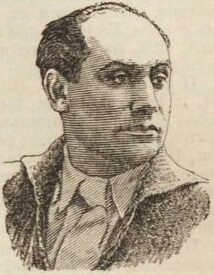
Béla Illés
Béla Illés was a Hungarian left-wing writer. Born March 22, 1895, in Košice. Died January 5, 1974, in Budapest. Positions held include editor-in-chief. Educated at Eötvös Loránd University. Awards include Kossuth Prize (2 times) and Order of the Red Star.
Facts
15 facts · 0 confirmed by two sources · 6 cited · 9 from one source
Where this comes from
Papalocal keeps its own record. It started from these sources; what each one said is kept here as it was copied, so a change on their side never changes this page by itself. Tap one to read its version.
What Wikidata says · copied November 18, 2026 · revision 2567355001
- Described as
- Hungarian left-wing writer
- Other names
- Bela Illes
- Born
- March 22, 1895 · 1 reference
- Died
- January 5, 1974 · 1 reference
- Born in
- Košice · 1 reference
- Died in
- Budapest · 1 reference
- Buried in
- Fiume Road Graveyard · 1 reference
- Citizen of
- Hungary
- Occupation
- journalist · 1 reference; writer · 1 reference
- Positions held
- editor-in-chief
- Political party
- Communist Party of the Soviet Union
- Worked for
- Nyugat
- Education
- Eötvös Loránd University (–1916)
- Member of
- Russian Association of Proletarian Writers
- Awards
- Kossuth Prize (2 times) (1950, 1955); Order of the Red Star (1945)
- Wikipedias with a page
- 21
Wikidata item Q374605 (wikidata.org/wiki/Q374605), public domain (CC0). Copied November 18, 2026.
What Wikipedia says · copied November 18, 2026 · revision 1351304265
Béla Illés (Born: Béla Lipner from Kassa, Austria-Hungary; now Košice, Slovakia), March 22, 1895 – Budapest, January 5, 1974) was a Hungarian left-wing and Communist writer and journalist of Jewish descent, who spent over 20 years of his life in exile in the Soviet Union. In 1945 he returned to Hungary in Soviet uniform as a major in the Red Army.
In now Communist Hungary, he was not particularly appreciated by the Minister of Culture, József Révai, nor by György Lukács. However, he was used as a writer of articles intended for the masses glorifying the communist system and the Soviet Union. He himself took the model role for literary Socialist realism. He was awarded the Kossuth Prize twice, in 1950 and 1956. In 1948, he came up with the (almost certainly fictional) story of the Belarusian cavalry captain Alexei Gusev, who had opposed the tsarist intervention in the suppression of the 1848 revolution in Hungary in 1848, and had been executed for it in Minsk along with six companions. In 1948, a Hungarian delegation travelled to the Soviet Union to pay their respects at the graves of Gusev and his companions. However, the graves and the archival documents cited by Illés were nowhere to be found. (Illés claimed he had found information about Gusev in the Minsk archives. However, the archives were burnt to the ground during the Second World War, so there was nothing left to research.) Although Béla Illés never admitted to the forgery, historians saw it as proven by the mid-1950s. However, in contemporary Communist propaganda, Gusev became a symbol of the (purported) centuries-old Russian-Hungarian and then Soviet-Hungarian "friendship", coincidentally with the centennial of the 1848 revolution, which was celebrated in Hungary on a grand scale. His writing was printed en masse, and streets were named after Gusev.
From the Wikipedia article “Béla Illés (writer)” (en.wikipedia.org/wiki/Béla_Illés_(writer)), by its contributors, under CC BY-SA 4.0 (creativecommons.org/licenses/by-sa/4.0/). Copied November 18, 2026; not changed.
Confirmed Two sources agree. Cited One source, and it names where it got it. One source One source, without a reference of its own. Sources disagree The sources disagree. We show the best-supported value and keep theirs below.
