
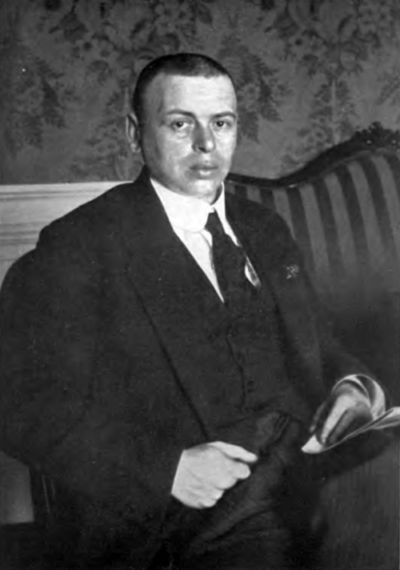
Béla Kun
Béla Kun was a Hungarian Communist revolutionary and politician, the de facto leader of the Hungarian Soviet Republic in 1919, People's Commissar of Foreign Affairs. Born February 20, 1886, in Cehu Silvaniei. Died August 29, 1938, in Moscow. Positions held include People's Commissar (1919) and member of ECCI (1921–). Educated at Franz Joseph University and Calvinist College in Zilah.
Facts
26 facts · 2 confirmed by two sources · 9 cited · 15 from one source
Where this comes from
Papalocal keeps its own record. It started from these sources; what each one said is kept here as it was copied, so a change on their side never changes this page by itself. Tap one to read its version.
What Wikidata says · copied November 16, 2026 · revision 2562969716
- Described as
- Hungarian Communist revolutionary and politician, the de facto leader of the Hungarian Soviet Republic in 1919, People's Commissar of Foreign Affairs
- Other names
- Béla Kohn, Emmerich Schwarz, Elemér Schwarz, Imre Schwarz, Bela Kun, Bela Kohn, Elemer Schwarz
- Born
- February 20, 1886 · 2 references
- Died
- August 29, 1938 · 1 reference
- Born in
- Cehu Silvaniei · 2 references
- Died in
- Moscow · 2 references
- Buried in
- Kommunarka shooting ground
- Cause of death
- execution
- Name at birth
- Kohn Béla
- Citizen of
- Hungary; Soviet Union
- Occupation
- politician · 1 reference; diplomat; journalist · 1 reference; communist · 1 reference; revolutionary · 1 reference; author · 1 reference; reserve officer · 1 reference
- Positions held
- People's Commissar (1919) · 1 reference; member of ECCI (1921–)
- Political party
- Communist Party of Hungary; Communist Party of the Soviet Union
- Education
- Franz Joseph University (–1904); Calvinist College in Zilah (–1902)
- Spouse
- Irén Gál
- Children
- Ágnes Kun; Miklós Kun
- Religion
- atheism
- Wikipedias with a page
- 60
Wikidata item Q151646 (wikidata.org/wiki/Q151646), public domain (CC0). Copied November 16, 2026.
What Wikipedia says · copied November 16, 2026 · revision 1383396641
Béla Kun (Hungarian: Kun Béla, born Béla Kohn; 20 February 1886 – 29 August 1938) was a Hungarian communist revolutionary and politician who in 1919 governed the Hungarian Soviet Republic.
After attending Franz Joseph University at Kolozsvár (today Cluj-Napoca, Romania), Kun had worked as a journalist until World War I. He served in the Austro-Hungarian Army, was captured by the Imperial Russian Army in 1916, and was sent to a prisoner-of-war camp in the Ural Mountains. In Russia, Kun embraced communist ideas, and in 1918 in Moscow he co-founded a Hungarian arm of the Russian Communist Party. He befriended Vladimir Lenin and fought for the Bolsheviks in the Russian Civil War.
In November 1918 Kun returned to Hungary with Soviet support and set up the Party of Communists in Hungary. Adopting Lenin's tactics, he agitated against the government of Mihály Károlyi and achieved great popularity despite being imprisoned. After his release in March 1919, Kun led a successful coup d'état, formed a Communist-Social Democratic coalition government, and proclaimed a Hungarian Soviet Republic. Though the Republic's de jure leader was Prime Minister Sándor Garbai, de facto power was held by Foreign Minister Kun, who maintained direct contact with Lenin via radiotelegraph and received orders and advice from the Kremlin.
Four months later, the new regime collapsed in the face of a military offensive by the Kingdom of Romania. Kun fled to Soviet Russia, where from 1920 he worked as a functionary in the Communist International bureaucracy as head of the Crimean Revolutionary Committee. He organised and actively participated in the Red Terror in Crimea (1920–1921), following which he participated in the 1921 March Action, a failed Communist uprising in Germany.
During the late-1930s Great Purge, Kun was accused of Trotskyism and was arrested, interrogated, tried, and executed in quick succession. In 1956, following Joseph Stalin's death and the Soviet Union's de-Stalinization under Nikita Khrushchev, he was posthumously rehabilitated by the Soviet leadership.
- Born, in its opening lines
- February 20, 1886
- Died, in its opening lines
- August 29, 1938
From the Wikipedia article “Béla Kun” (en.wikipedia.org/wiki/Béla_Kun), by its contributors, under CC BY-SA 4.0 (creativecommons.org/licenses/by-sa/4.0/). Copied November 16, 2026; not changed.
Confirmed Two sources agree. Cited One source, and it names where it got it. One source One source, without a reference of its own. Sources disagree The sources disagree. We show the best-supported value and keep theirs below.
