
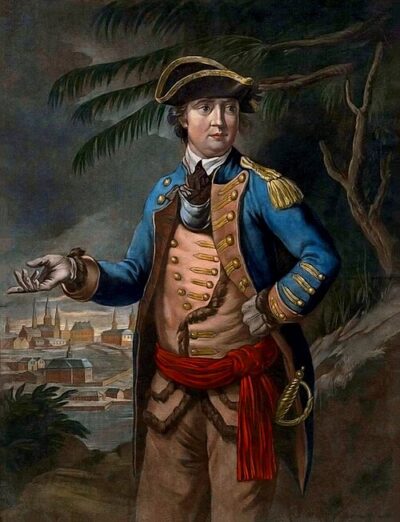
Benedict Arnold
Benedict Arnold was an army officer who betrayed America to the British during the Revolutionary War. Born January 14, 1741, in Norwich. Died June 14, 1801, in London. Positions held include commanding officer (1780–1783).
Facts
28 facts · 2 confirmed by two sources · 9 cited · 17 from one source
Where this comes from
Papalocal keeps its own record. It started from these sources; what each one said is kept here as it was copied, so a change on their side never changes this page by itself. Tap one to read its version.
What Wikidata says · copied November 13, 2026 · revision 2557808547
- Described as
- army officer who betrayed America to the British during the Revolutionary War (1740–1801)
- Other names
- B. Arnold
- Born
- January 14, 1741 · 5 references
- Died
- June 14, 1801 · 5 references
- Born in
- Norwich · 1 reference
- Died in
- London · 1 reference
- Buried in
- St Mary's Church, Battersea
- Cause of death
- edema
- Citizen of
- Kingdom of Great Britain (2 times) (1776–); United States (1776–1780)
- Occupation
- apothecary; merchant; military officer; military commander · 1 reference
- Positions held
- commanding officer (1780–1783)
- Member of
- Freemasonry · 1 reference
- Field
- military affairs · 1 reference; American Revolutionary War · 1 reference; military art · 1 reference; commerce · 1 reference
- Spouse
- Peggy Shippen
- Children
- James Robertson Arnold; William Finch Arnold
- Father
- Benedict Arnold · 1 reference
- Mother
- Hannah Arnold
- Military branch
- Continental Army (1775–1780); British Army (1780–1781)
- Military rank
- major general; brigadier general
- Lived in
- Mount Pleasant (1779–)
- Wikipedias with a page
- 44
Wikidata item Q298237 (wikidata.org/wiki/Q298237), public domain (CC0). Copied November 13, 2026.
What Wikipedia says · copied November 13, 2026 · revision 1385329229
Benedict Arnold (January 14, 1741 [O.S. January 3, 1740] – June 14, 1801) was an American-born British military officer who served during the American Revolutionary War. He fought with distinction for the American Continental Army and rose to the rank of major general before defecting to the British in 1780. General George Washington had given him his fullest trust and had placed him in command of West Point in New York. Arnold was planning to surrender the fort to British forces, but the plot was discovered in September 1780, whereupon he fled to the British lines. In the later part of the war, Arnold was commissioned as a brigadier general in the British Army and placed in command of the American Legion. He led British forces in battle against the army which he had once commanded, and his name became synonymous with treason and betrayal in the United States.
Born in Connecticut, Arnold was a merchant operating ships in the Atlantic when the war began. He joined the growing American army outside of Boston and distinguished himself by acts that demonstrated intelligence and bravery: In 1775, he captured Fort Ticonderoga. In 1776, he employed defensive and delaying tactics at the Battle of Valcour Island on Lake Champlain that gave American forces time to prepare New York's defenses. His performance in the Battle of Ridgefield in Connecticut prompted his promotion to major general. He conducted operations that provided the Americans with relief during the Siege of Fort Stanwix, and key actions during the pivotal 1777 Battles of Saratoga in which he sustained leg injuries that put him out of combat for several years.
Arnold repeatedly claimed that he was being passed over for promotion by the Second Continental Congress, and that other officers were being given credit for some of his accomplishments. Some in his military and political circles charged him with corruption. After formal inquiries, he was acquitted of all but two minor charges, but Congress investigated his finances and determined that he was indebted to Congress and that he had borrowed money heavily to maintain a lavish lifestyle.
Arnold mingled with Loyalist sympathizers in Philadelphia and married into the Loyalist family of Peggy Shippen. She was a close friend of British Major John André and kept in contact with him when he became head of the British espionage system in New York. Many historians see her as having facilitated Arnold's plans to switch sides; he opened secret negotiations with André, and she relayed their messages to each other. The British promised £20,000 (equivalent to £3,104,000 in 2025) for the capture of West Point, a major American stronghold. Washington greatly admired Arnold and gave him command of that fort in July 1780. Arnold planned to surrender the fort to the British, but it was exposed in September 1780 when American militiamen captured André carrying papers which revealed the plot. Arnold escaped, and André was hanged.
Arnold received a commission as a brigadier general in the British Army, an annual pension of £360 (equivalent to £56,000 in 2025) and a lump sum of over £6,000 (equivalent to £931,000 in 2025). He led British forces in the raid on Richmond and oversaw a raid on New London, Connecticut, which burned much of it to the ground. Arnold also commanded British forces at the Battle of Blandford and the Battle of Groton Heights, the latter taking place just a few miles downriver from the town where he had grown up. In the winter of 1782, he and Shippen moved to London. He was well received by King George III and the Tories but frowned upon by the Whigs and most British Army officers. In 1787, he moved to the colony of New Brunswick in what is now Canada to run a merchant business with his sons Richard and Henry. He was extremely unpopular there and returned to London permanently in 1791, where he died ten years later.
- Born, in its opening lines
- January 14, 1741
- Died, in its opening lines
- June 14, 1801
From the Wikipedia article “Benedict Arnold” (en.wikipedia.org/wiki/Benedict_Arnold), by its contributors, under CC BY-SA 4.0 (creativecommons.org/licenses/by-sa/4.0/). Copied November 13, 2026; not changed.
Confirmed Two sources agree. Cited One source, and it names where it got it. One source One source, without a reference of its own. Sources disagree The sources disagree. We show the best-supported value and keep theirs below.
