
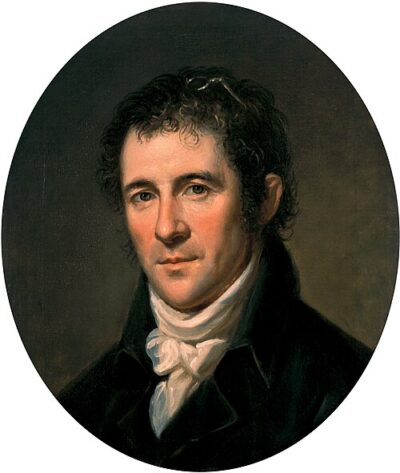
Benjamin Henry Latrobe
Benjamin Henry Latrobe was a British-American architect. Born May 1, 1764, in Fulneck Moravian Settlement. Died September 3, 1820, in New Orleans. Positions held include Architect of the Capitol (2 times) (1803–1817). Known for Hammerwood Park, United States Capitol and National Statuary Hall. Educated at Fulneck School.
Facts
33 facts · 2 confirmed by two sources · 21 cited · 10 from one source
Where this comes from
Papalocal keeps its own record. It started from these sources; what each one said is kept here as it was copied, so a change on their side never changes this page by itself. Tap one to read its version.
What Wikidata says · copied November 15, 2026 · revision 2565599290
- Described as
- British-American architect (1764–1820)
- Other names
- B. H. Latrobe, Benjamin Latrobe, Benjamin H. Latrobe, Benjamin Henry Latrobe Boneval, Benjamin Henry Latrobe, Sr., B. Henry Latrobe, Benjamin Henry La Trobe, Benjamin Henry Boneval Latrobe
- Born
- May 1, 1764 · 11 references
- Died
- September 3, 1820 · 10 references
- Born in
- Fulneck Moravian Settlement · 7 references
- Died in
- New Orleans · 7 references
- Buried in
- Saint Louis Cemetery No. 1 · 3 references
- Cause of death
- yellow fever · 4 references
- Name at birth
- Benjamin Henry Boneval Latrobe
- Citizen of
- United States · 1 reference; Kingdom of Great Britain
- Occupation
- architect · 5 references; civil engineer · 1 reference; naturalist; painter · 1 reference; draftsperson · 1 reference; engineer · 1 reference
- Positions held
- Architect of the Capitol (2 times) (1803–1817) · 2 references
- Education
- Fulneck School
- Member of
- American Philosophical Society (1799–) · 2 references; American Antiquarian Society
- Known for
- Hammerwood Park (1792) · 1 reference; United States Capitol (1803–1817) · 7 references; National Statuary Hall · 3 references; Old Senate Chamber · 3 references; Old Supreme Court Chamber · 3 references; St. John's Episcopal Church (1816) · 3 references
- Children
- Benjamin Henry Latrobe, II · 3 references; Henry Sellon Boneval Latrobe · 4 references; John H. B. Latrobe · 3 references; Lydia Sellon La Trobe · 2 references
- Father
- Benjamin La Trobe
- Siblings
- Christian Ignatius Latrobe; Johann Friedrich La Trobe; Mary Agnes La Trobe
- Wikipedias with a page
- 24
Wikidata item Q726082 (wikidata.org/wiki/Q726082), public domain (CC0). Copied November 15, 2026.
What Wikipedia says · copied November 15, 2026 · revision 1383140982
Benjamin Henry Boneval Latrobe (May 1, 1764 – September 3, 1820) was a British-American neoclassical architect who immigrated to the United States. He was one of the first formally trained, professional architects arriving in the newly independent United States, drawing on influences from his travels in Italy, as well as British and French Neoclassical architects such as Claude Nicolas Ledoux. In his thirties, he immigrated to the new United States and designed the United States Capitol, on "Capitol Hill" in Washington, D.C., as well as the Old Baltimore Cathedral or The Baltimore Basilica, (later renamed the Basilica of the National Shrine of the Assumption of the Blessed Virgin Mary). It is the first Cathedral constructed in the United States for any Christian denomination. Latrobe also designed the largest structure in America at the time, the "Merchants' Exchange" in Baltimore. With extensive balconied atriums through the wings and a large central rotunda under a low dome which dominated the city, it was completed in 1820 after five years of work and endured into the early twentieth century.
Latrobe immigrated to America from England in 1796, initially settling in Virginia where he worked on the Virginia State Penitentiary in Richmond. Latrobe then moved to Philadelphia where he established his practice. In 1803, he was hired as Surveyor of the Public Buildings of the United States, and spent much of the next fourteen years working on projects in the new national capital of Washington, D.C., where he served as the second architect of the Capitol. He also was responsible for the design of the White House porticos. Latrobe spent the later years of his life in New Orleans, Louisiana working on a waterworks project, and died there in 1820 from yellow fever.
Latrobe has been called the "father of American architecture". He was the uncle of Charles La Trobe, who was the first lieutenant-governor of Victoria in Australia.
- Born, in its opening lines
- May 1, 1764
- Died, in its opening lines
- September 3, 1820
From the Wikipedia article “Benjamin Henry Latrobe” (en.wikipedia.org/wiki/Benjamin_Henry_Latrobe), by its contributors, under CC BY-SA 4.0 (creativecommons.org/licenses/by-sa/4.0/). Copied November 15, 2026; not changed.
Confirmed Two sources agree. Cited One source, and it names where it got it. One source One source, without a reference of its own. Sources disagree The sources disagree. We show the best-supported value and keep theirs below.
