
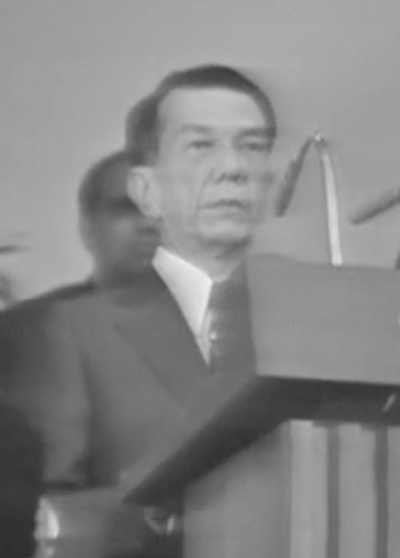
Benjamin Sheares
Benjamin Sheares was the 2nd President of Singapore. Born August 12, 1907, in Singapore. Died May 12, 1981, in Singapore. Positions held include President of Singapore (1971–1981). Educated at National University of Singapore and Saint Andrew's Secondary School. Awards include Knight Grand Cross of the Order of the Bath.
Facts
20 facts · 2 confirmed by two sources · 6 cited · 12 from one source
Where this comes from
Papalocal keeps its own record. It started from these sources; what each one said is kept here as it was copied, so a change on their side never changes this page by itself. Tap one to read its version.
What Wikidata says · copied November 16, 2026 · revision 2567327574
- Described as
- 2nd President of Singapore (1907–1981)
- Other names
- Benjamin Henry Sheares
- Born
- August 12, 1907 · 1 reference
- Died
- May 12, 1981 · 1 reference
- Born in
- Singapore · 1 reference
- Died in
- Singapore · 1 reference
- Buried in
- Kranji State Cemetery · 1 reference
- Cause of death
- disease
- Citizen of
- Singapore
- Occupation
- politician · 1 reference; gynecologist · 1 reference; physician · 1 reference
- Positions held
- President of Singapore (1971–1981)
- Political party
- People's Action Party · 1 reference
- Education
- National University of Singapore; Saint Andrew's Secondary School; Yong Loo Lin School of Medicine
- Awards
- Knight Grand Cross of the Order of the Bath
- Spouse
- Yeo Seh Geok (1939–1981) · 1 reference
- Children
- Joseph Sheares; Constance Sheares
- Religion
- Christianity
- Wikipedias with a page
- 33
Wikidata item Q125139 (wikidata.org/wiki/Q125139), public domain (CC0). Copied November 16, 2026.
What Wikipedia says · copied November 16, 2026 · revision 1382830593
Benjamin Henry Sheares (12 August 1907 – 12 May 1981) was a Singaporean obstetrician, gynaecologist, and academic who served as the second president of Singapore between 1971 until his death in 1981.
Born in Singapore under British rule, Sheares graduated from the King Edward VII College of Medicine in 1929. He specialised in obstetrics and gynaecology and worked at the Singapore General Hospital and Kandang Kerbau Hospital (KKH), eventually serving as the acting professor of obstetrics and gynaecology at the University of Malaya in Singapore. He later became the professor of obstetrics and gynaecology in 1950, becoming the first local to rise to such a position as high-ranking colonial officers were usually appointed instead.
Sheares retired in 1961 due to health complications and went into private practice before being elected as the president of Singapore by parliament following the death of incumbent president Yusof Ishak. Sheares was sworn in on 2 January 1971 following a unanimous agreement by Parliament and served as the president of Singapore for three terms, from 2 January 1971 till his death in office on 12 May 1981. He was succeeded by Devan Nair on 23 October 1981. During his presidency, he officiated multiple events and ceremonies such as the 1971 Commonwealth Heads of Government Meeting and the 1973 South East Asian Peninsular Games.
Regarded as "the father of obstetrics and gynaecology in Singapore", Sheares was known for standardising the lower Caesarian section in Singapore and creating an artificial vagina. The lower Caesarian section has since become the standard procedure in Singapore whilst his method to create an artificial vagina has been dubbed the "Sheares operation" and is used to help women who suffer from birth defects such as vaginal agenesis or in sex-change operations. Sheares remains the only president to have been elected for three terms. Both the Benjamin Sheares Bridge and Sheares Hall at the National University of Singapore (NUS) are named after him.
- Born, in its opening lines
- August 12, 1907
- Died, in its opening lines
- May 12, 1981
From the Wikipedia article “Benjamin Sheares” (en.wikipedia.org/wiki/Benjamin_Sheares), by its contributors, under CC BY-SA 4.0 (creativecommons.org/licenses/by-sa/4.0/). Copied November 16, 2026; not changed.
Confirmed Two sources agree. Cited One source, and it names where it got it. One source One source, without a reference of its own. Sources disagree The sources disagree. We show the best-supported value and keep theirs below.
