
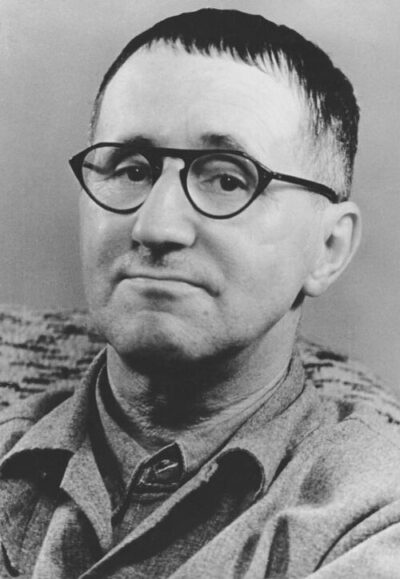
Bertolt Brecht
Bertolt Brecht was a German poet, playwright, and theatre director. Born February 10, 1898, in Augsburg. Died August 14, 1956, in East Berlin. Known for The Threepenny Opera, Life of Galileo and The Caucasian Chalk Circle. Educated at LMU Munich. Awards include National Prize of East Germany, International Stalin Prize for Peace and star on Playwrights' Sidewalk.
Facts
45 facts · 2 confirmed by two sources · 21 cited · 22 from one source
Where this comes from
Papalocal keeps its own record. It started from these sources; what each one said is kept here as it was copied, so a change on their side never changes this page by itself. Tap one to read its version.
What Wikidata says · copied November 16, 2026 · revision 2569794035
- Described as
- German poet, playwright, and theatre director (1898–1956)
- Other names
- Pertōlṭ Pirekcṭ, Bertolʹd Brekht, Bŭrehitʻŭ, Pei-tʻo-erh-tʻe Pu-lai-hsi-tʻe, Bert Brecht, Berŭtʻoltʻŭ Bŭrehitʻŭ, Pu-lai-hsi-tʻe, Perṭōlṭ Pireṣṭ, Bertolt Breht, Eugen Berthold Friedrich Brecht, Pertōl Pirekcṭ, Bertolʹt Brekht
- Born
- February 10, 1898 · 25 references
- Died
- August 14, 1956 · 26 references
- Born in
- Augsburg · 5 references
- Died in
- East Berlin · 2 references
- Buried in
- Dorotheenstadt Cemetery · 1 reference
- Cause of death
- myocardial infarction · 1 reference
- Name at birth
- Eugen Berthold Friedrich Brecht
- Citizen of
- East Germany (1949–); German Reich (1898–1949); Austria (1950–) · 1 reference
- Occupation
- playwright · 3 references; lyricist; screenwriter · 1 reference; theatre director · 1 reference; poet · 3 references; librettist · 1 reference; literary critic; writer · 3 references
- Political party
- Independent Social Democratic Party of Germany
- Education
- LMU Munich (1917–1921) · 1 reference
- Member of
- Academy of Arts, Berlin; Academy of Arts of the GDR
- Known for
- The Threepenny Opera; Life of Galileo; The Caucasian Chalk Circle; Fear and Misery of the Third Reich; Mother Courage and Her Children; The Good Person of Szechwan; The Resistible Rise of Arturo Ui
- Awards
- National Prize of East Germany; International Stalin Prize for Peace; star on Playwrights' Sidewalk · 1 reference
- Field
- drama · 1 reference
- Spouse
- Marianne Zoff (1922–1927) · 2 references; Helene Weigel (1929–1956) · 2 references
- Children
- Stefan Brecht · 1 reference; Hanne Hiob · 1 reference; Barbara Brecht-Schall · 1 reference; Michel Berlau · 1 reference; Frank Banholzer
- Father
- Berthold Friedrich Brecht · 1 reference
- Mother
- Sophie Brezing
- Siblings
- Walter Brecht · 1 reference
- Religion
- atheism
- Lived in
- Chausseestraße (1953–1956)
- Wikipedias with a page
- 156
Wikidata item Q38757 (wikidata.org/wiki/Q38757), public domain (CC0). Copied November 16, 2026.
What Wikipedia says · copied November 16, 2026 · revision 1381565812
Eugen Berthold Friedrich Brecht (10 February 1898 – 14 August 1956), known as Bertolt Brecht and Bert Brecht, was a German theatre practitioner, playwright, and poet. Coming of age during the Weimar Republic, he had his first successes as a playwright in Munich and moved to Berlin in 1924, where he wrote The Threepenny Opera with Elisabeth Hauptmann and Kurt Weill and began a lifelong collaboration with the composer Hanns Eisler. Immersed in Marxist thought during this period, Brecht wrote didactic Lehrstücke and became a leading theoretician of epic theatre (which he later preferred to call "dialectical theatre") and the Verfremdungseffekt.
When the Nazis came to power in Germany in 1933, Brecht fled his home country, initially to Scandinavia. During World War II he moved to Southern California, where he established himself as a screenwriter while being surveilled by the FBI. In 1947, he was part of the first group of Hollywood film artists to be subpoenaed by the House Un-American Activities Committee for alleged Communist Party affiliations. The day after testifying, he returned to Europe, eventually settling in East Berlin, where he co-founded the theatre company Berliner Ensemble with his wife and long-time collaborator, actress Helene Weigel.
- Born, in its opening lines
- February 10, 1898
- Died, in its opening lines
- August 14, 1956
From the Wikipedia article “Bertolt Brecht” (en.wikipedia.org/wiki/Bertolt_Brecht), by its contributors, under CC BY-SA 4.0 (creativecommons.org/licenses/by-sa/4.0/). Copied November 16, 2026; not changed.
Confirmed Two sources agree. Cited One source, and it names where it got it. One source One source, without a reference of its own. Sources disagree The sources disagree. We show the best-supported value and keep theirs below.
