
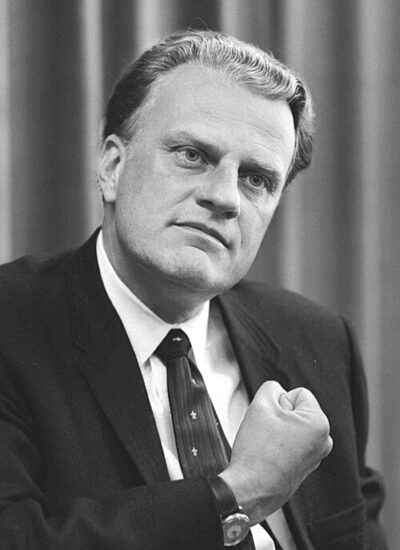
Billy Graham
Billy Graham was an American Baptist evangelist. Born November 7, 1918, in Charlotte. Died February 21, 2018, in Montreat. Educated at Wheaton College and Bob Jones University. Awards include Knight Commander of the Order of the British Empire, Presidential Medal of Freedom and Gospel Music Hall of Fame.
Facts
36 facts · 2 confirmed by two sources · 13 cited · 21 from one source
Where this comes from
Papalocal keeps its own record. It started from these sources; what each one said is kept here as it was copied, so a change on their side never changes this page by itself. Tap one to read its version.
What Wikidata says · copied November 13, 2026 · revision 2567478804
- Described as
- American Baptist evangelist (1918–2018)
- Other names
- William Franklin Graham Jr., William Graham, William Franklin Graham
- Born
- November 7, 1918 · 12 references
- Died
- February 21, 2018 · 4 references
- Born in
- Charlotte · 1 reference
- Died in
- Montreat
- Cause of death
- Parkinson's disease
- Name at birth
- William Franklin Graham Jr.
- Citizen of
- United States · 3 references
- Occupation
- pastor · 1 reference; theologian; preacher · 2 references; autobiographer; Christian minister · 1 reference; evangelist · 1 reference
- Political party
- Democratic Party
- Education
- Wheaton College; Bob Jones University; Trinity College
- Awards
- Knight Commander of the Order of the British Empire; Presidential Medal of Freedom (1983) · 1 reference; Gospel Music Hall of Fame; Templeton Prize; Ronald Reagan Freedom Award; Congressional Gold Medal; Horatio Alger Award; star on Hollywood Walk of Fame · 1 reference; Order of African Redemption · 1 reference; Golden Plate Award (1965) · 1 reference
- Field
- Bible · 1 reference; Protestant theology · 1 reference; Evangelicalism · 1 reference
- Spouse
- Ruth Bell Graham (1943–2007) · 1 reference
- Children
- Franklin Graham · 1 reference; Anne Graham Lotz; Gigi Graham
- Mother
- Morrow Graham · 1 reference
- Religion
- Baptists
- Wikipedias with a page
- 82
Wikidata item Q213550 (wikidata.org/wiki/Q213550), public domain (CC0). Copied November 13, 2026.
What Wikipedia says · copied November 13, 2026 · revision 1384917908
William Franklin Graham Jr. (; November 7, 1918 – February 21, 2018) was an American evangelist, ordained Southern Baptist minister, and civil rights advocate, whose broadcasts and world tours featuring live sermons became well known in the mid-to-late 20th century. Throughout his career, spanning over six decades, Graham rose to prominence as an evangelical Christian figure in the United States and abroad.
According to a biographer, Graham was considered "among the most influential Christian leaders" of the 20th century. Beginning in the late 1940s and early 1950s, Graham became known for filling stadiums and other massive venues around the world where he preached live sermons; these were often broadcast via radio and television with some continuing to be seen into the 21st century. During his six decades on television, Graham hosted his annual "crusades", evangelistic live-campaigns, from 1947 until his retirement in 2005. He also hosted the radio show Hour of Decision from 1950 to 1954. He repudiated racial segregation, at a time of intense racial strife in the United States, insisting on racial integration for all of his revivals and crusades, as early as 1953. He also later invited Martin Luther King Jr. to preach jointly at a revival in New York City in 1957. In addition to his religious aims, he helped shape the worldview of a huge number of people who came from different backgrounds, leading them to find a relationship between the Bible and contemporary secular viewpoints. According to his website, Graham spoke to live audiences consisting of at least 210 million people, in more than 185 countries and territories, through various meetings, including BMS World Mission and Global Mission events.
Graham was close to US presidents Dwight D. Eisenhower, Lyndon B. Johnson (one of his closest friends), and Richard Nixon. He was also a lifelong friend with Robert Schuller, another televangelist and the founding pastor of the Crystal Cathedral, whom Graham talked into starting his own television ministry. Graham's evangelism was appreciated by mainline Protestant denominations, as he encouraged mainline Protestants, who were converted to his evangelical message, to remain within or return to their mainline churches. Despite early suspicions and apprehension on his part towards Catholicism—common among contemporaneous evangelical Protestants—Graham eventually developed amicable ties with many American Catholic Church figures, later encouraging unity between Catholics and Protestants.
Graham operated a variety of media and publishing outlets; according to his staff, more than 3.2 million people have responded to the invitation at Billy Graham Crusades to "accept Jesus Christ as their personal savior". Graham's lifetime audience, including radio and television broadcasts, likely surpassed billions of people. As a result of his crusades, Graham possibly preached the gospel to more people, live and in-person, than anyone in the history of Christianity. Graham was on Gallup's list of most admired men and women a record 61 times. Grant Wacker wrote that, by the mid-1960s, he had become the "Great Legitimator", saying: "By then his presence conferred status on presidents, acceptability on wars, shame on racial prejudice, desirability on decency, dishonor on indecency, and prestige on civic events."
- Born, in its opening lines
- November 7, 1918
- Died, in its opening lines
- February 21, 2018
From the Wikipedia article “Billy Graham” (en.wikipedia.org/wiki/Billy_Graham), by its contributors, under CC BY-SA 4.0 (creativecommons.org/licenses/by-sa/4.0/). Copied November 13, 2026; not changed.
Confirmed Two sources agree. Cited One source, and it names where it got it. One source One source, without a reference of its own. Sources disagree The sources disagree. We show the best-supported value and keep theirs below.
