
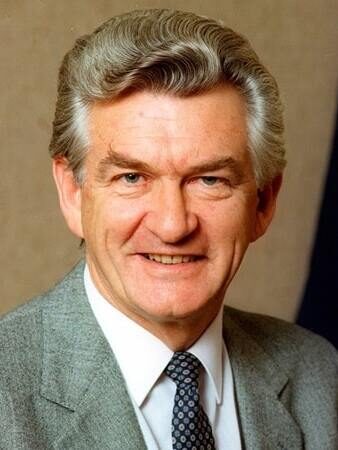
Bob Hawke
Bob Hawke was an Australian politician, 23rd Prime Minister of Australia. Born December 9, 1929, in Bordertown. Died May 16, 2019, in Sydney. Positions held include Prime Minister of Australia (1983–1991), member of the Australian House of Representatives (1980–1992) and Treasurer of Australia (1991). Educated at University of Western Australia and University College, Oxford. Awards include Rhodes Scholarship, Honorary doctor at the Nanjing University and Companion of the Order of Australia.
Facts
27 facts · 2 confirmed by two sources · 10 cited · 15 from one source
Where this comes from
Papalocal keeps its own record. It started from these sources; what each one said is kept here as it was copied, so a change on their side never changes this page by itself. Tap one to read its version.
What Wikidata says · copied November 16, 2026 · revision 2562815238
- Described as
- Australian politician, 23rd Prime Minister of Australia (1929-2019)
- Other names
- Robert James Lee Hawke, The Honourable Bob Hawke, Robert James Lee "Bob" Hawke
- Born
- December 9, 1929 · 6 references
- Died
- May 16, 2019 · 4 references
- Born in
- Bordertown · 1 reference
- Died in
- Sydney · 1 reference
- Buried in
- Macquarie Park Cemetery and Crematorium · 1 reference
- Citizen of
- Australia
- Occupation
- politician · 2 references; union organizer; trade unionist; head of government · 1 reference
- Positions held
- Prime Minister of Australia (1983–1991); member of the Australian House of Representatives (1980–1992); Treasurer of Australia (1991)
- Political party
- Australian Labor Party
- Education
- University of Western Australia; University College, Oxford · 1 reference; Australian National University; Perth Modern School; University of Oxford · 1 reference; West Leederville Primary School · 1 reference
- Awards
- Rhodes Scholarship (1953) · 1 reference; Honorary doctor at the Nanjing University (1986) · 1 reference; Companion of the Order of Australia (1979) · 1 reference
- Spouse
- Blanche d'Alpuget (1995–2019) · 1 reference; Hazel Hawke (1956–1995)
- Father
- Clem Hawke
- Lived in
- Northbridge
- Wikipedias with a page
- 58
Wikidata item Q269372 (wikidata.org/wiki/Q269372), public domain (CC0). Copied November 16, 2026.
What Wikipedia says · copied November 16, 2026 · revision 1385759092
Robert James Lee Hawke (9 December 1929 – 16 May 2019) was the 23rd prime minister of Australia, serving from 1983 to 1991. He held office as leader of the Australian Labor Party (ALP), having previously served as president of the Australian Council of Trade Unions from 1969 to 1980 and as president of the Labor Party national executive from 1973 to 1978.
Hawke was born in Border Town, South Australia. He attended the University of Western Australia and went on to study at University College, Oxford as a Rhodes Scholar. In 1956, Hawke joined the Australian Council of Trade Unions (ACTU) as a research officer. Having risen to become responsible for national wage case arbitration, he was elected as president of the ACTU in 1969, where he achieved a high public profile. In 1973, he was appointed as president of the Labor Party.
In 1980, Hawke stood down from his roles as ACTU and Labor Party president to announce his intention to enter parliamentary politics, and was subsequently elected to the Australian House of Representatives as a member of parliament (MP) for the division of Wills at the 1980 federal election. Three years later, he was elected unopposed to replace Bill Hayden as leader of the Australian Labor Party, and within five weeks led Labor to a landslide victory at the 1983 election, and was sworn in as prime minister. He led Labor to victory a further three times, with successful outcomes in 1984, 1987 and 1990 elections, making him the most electorally successful prime minister in the history of the Labor Party.
The Hawke government oversaw one of the largest overhauls of Australia's political economy in its history. A defining feature of the Hawke term was the close co-operation between business, the government and trade unions via conferences such as the national economic summit, the tax summit and the accord.
Key reforms implemented by the Hawke government included widespread deregulation, dramatic cuts to tariffs as well as business subsidies, the introduction of universal healthcare under Medicare, increased federal expenditure on education, creating APEC, floating the Australian dollar, enacting the Sex Discrimination Act to prevent discrimination in the workplace, declaring "Advance Australia Fair" as the country's national anthem, initiating superannuation pension schemes for all workers, negotiating a ban on mining in Antarctica and overseeing passage of the Australia Act that removed all remaining jurisdiction by the United Kingdom from Australia.
Instead of supporting the public ownership of government industries, the Hawke government sought to redistribute money from the wealthy to the poor via direct fiscal transfers and training programs to help people find employment. Measures implemented by the Hawke government towards this end included the creation of programs such as Newstart, commonwealth rent assistance and the Family Tax Benefit as well as increased progressiveness in taxation. The Hawke government privatised state-owned enterprises such as Qantas.
In June 1991, Hawke faced a leadership challenge by the Treasurer, Paul Keating, but Hawke managed to retain power; however, Keating mounted a second challenge six months later, and won narrowly, replacing Hawke as prime minister. Hawke subsequently retired from parliament, pursuing both a business career and a number of charitable causes, until his death in 2019, aged 89. Hawke remains his party's longest-serving prime minister, and Australia's third-longest-serving prime minister behind Robert Menzies and John Howard. He is also the only prime minister to be born in South Australia and the only one raised and educated in Western Australia. Hawke holds the highest-ever approval rating for an Australian prime minister, reaching 75% approval in 1984. Hawke is frequently ranked within the upper tier of Australian prime ministers by historians.
- Born, in its opening lines
- December 9, 1929
- Died, in its opening lines
- May 16, 2019
From the Wikipedia article “Bob Hawke” (en.wikipedia.org/wiki/Bob_Hawke), by its contributors, under CC BY-SA 4.0 (creativecommons.org/licenses/by-sa/4.0/). Copied November 16, 2026; not changed.
Confirmed Two sources agree. Cited One source, and it names where it got it. One source One source, without a reference of its own. Sources disagree The sources disagree. We show the best-supported value and keep theirs below.
