
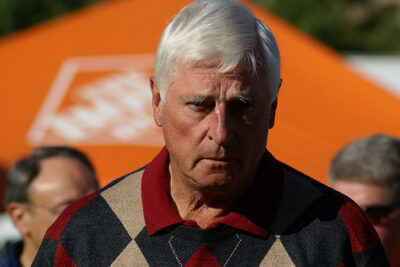
Bob Knight
Bob Knight was an American basketball coach. Born October 25, 1940, in Massillon. Died November 1, 2023, in Bloomington. Teams include Ohio State Buckeyes men's basketball (1959–1962). Educated at Ohio State University. Awards include Associated Press College Basketball Coach of the Year (3 times).
Facts
15 facts · 2 confirmed by two sources · 4 cited · 9 from one source
Where this comes from
Papalocal keeps its own record. It started from these sources; what each one said is kept here as it was copied, so a change on their side never changes this page by itself. Tap one to read its version.
What Wikidata says · copied November 16, 2026 · revision 2545281051
- Described as
- American basketball coach (1940–2023)
- Other names
- Bobby Knight, The General, Robert Montgomery Knight
- Born
- October 25, 1940 · 2 references
- Died
- November 1, 2023 · 1 reference
- Born in
- Massillon
- Died in
- Bloomington
- Name at birth
- Robert Montgomery Knight
- Citizen of
- United States
- Occupation
- basketball coach · 1 reference; basketball player
- Political party
- Republican Party
- Education
- Ohio State University · 1 reference
- Teams
- Ohio State Buckeyes men's basketball (1959–1962) · 1 reference
- Sport
- basketball · 1 reference
- Awards
- Associated Press College Basketball Coach of the Year (3 times) (1975, 1976, 1989)
- Children
- Pat Knight
- Height
- 1.96 m (6 ft 5 in)
- Wikipedias with a page
- 23
Wikidata item Q888594 (wikidata.org/wiki/Q888594), public domain (CC0). Copied November 16, 2026.
What Wikipedia says · copied November 16, 2026 · revision 1384317917
Robert Montgomery Knight (October 25, 1940 – November 1, 2023) was an American men's college basketball coach. Nicknamed "the General", he won 902 NCAA Division I men's basketball games, a record at the time of his retirement, and sixth all-time record at the time of his death.
Knight was the head coach of the Army Black Knights (1965–1971), the Indiana Hoosiers (1971–2000), and the Texas Tech Red Raiders (2001–2008). While at Army, he led the Black Knights to four post-season tournament appearances in six seasons, winning two-thirds of his games along the way.
After taking the job at Indiana, his teams won three NCAA championships, one National Invitation Tournament (NIT) championship, and 11 Big Ten Conference championships. His 1975–76 team won the 1976 NCAA tournament, and, as of 2025–26, remain the last men's team in Division I college basketball to go undefeated during an entire season (32–0).
In the seven full seasons that he coached at Texas Tech, his teams qualified for a post-season tournament five times. He retired partway through the 2007–08 season and was replaced by his son Pat Knight. He later worked as a men's college basketball studio analyst at ESPN until 2015.
Knight sparked controversy with his outspoken personality and his volatility. He once threw a chair across the court during a game and was once arrested following a physical confrontation with a police officer. He was also accused of choking an Indiana player during practice in an incident that was recorded on video, prompting the university to institute a "zero tolerance" policy for him. Following a subsequent run-in with a student, Indiana University terminated his contract in the fall of 2000.
Knight received national coach of the year honors four times and Big Ten Coach of the Year honors eight times. He was also successful on the international stage, winning gold medals at both the 1979 Pan American Games and the 1984 Summer Olympics with the U.S. men's national team. He is one of only three basketball coaches to win an NCAA title, an NIT title, and an Olympic gold medal. He was inducted into the Naismith Memorial Basketball Hall of Fame in 1991.
- Born, in its opening lines
- October 25, 1940
- Died, in its opening lines
- November 1, 2023
From the Wikipedia article “Bob Knight” (en.wikipedia.org/wiki/Bob_Knight), by its contributors, under CC BY-SA 4.0 (creativecommons.org/licenses/by-sa/4.0/). Copied November 16, 2026; not changed.
Confirmed Two sources agree. Cited One source, and it names where it got it. One source One source, without a reference of its own. Sources disagree The sources disagree. We show the best-supported value and keep theirs below.
