
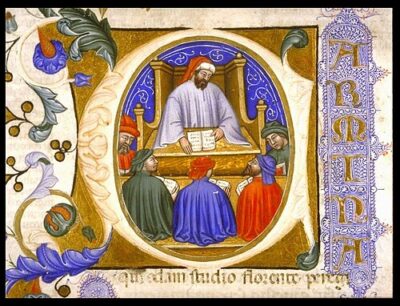
Boethius
Boethius was a Roman senator and philosopher of the early 6th century. Born 480, in Rome. Died 524, in Pavia. Positions held include ancient Roman senator (505–510) and Roman consul (510–511). Known for The Consolation of Philosophy, Opuscula sacra and History.
Facts
30 facts · 2 confirmed by two sources · 6 cited · 21 from one source · 1 where the sources disagree
What’s different
- Father: we show Manlius Boethius (Sources disagree). Wikidata also lists Quintus Aurelius Memmius Symmachus
Where this comes from
Papalocal keeps its own record. It started from these sources; what each one said is kept here as it was copied, so a change on their side never changes this page by itself. Tap one to read its version.
What Wikidata says · copied November 16, 2026 · revision 2567822280
- Described as
- Roman senator and philosopher of the early 6th century (480–524)
- Other names
- Anicius Manlius Torquatus Severinus Boethius, Anicius Manlius Severinus Boëthius, Anicus Manlius Severinus Boethius
- Born
- 480 · 9 references
- Died
- 524 · 3 references
- Born in
- Rome · 1 reference
- Died in
- Pavia · 2 references
- Buried in
- San Pietro in Ciel d'Oro
- Cause of death
- decapitation
- Name at birth
- Anicius Manlius Severinus Boethius · 1 reference
- Citizen of
- Ostrogothic Kingdom
- Occupation
- philosopher · 3 references; writer · 5 references; musicologist; music theorist; politician · 2 references; mathematician; translator · 1 reference
- Positions held
- ancient Roman senator (505–510); Roman consul (510–511) · 1 reference
- Known for
- The Consolation of Philosophy; Opuscula sacra; History; elogia; De institutione musica; De institutione arithmetica
- Field
- philosophy
- Spouse
- Elpis; Rusticiana
- Children
- Boethius; Symmachus
- Father
- Manlius Boethius; Quintus Aurelius Memmius Symmachus
- Religion
- Catholic Church
- Wikipedias with a page
- 93
Wikidata item Q102851 (wikidata.org/wiki/Q102851), public domain (CC0). Copied November 16, 2026.
What Wikipedia says · copied November 16, 2026 · revision 1385557640
Anicius Manlius Severinus Boethius, commonly known simply as Boethius (; Latin: Boetius; c. 480 – 524 AD), was a Roman senator, consul, magister officiorum, polymath, historian, and philosopher of the Early Middle Ages. He was a central figure in the translation of the Greek classics into Latin, a precursor to the Scholastic movement, and, along with Cassiodorus, one of the two leading Christian scholars of the 6th century. The local cult of Boethius in the Diocese of Pavia was sanctioned by the Sacred Congregation of Rites in 1883, confirming the diocese's custom of honoring him on 23 October.
Boethius was born in Rome a few years after the forced abdication of the last Western Roman emperor, Romulus Augustulus. A member of the Anicii family, he was orphaned following the family's sudden decline and was raised by Quintus Aurelius Memmius Symmachus, a later consul. After mastering both Latin and Greek in his youth, Boethius rose to prominence as a statesman during the Ostrogothic Kingdom, becoming a senator by age 25, a consul by age 33, and later chosen as a personal advisor to Theodoric the Great.
In seeking to reconcile the teachings of Plato and Aristotle with Christian theology, Boethius sought to translate the entirety of the Greek classics for Western scholars. He published numerous transcriptions and commentaries of the works of Nicomachus, Porphyry, and Cicero, among others, and wrote extensively on matters concerning music, mathematics, and theology. Though his translations were unfinished following an untimely death, it is largely due to them that the works of Aristotle survived into the Renaissance.
Despite his successes as a senior official, Boethius became deeply unpopular among other members of the Ostrogothic court for denouncing the extensive corruption prevalent among other members of government. After publicly defending fellow consul Caecina Albinus from charges of conspiracy, he was imprisoned by Theodoric around the year 523. While jailed Boethius wrote On the Consolation of Philosophy, a philosophical treatise on fortune, death, and other issues which became one of the most influential and widely reproduced works of the Early Middle Ages. He was tortured and executed in 524, becoming a martyr in the Christian faith by tradition.
- Born, in its opening lines
- 480
- Died, in its opening lines
- 524
From the Wikipedia article “Boethius” (en.wikipedia.org/wiki/Boethius), by its contributors, under CC BY-SA 4.0 (creativecommons.org/licenses/by-sa/4.0/). Copied November 16, 2026; not changed.
Confirmed Two sources agree. Cited One source, and it names where it got it. One source One source, without a reference of its own. Sources disagree The sources disagree. We show the best-supported value and keep theirs below.
