
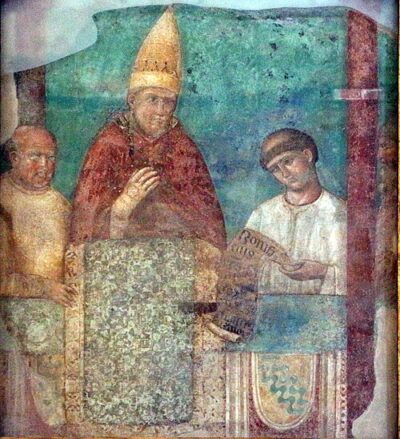
Boniface VIII
Boniface VIII was a pope of the Catholic Church from 1294 to 1303. Born January 23, 1235, in Anagni. Died October 11, 1303, in Rome. Positions held include Pope (1294–1303), cardinal (1281–) and cardinal-deacon. Educated at University of Bologna.
Facts
18 facts · 1 confirmed by two sources · 8 cited · 8 from one source · 1 where the sources disagree
What’s different
- Born: we show January 23, 1235 (Sources disagree). Wikipedia says c. 1230
Where this comes from
Papalocal keeps its own record. It started from these sources; what each one said is kept here as it was copied, so a change on their side never changes this page by itself. Tap one to read its version.
What Wikidata says · copied November 16, 2026 · revision 2569839446
- Described as
- pope of the Catholic Church from 1294 to 1303
- Other names
- Benedetto Gaetani, Benedictus Caetani, Benedict Caetani, Bonifatius VIII. Papa, Bonifacio VIII, pape Boniface VIII, Pope Boniface VIII, Bonifacius PP. VIII, Bonifacio VIII, Benedetto Gaetano, Benedetto Caetani
- Born
- January 23, 1235 · 1 reference
- Died
- October 11, 1303 · 3 references
- Born in
- Anagni · 1 reference
- Died in
- Rome · 2 references
- Buried in
- Vatican Grotto
- Cause of death
- poison
- Name at birth
- Benedetto Caetani
- Citizen of
- Papal States · 1 reference
- Occupation
- Catholic priest; writer · 1 reference
- Positions held
- Pope (1294–1303) · 1 reference; cardinal (1281–) · 1 reference; cardinal-deacon
- Education
- University of Bologna
- Father
- Roffredo I Caetani · 1 reference
- Mother
- Emilia Patrasso · 1 reference
- Siblings
- Roffredo Caetani
- Religion
- Catholic Church · 1 reference
- Wikipedias with a page
- 87
Wikidata item Q134646 (wikidata.org/wiki/Q134646), public domain (CC0). Copied November 16, 2026.
What Wikipedia says · copied November 16, 2026 · revision 1369994479
Pope Boniface VIII (Latin: Bonifacius PP. VIII, Italian: Bonifacio VIII; born Benedetto Caetani; c. 1230 – 11 October 1303) was head of the Catholic Church and leader of the Papal States from 24 December 1294 until his death in 1303. The Caetani family was of baronial origin with connections to the papacy. He succeeded Pope Celestine V, who had abdicated from the papal throne. Boniface spent his early pontificate abroad in diplomatic roles.
Boniface VIII put forward some of the strongest claims of any pope to temporal as well as spiritual power. He involved himself often with foreign affairs, including in France, Sicily, Italy, and the First War of Scottish Independence. These views, and his chronic intervention in temporal affairs, led to many bitter quarrels with Albert I of Germany, Philip IV of France, and later Dante Alighieri, who expected the pope to soon arrive at the eighth circle of Hell in his Divine Comedy, among the simoniacs.
Boniface systematized canon law by collecting it in a new volume, the Liber Sextus (1298), which continues to be important source material for canon lawyers. He established the first Catholic jubilee year to take place in Rome. Boniface had first entered into conflict with King Philip IV in 1296 when the latter sought to reinforce the nascent nation state by imposing taxes on the clergy and barring them from administration of the law. Boniface excommunicated Philip and all others who prevented French clergy from traveling to the Holy See, after which the king sent his troops to attack the pope's residence in Anagni on 7 September 1303 and capture him. Boniface was held for three days. He died a month afterwards.
King Philip IV pressured Pope Clement V of the Avignon Papacy into staging a posthumous trial of Boniface. He was accused of heresy, but no verdict against him was delivered.
- Born, in its opening lines
- c. 1230
- Died, in its opening lines
- October 11, 1303
From the Wikipedia article “Pope Boniface VIII” (en.wikipedia.org/wiki/Pope_Boniface_VIII), by its contributors, under CC BY-SA 4.0 (creativecommons.org/licenses/by-sa/4.0/). Copied November 16, 2026; not changed.
Confirmed Two sources agree. Cited One source, and it names where it got it. One source One source, without a reference of its own. Sources disagree The sources disagree. We show the best-supported value and keep theirs below.
