
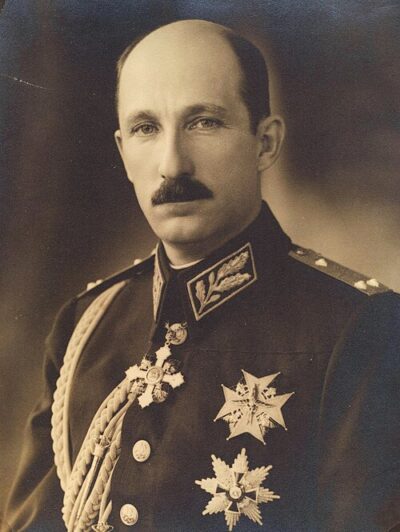
Boris III of Bulgaria
Boris III of Bulgaria was a king of Bulgaria. Born January 30, 1894, in Sofia. Died August 28, 1943, in Sofia. Positions held include King of Bulgaria (1918–1943). Educated at Vasil Levski National Military University. Awards include Order of the White Eagle, Order of Saint Anna, 1st class and Order of the White Eagle.
Facts
42 facts · 2 confirmed by two sources · 3 cited · 36 from one source · 1 where the sources disagree
What’s different
- Buried in: we show Monastery of Saint John of Rila (Sources disagree). Wikidata also lists Vrana Palace
Where this comes from
Papalocal keeps its own record. It started from these sources; what each one said is kept here as it was copied, so a change on their side never changes this page by itself. Tap one to read its version.
What Wikidata says · copied November 16, 2026 · revision 2568619247
- Described as
- king of Bulgaria (1894–1943)
- Born
- January 30, 1894 · 6 references
- Died
- August 28, 1943 · 9 references
- Born in
- Sofia · 3 references
- Died in
- Sofia · 3 references
- Buried in
- Monastery of Saint John of Rila; Vrana Palace
- Cause of death
- myocardial infarction
- Citizen of
- Bulgaria
- Occupation
- monarch; military officer; military personnel
- Positions held
- King of Bulgaria (1918–1943)
- Education
- Vasil Levski National Military University
- Awards
- Order of the White Eagle; Order of Saint Anna, 1st class; Order of the White Eagle; Order of St. Vladimir, 1st class; Order of Saints Cyril and Methodius Equal-to-apostles; Order of Bravery; Order of Saint Alexander; Order of Saint Alexander Nevsky; Order of St. Andrew; honorary doctor of Sofia University; Order of Military Merit (Bulgaria) · 1 reference; Order of Civil Merit · 1 reference; Grand Officer of the Legion of Honour · 1 reference; Royal Victorian Order · 1 reference; Order of Leopold · 1 reference
- Field
- politician
- Spouse
- Giovanna of Savoy (1930–1943) · 1 reference
- Children
- Princess Maria Luisa, 9th Princess of Koháry · 1 reference; Simeon II of Bulgaria
- Father
- Ferdinand I of Bulgaria
- Mother
- Princess Marie Louise of Bourbon-Parma
- Siblings
- Kiril, Prince of Preslav; Princess Nadejda of Bulgaria; Princess Eudoxia of Bulgaria
- Religion
- Eastern Orthodoxy; Catholicism · 1 reference
- Military rank
- general of the infantry (Bundeswehr) (1938–); lieutenant general (1928–); major general (1918–)
- Lived in
- Sofia
- Wikipedias with a page
- 58
Wikidata item Q159585 (wikidata.org/wiki/Q159585), public domain (CC0). Copied November 16, 2026.
What Wikipedia says · copied November 16, 2026 · revision 1382132012
Boris III (Boris Klemens Robert Maria Pius Ludwig Stanislaus Xaver; 30 January [O.S. 18 January] 1894 – 28 August 1943) was Tsar of Bulgaria from 1918 until his death in 1943.
The eldest son of Ferdinand I, Boris assumed the throne upon the abdication of his father in the wake of Bulgaria's defeat in World War I. Under the 1919 Treaty of Neuilly, Bulgaria was forced to cede various territories, pay crippling war reparations, and greatly reduce the size of its military. That same year, Aleksandar Stamboliyski of the Bulgarian Agrarian National Union became prime minister. After Stamboliyski was overthrown in a coup in 1923, Boris recognized the new government of Aleksandar Tsankov, who harshly suppressed the Bulgarian Communist Party and led the nation through a brief border war with Greece. Tsankov was removed from power in 1926, and a series of prime ministers followed until 1934, when the corporatist Zveno (Bulgarian: Звено) movement staged a coup and outlawed all political parties. Boris opposed the Zveno government and overthrew them in 1935, eventually installing Georgi Kyoseivanov as prime minister. For the remainder of his reign, Boris would rule as a de facto absolute monarch, with his prime ministers largely submitting to his will.
Following the outbreak of World War II, Bulgaria initially remained neutral. In 1940, Nazi sympathizer Bogdan Filov replaced Kyoseivanov as prime minister, becoming the last prime minister to serve under Boris. In September 1940, with the support of Nazi Germany, Bulgaria received the region of Southern Dobrudja from Romania as part of the Treaty of Craiova. In January 1941, Boris approved the antisemitic Law for Protection of the Nation, which denied citizenship to Bulgarian Jews and placed numerous restrictions upon them. In March 1941, Bulgaria joined the Axis and allowed German troops to use Bulgaria as a base from which to invade Yugoslavia and Greece. Bulgaria then received large portions of Yugoslav Macedonia, Pirot County in eastern Serbia and Greek Thrace, which were key targets of Bulgarian irredentism. Bulgaria opted out of participation in the German invasion of the Soviet Union, as allowed by the provisions of the Axis alliance. As part of the Holocaust, Bulgarian authorities deported most Jews from occupied Greek and Yugoslav territories and transferred them to the German extermination camp of Treblinka. Under public pressure, Boris cancelled the deportation of Bulgarian Jews while expelling almost 20,000 Jews to the Bulgarian countryside to be deployed in forced labour camps. In 1942, Zveno, the Agrarian National Union, the Bulgarian Communist Party, and other far-left groups united to form a resistance movement known as the Fatherland Front, which went on to overthrow the government in 1944. In August 1943, shortly after returning from a visit to Germany, Boris died at the age of 49. Following his death, he was succeeded as Tsar by his six-year-old son, Simeon Borisov Saxe-Coburg-Gotha (Bulgarian: Симеон Борисов Сакскобургготски), who ascended the throne as Simeon II.
- Born, in its opening lines
- January 30, 1894
- Died, in its opening lines
- August 28, 1943
From the Wikipedia article “Boris III of Bulgaria” (en.wikipedia.org/wiki/Boris_III_of_Bulgaria), by its contributors, under CC BY-SA 4.0 (creativecommons.org/licenses/by-sa/4.0/). Copied November 16, 2026; not changed.
Confirmed Two sources agree. Cited One source, and it names where it got it. One source One source, without a reference of its own. Sources disagree The sources disagree. We show the best-supported value and keep theirs below.
